
UK's 2026 Crypto Licensing Timeline: A Strategic Inflection Point for Market Entrants and Incumbents
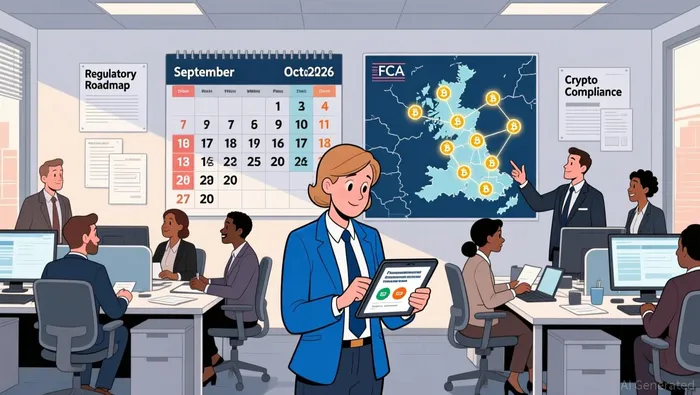
The UK's Financial Conduct Authority (FCA) has set a clear and ambitious timeline for the licensing of crypto asset service providers (CASPs), marking a pivotal moment for the sector. With the application window opening in September 2026 and the new regulatory regime taking effect in October 2027, firms face a critical juncture to align with the Financial Services and Markets Act (FSMA) framework. This transition, as outlined by the FCA, will bring crypto assets under the same regulatory perimeter as traditional financial products, enforcing transparency, prudential standards, and consumer protections. For market entrants and incumbents alike, this represents both a challenge and an opportunity to capitalize on regulatory clarity and structural change.
Regulatory Clarity as a Catalyst for Growth
The FCA's phased approach to crypto regulation-dubbed the "Crypto Roadmap"-is designed to balance innovation with market integrity. By requiring all crypto firms to apply for formal authorization by September 2026, the regulator aims to eliminate the ambiguity that has long plagued the sector. Firms that secure approval during this window will benefit from a "saving provision," allowing them to operate temporarily if their applications remain pending when the new regime begins. This creates a low-risk corridor for firms to refine compliance strategies while maintaining revenue streams.
 For incumbents, the transition offers a chance to consolidate market share. Established players like Ripple, which recently secured a Cryptoasset Registration and Electronic Money Institution (EMI) license from the FCA, exemplify how regulatory alignment can unlock cross-border infrastructure opportunities. Meanwhile, market entrants-particularly startups in stablecoin issuance and decentralized finance (DeFi)-can leverage the FCA's sandbox environment to test innovations in a controlled setting. The regulator has explicitly prioritized stablecoins as a tool for faster, more efficient payments, signaling a strategic advantage for firms specializing in this area.
Strategic Opportunities in a Structurally Changing Market
The UK's regulatory overhaul is not merely a compliance exercise; it is a structural repositioning of the crypto sector. By aligning crypto with traditional financial services, the FCA is fostering a level playing field where innovation and risk management coexist. For instance, the Property (Digital Assets etc) Bill, currently in legislative review, will classify digital assets as a third category of personal property under English law, addressing long-standing legal uncertainties. This legal clarity is expected to attract institutional investors and global capital, positioning the UK as a competitive hub for digital finance.
Moreover, the FCA's focus on cross-border integration-through initiatives like the Transatlantic Taskforce for Markets of the Future-highlights the UK's ambition to lead in global crypto governance. Firms that align with these priorities, such as those developing interoperable blockchain solutions or AI-driven compliance tools, stand to benefit from early mover advantages. The regulator's emphasis on "same risk, same regulatory outcome" also underscores the importance of operational resilience and cybersecurity, areas where tech-savvy entrants can differentiate themselves.
Risk Mitigation and the Cost of Inaction
While the FCA's timeline provides a roadmap for success, it also imposes significant risks for firms that fail to act. Those missing the September 2026 application window will enter a transitional regime, restricted to servicing existing contracts without offering new services. If authorization is denied, such firms will be required to exit the UK market "in an orderly manner," a costly and disruptive outcome.
To mitigate these risks, firms must prioritize early engagement with the FCA's consultation processes and invest in robust compliance frameworks. The regulator has already published guidance on admissions, disclosures, and market abuse controls for crypto trading platforms, offering a blueprint for proactive alignment. Additionally, the FCA's temporary exemptions from principle-based conduct rules for early-stage platforms provide a buffer for firms to adapt without sacrificing key safeguards.
Sector-Specific Advantages: Stablecoins and DeFi
The FCA's regulatory focus on stablecoins and DeFi presents sector-specific opportunities. Stablecoin issuers, now subject to prudential safeguards akin to e-money institutions, can leverage the UK's regulatory credibility to attract institutional adoption. The FCA's sandbox for stablecoin innovation, coupled with its collaboration with the Bank of England, further reinforces the UK's position as a testing ground for next-generation payment systems.
For DeFi, the FCA's approach is pragmatic: while decentralized protocols without identifiable controlling entities remain outside the regulatory perimeter, firms operating within this space-such as those managing liquidity pools or staking services-must secure authorization if they engage in activities deemed equivalent to traditional financial services. This creates a niche for DeFi-native startups to innovate within a compliant framework, particularly in areas like automated market makers and tokenized asset platforms.
Conclusion: A Defining Moment for the UK Crypto Sector
The UK's 2026 crypto licensing timeline is more than a regulatory deadline-it is a strategic inflection point. By aligning with the FCA's vision of a transparent, resilient, and innovative market, firms can position themselves to thrive in a post-MiCA (Markets in Crypto-Assets) landscape. For incumbents, this means leveraging scale and regulatory expertise to dominate core services. For entrants, it means capitalizing on the UK's sandbox environment and legal clarity to pioneer new use cases. As the FCA's gateway opens in 2026, the sector's winners will be those who treat regulatory change not as a hurdle, but as a catalyst for growth.







Comentarios
Aún no hay comentarios