
The UK's £20,000 Stablecoin Cap: Implications for Financial Stability and Investment Opportunities in GBP-Backed Digital Assets
Financial Stability: A Prudent Precaution or a Stifling Constraint?
The BoE's rationale for the £20,000 cap is rooted in the UK's unique financial architecture. As stated by Deputy Governor Sarah Breeden, the UK's mortgage market is heavily bank-dependent, making it vulnerable to sudden shifts in deposits into stablecoins, according to a Yahoo Finance report. To address this, the BoE has proposed temporary holding limits for individuals and businesses-£20,000 and £10 million, respectively-while allowing systemic stablecoins (those used at scale in payments) to hold up to 60% of their reserves in short-term UK government debt, as outlined in a The Block article. These caps are designed to prevent destabilizing outflows during periods of economic stress, ensuring that stablecoin issuers remain solvent and that traditional banks retain liquidity.
According to a The Block report, the BoE plans to implement these rules by 2025, with public consultation running until February 2026. The temporary nature of the caps suggests regulators are not seeking to suppress innovation but to manage risks during a transitional phase. However, critics argue that such restrictions could deter retail adoption, particularly among small businesses and everyday users who might view stablecoins as a low-cost alternative to traditional banking, as noted in a Bloomberg article.
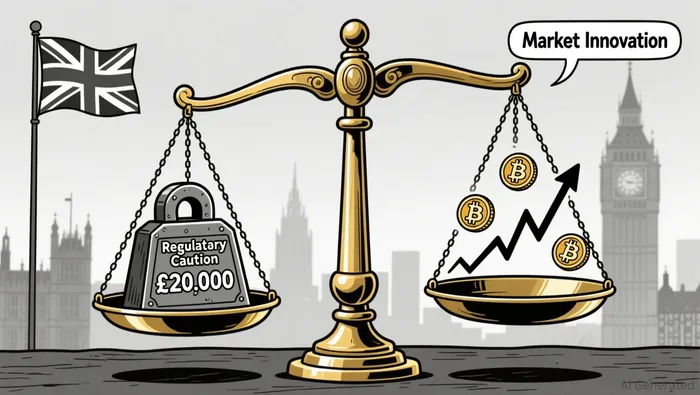
Market Innovation: Navigating a Tightrope
While the BoE's approach prioritizes stability, the FCA's parallel efforts highlight the UK's ambition to attract crypto innovation. The FCA's Consultation Paper CP25/14 mandates that stablecoins be fully backed by secure, liquid assets held in a statutory trust, with third-party custodians ensuring transparency, as detailed in a Arnold & Porter advisory. These rules, while stringent, align with international standards and could position the UK as a trusted hub for institutional-grade stablecoin projects.
Yet, the £20,000 cap raises concerns about competitiveness. As noted in a The Block report, the UK's regulatory framework is stricter than those in the U.S. and EU, where caps are either absent or less rigid. For instance, the U.S. has yet to implement a federal cap, while the EU's MiCA framework focuses more on issuer accountability than user limits. This divergence could push startups and investors to jurisdictions with more lenient rules, undermining the UK's goal of becoming a crypto-friendly economy, as noted in a Bloomberg article.
The Path Forward: Adaptability Over Rigidity
The UK's dual-tier system-where systemic stablecoins face BoE oversight and smaller projects fall under the FCA-offers a nuanced approach. However, the success of this framework hinges on adaptability. As the BoE acknowledges, the £20,000 cap is temporary and intended to be relaxed as risks subside, according to a The Block article. This flexibility is critical: overregulation could stifle innovation, while underregulation risks financial instability.
Investors should monitor two key developments:
1. Consultation Outcomes: The FCA's final rules, due in early 2026, will clarify how small stablecoin issuers can comply without excessive costs, as outlined in an Arnold & Porter advisory.
2. Global Competitiveness: If the UK's approach proves too restrictive, it may lose ground to the U.S. or EU, where regulatory clarity is advancing more rapidly, as noted in a Bloomberg article.
For now, the BoE's emphasis on asset backing and transparency provides a foundation for trust, while the cap acts as a temporary safeguard. Investors in GBP-backed stablecoins should weigh these measures against their risk tolerance and long-term growth potential.
Conclusion
The UK's £20,000 stablecoin cap is a calculated gamble. By prioritizing financial stability, regulators aim to prevent a repeat of the 2022 crypto collapses while laying the groundwork for responsible innovation. However, the cap's long-term viability depends on its ability to evolve alongside market dynamics. For investors, the challenge lies in balancing the security of a regulated ecosystem with the agility required to capitalize on emerging opportunities in digital assets.
As the UK's regulatory framework crystallizes in 2025 and beyond, one thing is clear: the intersection of caution and innovation will define the future of GBP-backed stablecoins.







Comentarios
Aún no hay comentarios