
UiPath's Sudden Stock Surge: Catalyst or Correction?
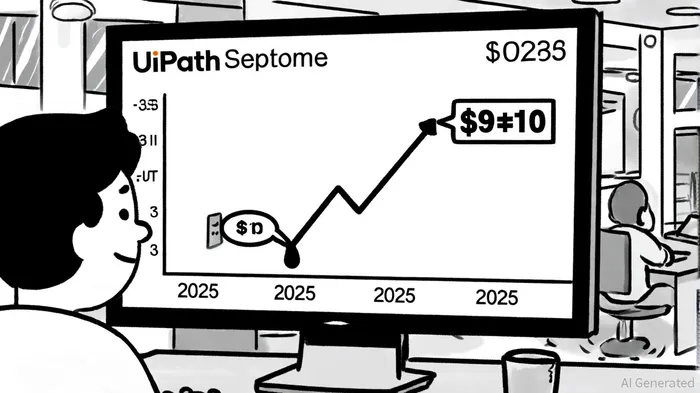
UiPath's (PATH) stock has experienced a dramatic rebound in late 2025, surging nearly 6.5% on September 30 amid a wave of AI-driven strategic partnerships and robust earnings. The stock price climbed from $12.56 to $15.18 pre-market, closing the day at $13.38, despite macroeconomic headwinds that had previously pushed the stock to a low of $9–$10 earlier in the year, according to a TS2 report. This sudden surge has sparked debate among investors: Is this a sustainable catalyst for long-term growth, or a temporary correction in a volatile market?
Catalysts: AI Partnerships and Earnings Outperformance
The immediate trigger for UiPath's stock rally was its strategic alignment with generative AI. In late September, the company announced collaborations with OpenAI, Google, NVIDIA, and Snowflake to integrate advanced AI capabilities into its automation platform - a development highlighted in the TS2 report. These partnerships aim to position UiPathPATH-- as a central hub in the enterprise AI ecosystem, enabling clients to deploy secure, on-premises AI models for tasks like document processing and workflow automation.
Financial results further fueled optimism. UiPath reported a 14% year-over-year revenue increase, a rare GAAP profit, and $45 million in free cash flow, with Annual Recurring Revenue (ARR) reaching $1.723 billion, details first reported in the TS2 report. Management raised full-year guidance, citing improved execution and growing demand for AI-powered automation. Analysts highlighted the company's cost-cutting measures-$40 million in savings combined with $45 million in revenue additions-as a key driver of its financial turnaround, also noted in that report.
Historical data on PATH's earnings-beat events since 2022 offers context. A backtest of 8 such events reveals a 1-day average excess move of +1.0%, with a 63% win rate on day 1. However, the cumulative effect fades rapidly, turning slightly negative by day 10, and the win rate drops to 14% by day 30. These results suggest that while UiPath's stock often reacts positively to earnings surprises, the edge is short-lived and not statistically significant over longer horizons, as the TS2 analysis points out.
Sustainability Amid Macroeconomic Pressures
Despite these positives, UiPath faces significant macroeconomic challenges. Rising interest rates, inflation, and currency fluctuations have disrupted enterprise budgets, slowing RPA adoption in some sectors. For instance, UiPath's Q4 2024 revenue grew only 4.6% year-over-year, reflecting broader economic caution, according to a GuruFocus article. The company's shift to SaaS and cloud-based offerings has also introduced volatility, as clients delay large-scale deployments amid uncertain spending environments, the GuruFocus piece also observed.
However, UiPath's leadership in the RPA market-35.8% global share, per CX Today-provides a buffer against these pressures. Its robust financial position, including $1.45 billion in cash reserves and no debt, further strengthens its ability to weather macroeconomic turbulence, as noted by Simply Wall St. Customer retention metrics, such as a 108% dollar-based net retention rate and 98% gross retention rate, underscore its competitive moat (Simply Wall St also reports these retention figures).
AI-Driven Growth: Promise vs. Reality
UiPath's AI initiatives are central to its growth narrative. The company's partnerships with AI leaders like NVIDIA and Anthropic aim to accelerate its transition from RPA to agentic automation, a market projected to grow to $8.2 billion by 2028, per the TS2 analysis. While the company has not disclosed AI-specific revenue figures, its Q3 2025 results highlighted strategic investments in AI-powered tools like Autopilot for Everyone and Clipboard AI, according to a UiPath press release.
Yet, converting AI innovation into consistent revenue remains a challenge. Analysts note that UiPath's AI-driven solutions are still in early adoption phases, with clients moving from pilots to full-scale implementations at varying speeds - a point emphasized in the TS2 coverage. Morgan Stanley raised its price target to $15, citing AI's long-term potential, while DA Davidson remains cautious, emphasizing the need for "consistent execution" before turning bullish, as discussed in industry commentary.
Sector-Specific Adoption: Finance and Healthcare as Key Drivers
Macroeconomic pressures are paradoxically accelerating RPA adoption in regulated sectors like finance and healthcare. In finance, UiPath's solutions automate tasks such as invoice processing and fraud detection, reducing operational costs by up to 30%, according to Valere Health. Healthcare providers are leveraging RPA for claims processing and patient scheduling, with over 75% of home medical equipment providers expected to adopt automation by 2025, Valere Health reports.
UiPath's sector-specific innovations, such as a medical record summarization tool powered by AI, align with these trends. However, the company must navigate sector-specific challenges, including stringent compliance requirements and the need for workforce reskilling, as Valere Health's analysis warns.
Conclusion: Catalyst or Correction?
UiPath's stock surge appears to be a mix of both. The AI partnerships and earnings outperformance represent genuine catalysts, positioning the company to capitalize on the $8.2 billion agentic automation market. However, macroeconomic pressures and the nascent stage of AI adoption suggest the rally may not be fully sustainable in the short term.
For investors, the key question is whether UiPath can maintain its momentum as it transitions from RPA to AI-driven hyperautomation. With a strong balance sheet, leading market share, and a clear strategic vision, the company is well-positioned to endure near-term volatility. Yet, execution risks-particularly in monetizing AI partnerships-remain critical to watch.





Comentarios
Aún no hay comentarios