
UEFA Champions League Rights Overhaul: Strategic Entry Points into European Sports Media and Streaming Stocks
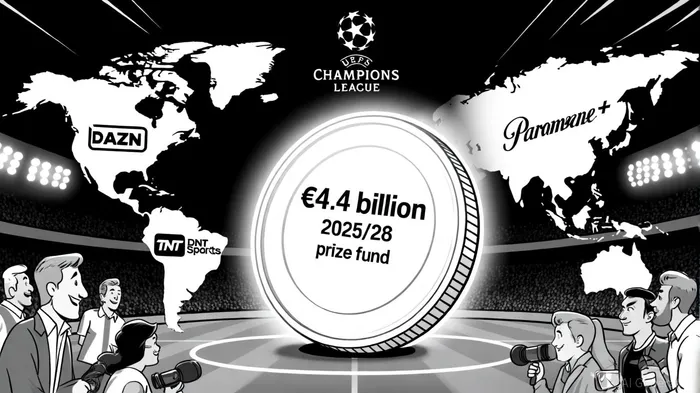
The UEFA Champions League has long been the crown jewel of European football, but its 2025/26 rights overhaul signals a seismic shift in the sports media landscape. With €4.4 billion in projected commercial revenue for the 2025/26 season—driven by a 36-team format, expanded match counts, and a new global commercial rights partnership with U.S.-based Relevent Sports—investors are now scrutinizing European sports media and streaming stocks for strategic entry points[1]. This analysis dissects the evolving dynamics of media rights, financial performance of key players, and the investment potential of platforms securing access to the world's most lucrative football competition.
The Rights Overhaul: A New Era of Globalization
UEFA's decision to hand global commercial rights to Relevent Sports for the 2027–2033 cycle marks a departure from its longstanding Swiss partner, TEAM Marketing[4]. This shift aims to capitalize on the U.S. market's growing appetite for European football, where Paramount Global and TelevisaUnivision now hold exclusive broadcast rights under a $1.5 billion, six-year deal[2]. Relevent's expertise in U.S. sports marketing—evidenced by its NFL and UFC ties—positions it to unlock new sponsorship and media revenue streams, potentially boosting UEFA's global commercial appeal by 30% by 2030[6].
Meanwhile, European broadcasters are adapting to the new normal. DAZN, for instance, has secured non-exclusive rights in Germany, Austria, and Italy, streaming 186 out of 203 Champions League matches annually[3]. Its 2025 revenue is projected at $880 million, up from $2.86 billion in 2023, as it leverages partnerships like Sky Deutschland to expand its subscriber base[5]. Similarly, TNT Sports (owned by Warner Bros. Discovery, ticker: WBD) holds a $514 million annual deal in the UK, though it reported a £187 million pre-tax loss in 2024 due to high rights costs and market saturation[7].
Financial Metrics and Analyst Ratings: Where to Invest?
The Champions League's financial architecture offers clues for investors. For the 2025/26 season, UEFA will distribute €3.31 billion in prize money, with 35% tied to a club's TV market value and UEFA coefficient[8]. This “value pillar” disproportionately benefits top clubs like Real Madrid and Bayern Munich, whose global fanbases drive higher broadcast revenues. For streaming platforms, this means that rights to matches involving these clubs—often sold at a premium—could yield outsized returns.
Key stocks to watch include:
- Warner Bros. Discovery (WBD): TNT Sports' UK Champions League deal is a cornerstone of WBD's sports division. Despite a 2024 loss, the company's third-quarter 2024 earnings report highlighted 7.2 million new Max subscribers, suggesting potential for cross-promotion of sports content[7]. Analysts at JMP Securities rate WBD as “Market Outperform,” citing its hybrid streaming-sports model[9]. However, historical data on WBD's earnings releases from 2022 to 2025 reveals a mixed picture: a simple buy-and-hold strategy around earnings dates yielded an average cumulative return of -5.2% over 30 days, underperforming the benchmark by nearly 5 percentage points[7]. This suggests that while WBD's fundamentals show promise, its stock has not consistently rewarded investors in the short term following earnings announcements.
- DAZN Group: Though not publicly traded, DAZN's 2025 revenue is estimated at $880 million, with a $6 billion target by 2025 driven by its FIFA Club World Cup and Foxtel acquisitions[5]. Ampere Analysis notes DAZN's 33% share of global sports streaming spend in 2025, outpacing rivals like Amazon and Netflix[10].
- Paramount Global (PARA): The U.S. rights deal with CBS Sports is a $250 million annual commitment, but Paramount's broader streaming strategy—bolstered by a multi-year distribution agreement with EverPass Media—could drive subscriber growth[2]. However, its stock remains volatile, with a “Market Outperform” rating from Wedbush but concerns over debt levels[11].
Market Trends and Long-Term Projections
The Champions League's media rights market is expanding at a 8% CAGR, projected to reach $8 billion by 2032[8]. This growth is fueled by two trends:
1. Digital-First Consumption: 40.7% of global sports fans now watch live events on digital platforms, with streaming services like DAZN and Amazon Prime Video capturing 60% of Champions League viewership in Germany[12].
2. Global Expansion: The inclusion of teams from Kazakhstan (Kairat Almaty) and Norway (Bodo/Glimt) has broadened the competition's appeal, creating new sponsorship and tourism opportunities[13].
For investors, the key is to balance short-term volatility with long-term tailwinds. While DAZN's 2023 operational losses ($3.1 billion in rights fees) highlight the sector's capital intensity[5], the Champions League's €2.467 billion prize pool for 2025/26—74% of UEFA's total prize fund—ensures that rights holders will continue to command premium valuations[8].
Strategic Entry Points
Given the sector's dynamics, investors should consider:
- Undervalued Streaming Stocks: WBD and PARA trade at discounts to their peers, offering entry points if their sports divisions stabilize.
- Private Equity in DAZN: While not publicly traded, DAZN's aggressive rights acquisitions and Foxtel integration suggest potential for a future IPO or strategic buyout.
- Thematic ETFs: Funds focused on global sports media (e.g., SPDR S&P Global Sports Media ETF) provide diversified exposure to Champions League rights holders.
Conclusion
The UEFA Champions League's rights overhaul is not just a corporate restructuring—it's a catalyst for reshaping the European sports media and streaming industry. For investors, the path forward lies in identifying platforms that can balance high-cost rights acquisitions with scalable digital distribution. As the 2025/26 season approaches, the stakes have never been higher, and the rewards for those who navigate this landscape wisely could be equally monumental.







Comentarios
Aún no hay comentarios