
Uber's Strategic Transformation and Undervalued Opportunity in the Evolving Mobility Ecosystem
In the post-pandemic era, Uber TechnologiesUBER-- Inc. (UBER) has emerged as a transformative force in the global mobility and logistics ecosystem. Once a high-growth, cash-burning ride-hailing platform, the company has redefined its business model to prioritize profitability, diversification, and long-term value creation. With a 24% year-over-year increase in trips and $37.6 billion in Gross Bookings in Q4 2023, Uber's strategic recalibration has positioned it as a multi-faceted platform spanning mobility, delivery, freight, and advertising, according to Uber's Q4 2023 results. This evolution, coupled with a compelling valuation profile, presents an undervalued opportunity for investors navigating the shifting landscape of digital mobility.
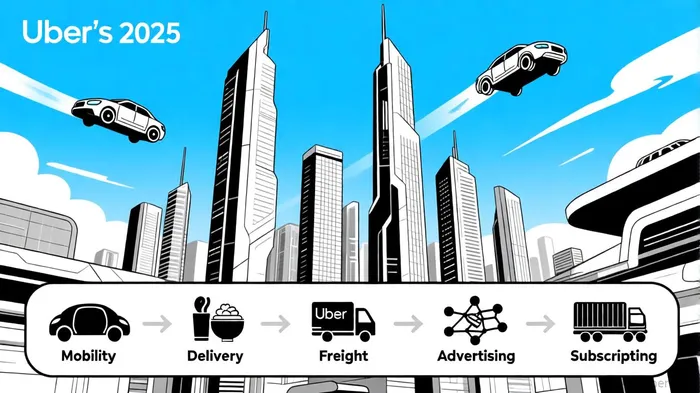
Business Model Evolution: From Ride-Hailing to Ecosystem Dominance
Uber's post-pandemic strategy has centered on expanding beyond its core ride-hailing service. By 2025, the company's revenue streams are diversified across five pillars: mobility (52%), delivery (32%), freight (10%), advertising (6%), and subscriptions (2%), per the 2025 financial model. This diversification is not merely defensive but a calculated move to capitalize on adjacent markets. For instance, UberUBER-- Eats has become a dominant player in food delivery, leveraging Uber's existing user base and logistics infrastructure to capture a significant market share, according to a Stockwave analysis. Similarly, the launch of Uber Advertising in 2023 has unlocked a new revenue stream, with the segment surpassing a $1.5 billion annual run rate by Q1 2025, per the 2025 financial model.
The company's innovation extends to niche markets. Services like Uber HCV (High-Capacity Vehicles) and Uber Moto cater to lower-income and non-core customer segments, achieving higher engagement rates than traditional offerings, according to the Statista outlook. Meanwhile, partnerships with autonomous vehicle (AV) firms like Lucid Motors and Nuro signal Uber's ambition to lead the next wave of mobility innovation. By deploying 20,000 Lucid cars equipped with Nuro's AV systems, Uber is positioning itself as a distribution layer for autonomous technology, reducing operational costs and enhancing scalability, as described in the Stockwave analysis.
Financial Performance: Profitability and Operational Efficiency
Uber's financial turnaround has been nothing short of remarkable. In Q4 2023, the company reported a net income of $1.4 billion and an adjusted EBITDA of $1.3 billion, with a 3.4% margin (Uber's Q4 2023 results). This momentum accelerated in 2024, with net income surging to $9.86 billion-a 421.7% year-over-year increase-on $43.98 billion in revenue (the 2025 financial model). By Q2 2025, Uber had authorized a $20 billion share repurchase program, reflecting management's confidence in its financial health, according to StockAnalysis stats.
The company's cost discipline and gross profit improvements have been pivotal. With a projected 10% compound annual growth rate (CAGR) in Gross Bookings-expected to reach $433 billion by 2034-Uber's take rate is set to rise from 27% in 2024 to 29% by 2034, driven by Uber One subscriptions and advertising (the 2025 financial model). Meanwhile, EBIT margins are forecasted to expand from 6% in 2024 to 24% by 2034, fueled by economies of scale and AV integration (the 2025 financial model).
Strategic Initiatives: Monetizing the Platform and Expanding Reach
Uber's strategic levers-deepening penetration in existing services, monetizing its platform, and investing in AV partnerships-underscore its long-term vision. The company's "platform-first" approach has enabled it to extract value from its ecosystem. For example, Uber One, a subscription service offering discounts and perks, has enhanced customer lifetime value, while Uber Advertising leverages its 150 million monthly active users to connect merchants with consumers (the 2025 financial model).
Geographic expansion and retail partnerships further amplify Uber's reach. Collaborations with retailers like Five Below and Dick's Sporting Goods have diversified its delivery offerings, creating new revenue streams and reinforcing its logistics infrastructure (the 2025 financial model). Additionally, Uber Freight's foray into logistics has tapped into the $1.5 trillion U.S. freight market, demonstrating the company's ability to scale beyond consumer-facing services, per the Stockwave analysis.
Valuation Metrics: Undervaluation Amid Growth
Despite its robust financials and strategic momentum, Uber remains undervalued relative to peers. As of Q3 2025, the company trades at a trailing P/E ratio of 15.86 and a forward P/E of 29.46, significantly lower than the peer average of 36.2x (StockAnalysis stats). Its EV/EBITDA ratio of 37.25, while higher than Lyft's 32.3x, is justified by Uber's superior growth prospects and diversified revenue streams (StockAnalysis stats). Analysts have assigned a "Strong Buy" rating, with an average price target of $105.00-12.42% above the current price-highlighting the stock's upside potential (Uber's Q4 2023 results).
Market Potential and Risks
The global ride-hailing market is projected to reach $179.7 billion by 2025, with user penetration expected to rise from 23.5% to 28.7% by 2030 (Statista outlook). Uber's 10,000-city footprint and 150 million monthly active users position it to benefit from this growth. However, regulatory challenges-such as the U.S. Department of Justice's ADA-related lawsuit-pose near-term risks, potentially increasing compliance costs, as noted in the Stockwave analysis.
Conclusion: A Compelling Investment Thesis
Uber's strategic transformation-from a ride-hailing disruptor to a diversified mobility and logistics leader-has unlocked significant value. With a resilient business model, expanding profit margins, and a compelling valuation, the company is well-positioned to capitalize on the $433 billion Gross Bookings target by 2034 (the 2025 financial model). While regulatory and competitive risks persist, Uber's innovation, operational efficiency, and platform monetization strategies make it a compelling long-term investment in the evolving mobility ecosystem.





Comentarios
Aún no hay comentarios