
Uber’s Strategic Position and Growth Leverage in the Post-2025 Mobility and Delivery Ecosystem
In the post-2025 mobility and delivery ecosystem, UberUBER-- has emerged as a formidable player, leveraging AI-driven platform efficiency and strategic expansion into emerging markets to solidify its dominance. By integrating advanced artificial intelligence (AI) into its core operations and forming high-impact partnerships for autonomous vehicle (AV) deployment, Uber is not only optimizing costs but also redefining the competitive landscape of urban mobility and food delivery.
AI-Driven Platform Efficiency: A Catalyst for Profitability
Uber’s investment in AI has become the backbone of its operational scalability. According to a report by DigitalDefynd, the company’s AI systems process 9.8 petabytes of data daily, enabling real-time optimizations in dynamic pricing, driver-rider matching, and fraud detection [1]. These initiatives have yielded measurable results: route efficiency improved by 14% since 2022, reducing average trip costs by $0.32 per ride, while surge pricing complaints dropped by 17% since 2020 [1]. Additionally, machine learning models have enhanced demand forecasting accuracy by 12% compared to 2021, reducing vehicle downtime by 32% through predictive maintenance [1].
The financial implications are significant. Analysts estimate that AI-driven dynamic pricing alone has boosted Uber’s revenue by 17.8%, contributing an estimated $1.2 billion annually [1]. These efficiencies are critical to Uber’s margin expansion, with Wall Street projecting potential operating margins to rise from 15.2% in 2025 to 19-21% by 2026 [1]. Such improvements align with broader expectations of 22% annual earnings growth over the next three years, making Uber’s current valuation of 16 times earnings appear increasingly attractive [3].
Strategic Expansion in Emerging Markets: Partnerships Over In-House Development
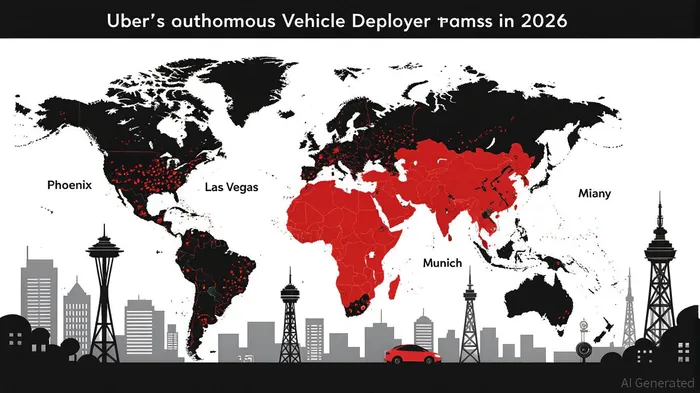
Uber’s approach to AV technology underscores its strategic agility. Rather than pursuing costly in-house development, the company has formed partnerships with firms like Momenta, Baidu, and WeRide to deploy robotaxi fleets in high-growth regions. For instance, its collaboration with BaiduBIDU-- involves scaling Apollo Go robotaxis in Asia and the Middle East, leveraging cost-efficient sixth-generation AVs to enter markets with favorable regulatory environments [1]. Similarly, trials with Momenta in Munich are positioned as a gateway to European expansion, with plans to scale to five new markets by 2026 [1].
This partnership model mitigates capital intensity and regulatory risks while accelerating Uber’s global footprint. By 2026, the company aims to deploy 1,800+ Level 4 autonomous vehicles in cities like Phoenix, Las Vegas, and Miami, with a long-term goal of achieving 32-38% operating margins if AV reliability reaches 98% [1]. Such a strategy not only reduces R&D costs but also preserves Uber’s core strengths in logistics and customer experience, as emphasized by CEO Dara Khosrowshahi in a recent analysis [3].
Financial Performance and Market Share: A Platform for Diversified Growth
Uber’s Q2 2025 financial results underscore its strategic success. Revenue surged 18% year-over-year to $12.65 billion, driven by robust growth in both Mobility and Delivery segments [1]. The company’s cross-platform integration—exemplified by 36 million Uber One members—has created a network effect that strengthens its competitive positioning against regional players like Didi, Bolt, and Ola [2].
New monetization streams, such as Uber Ads and Uber One, are further diversifying revenue. Advertising revenue alone surpassed a $1.5 billion annual run rate in Q1 2025, with higher profit margins than core transactions [2]. Meanwhile, free cash flow surged 66% in the most recent quarter, reflecting sustained profitability since 2023 [2]. These metrics highlight Uber’s transition from a cost-driven model to a scalable, high-margin platform.
Risks and Competitive Challenges
Despite its momentum, Uber faces headwinds. Regulatory delays in AV adoption and competition from standalone AV providers remain key risks [3]. Additionally, emerging markets present unique challenges, including varying consumer preferences and regulatory scrutiny. However, Uber’s brand strength and global infrastructure provide a buffer, enabling it to adapt quickly to local conditions.
Conclusion: A Compelling Investment Thesis
Uber’s strategic pivot toward AI and AV partnerships positions it as a leader in the next phase of mobility and delivery. By combining platform efficiency with targeted expansion, the company is addressing both cost optimization and market scalability. For investors, Uber’s 22% projected earnings growth, margin expansion potential, and diversified revenue streams present a compelling case for long-term value creation. As the mobility ecosystem evolves, Uber’s ability to balance innovation with operational discipline will likely determine its sustained success.
**Source:[1] Uber TechnologiesUBER-- Inc Financial Analysis and Strategic ... [https://monexa.ai/blog/uber-technologies-inc-latest-market-analysis-strat-UBER-2025-07-16][2] Uber Q2 2025 slides: Revenue jumps 18% as platform integration drives growth [https://www.investing.com/news/company-news/uber-q2-2025-slides-revenue-jumps-18-as-platform-integration-drives-growth-93CH-4172833][3] Billionaire Bill Ackman May Be the Next Warren Buffett [https://www.mitrade.com/insights/news/live-news/article-8-1102048-20250907]







Comentarios
Aún no hay comentarios