
Uber's Strategic Position Amid Disruption and Growth in Mobility and Delivery Markets
Financial Resilience and Strategic Reinvestment
Uber's Q3 2025 results underscore its financial resilience. Trips surged 22% year-over-year to 3.5 billion, with Gross Bookings reaching $49.7 billion and revenue hitting $13.5 billion, reflecting a 20% year-over-year growth according to the company's financial report. Net income of $6.6 billion, bolstered by a $4.9 billion tax valuation release, and adjusted EBITDA of $2.3 billion (up 33% year-over-year) highlight its improving profitability as reported in the Q3 earnings. These metrics suggest UberUBER-- has transitioned from a high-growth startup to a mature operator with disciplined cost management. However, the company's long-term compounding potential depends on reinvesting these gains into transformative technologies like AVs and expanding its delivery footprint.
Autonomous Vehicle Integration: A Hybrid Future
Uber's collaboration with NVIDIA and Stellantis to deploy 5,000 Level 4 autonomous vehicles by 2025 represents a bold bet on the future of mobility as detailed in the company's announcement. These vehicles, powered by NVIDIA's DRIVE AGX Hyperion 10 platform, will operate as a "robotaxi" network in the U.S. and internationally. The partnership leverages NVIDIA's AI-driven software and safety-certified operating systems, enabling seamless integration with Uber's marketplace according to the company's technical documentation. By overseeing end-to-end fleet operations-including charging, maintenance, and customer support-Uber aims to reduce driver dependency and lower unit economics.
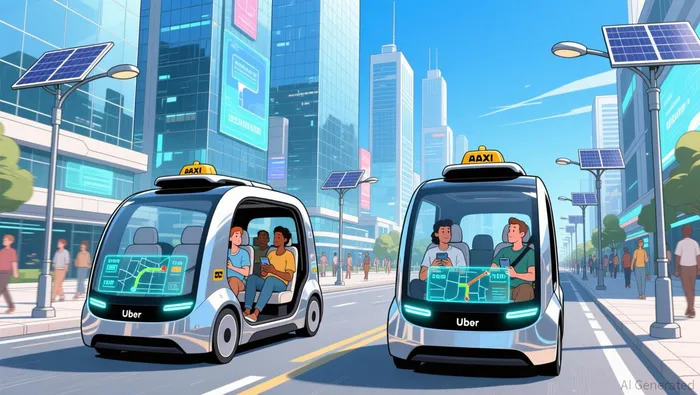
Yet, AVs are not yet a profit center. CEO Dara Khosrowshahi has acknowledged that autonomous vehicles remain unprofitable but anticipates breakeven within a few years according to company leadership statements. This timeline hinges on resolving technical challenges, such as low-speed signal processing in autonomous underwater vehicles (AUVs), which mirror broader AV industry hurdles as reported in industry analysis. Regulatory frameworks for data privacy and operational safety will also play a critical role. For instance, MineOS's shift to autonomous AI agents for privacy compliance highlights the growing need for AI-driven solutions to meet evolving regulatory demands according to recent industry news.
Delivery Market Expansion: Strategic Acquisitions and Competitive Pressures
Uber's delivery segment, which includes Uber Eats, is a key growth driver. In Q3 2025, delivery gross bookings hit a $12 billion annualized pace, driven by grocery and retail orders according to the company's financial update. The company's expansion into Turkey-where it seeks to acquire Getir Food from Mubadala-exemplifies its strategy to dominate regional delivery markets as reported in business news. This move would solidify Uber Eats' position against local rivals like Trendyol GO and Rapido, which has seen its gross merchandise value (GMV) surge 111% year-on-year in India according to market analysis.
However, Uber faces a dual challenge: scaling delivery margins while fending off competition. In India, Rapido's integration into Prosus's ecosystem threatens to erode Uber's market share through cross-sell opportunities and financial services as detailed in market reports. Meanwhile, Tesla's Full Self-Driving (FSD) software, with its 6.5 billion miles of real-world data, could disrupt Uber's AV ambitions by 2026 according to market analysis. Analyst Rob Wertheimer of Melius Research warns that Tesla's camera-only approach and AI5 chip may outpace Uber's partnerships, creating a "massive transfer of value" to Tesla over the next five years as reported in market commentary.
Regulatory and Competitive Risks
Regulatory challenges loom large. Autonomous systems must comply with data protection laws, such as the EU's AI Act and U.S. state-level privacy frameworks. Uber's AV deployment will require navigating these regulations while addressing public concerns about safety and job displacement. For example, gig worker classification debates in California and Europe could impact Uber's cost structure and profitability according to financial analysts.
Competitively, Uber's dominance in ride-hailing is under threat from both traditional automakers (e.g., Waymo) and tech firms (e.g., Tesla). Its hybrid model-combining human drivers with AVs-may mitigate some risks, but execution will be critical. As noted by Yahoo Finance analysts, Uber's stock price could reach $165.54 by 2030 in a bullish scenario, assuming it consolidates its logistics and mobility verticals according to market forecasts. Conversely, delays in AV deployment or regulatory setbacks could cap growth at $120.68 according to similar projections.
Analyst Outlook and Long-Term Prospects
Analysts remain cautiously optimistic. With a trailing P/E ratio of 11.69 and 29 out of 38 analysts rating Uber as a "Buy" or "Outperform," the stock appears undervalued relative to its growth potential according to financial analysis. However, risks such as rising competition, regulatory uncertainty, and the profitability of delivery and freight segments remain key variables as reported in market analysis.
Uber's 5-year financial projections hinge on its ability to scale AV partnerships and diversify revenue streams. By 2030, the company could achieve a market cap of $212 billion if it successfully integrates AVs and expands its delivery and freight operations according to industry forecasts. Yet, this outcome requires overcoming technical and regulatory hurdles while maintaining cost discipline.
Conclusion
Uber's strategic position as a long-term compounder depends on its execution of AV integration and delivery market expansion. While its financials and hybrid business model provide a strong foundation, the company must navigate a rapidly evolving landscape marked by technological disruption, regulatory complexity, and fierce competition. For investors, Uber represents a high-conviction bet on the future of mobility-one that balances transformative potential with significant risks.







Comentarios
Aún no hay comentarios