
Uber's Strategic Position in the Autonomous Vehicle Era: Why Autonomous Vehicle Disruption Risks Are Mispriced and Uber's Hybrid Model Offers a Unique Growth Moat
The autonomous vehicle (AV) revolution is reshaping the transportation landscape, and Uber Technologies Inc.UBER-- (UBER) has positioned itself at the forefront of this transformation. While skeptics argue that AVs could disrupt Uber's core business, a closer examination reveals that the market is mispricing these risks-and that Uber's hybrid business model, combining first-party innovation with strategic partnerships, creates a durable competitive moat. This analysis explores how Uber's strategic investments, global expansion, and financial resilience are outpacing concerns about AV-driven disruption.
A Hybrid Model: Balancing Innovation and Scalability
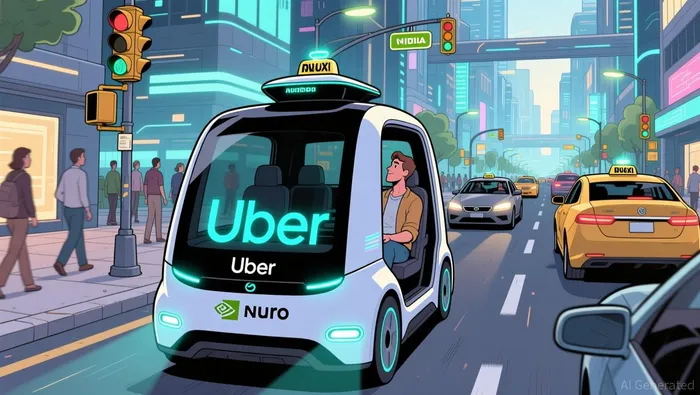
Uber's approach to AV integration is defined by a dual strategy: developing proprietary technology while leveraging third-party partnerships to accelerate deployment. For instance, the company has partnered with NVIDIA to power its AV network using the NVIDIANVDA-- DRIVE AGX Hyperion 10 platform, enabling the deployment of 100,000 Level 4-ready vehicles by 2027. Simultaneously, UberUBER-- has invested in Lucid and Nuro, aiming to deploy 20,000 Lucid vehicles equipped with Nuro's Level 4 autonomy system over six years. This hybrid model mitigates execution risks by diversifying technological dependencies while ensuring scalability.
 The Middle East's first fully driverless robotaxi service, launched in Abu Dhabi with WeRide, further underscores Uber's global ambition. This initiative, supported by the UAE's first city-level fully driverless permit, demonstrates Uber's ability to navigate regulatory hurdles and establish early-mover advantages in key markets. By combining in-house AV trials with third-party collaborations, Uber is effectively managing the transition to autonomy without overcommitting to a single technology path.
Mispricing of AV Disruption Risks: A Market Disconnect
Despite Uber's proactive strategy, the market appears to overestimate the threat of AV disruption. Analysts like Andrew Boone of JMP Securities caution that companies like Waymo could develop direct-to-consumer platforms, bypassing Uber's network. However, this narrative overlooks the company's entrenched network effects and strategic partnerships. For example, Goldman Sachs argues that most AV supply in the next one to two years will likely integrate into the Uber app rather than compete directly. This suggests that Uber's platform remains a critical infrastructure layer for AV operators, reducing the risk of displacement.
Valuation models further highlight a potential mispricing. A discounted cash flow (DCF) analysis estimates Uber's intrinsic value at $160.14 per share, implying a 40.5% discount to its projected future cash flows according to analysis. While some analysts argue Uber is overvalued based on EBITDA projections, others, like Sahm Capital, contend the stock is undervalued by 49% relative to intrinsic value. This divergence reflects divergent assumptions about AV adoption timelines and Uber's ability to monetize its hybrid model.
Financial Resilience and Diversification
Uber's Q1 2025 financial results reinforce its strategic agility. The company reported a 14% year-over-year increase in gross bookings to $42.8 billion, driven by expansion into retail delivery and AV trials. This diversification into logistics and technology services-rather than relying solely on ride-hailing-positions Uber as a broader mobility and delivery platform.
Moreover, Uber's near-peak net profit margins and rising average revenue per user (ARPU) indicate strong operational leverage. These metrics, combined with its investments in AI infrastructure (e.g., the NVIDIA joint AI data factory), suggest the company is primed to capitalize on cost efficiencies as AV deployment scales according to financial analysis. Critics who question Uber's long-term margins may be underestimating the compounding benefits of automation and data-driven optimization.
Conclusion: A Mispriced Opportunity in the AV Era
Uber's hybrid business model and strategic partnerships create a unique growth moat in the AV era. By balancing first-party innovation with third-party collaboration, the company is mitigating execution risks while accelerating deployment. The market's current discount on Uber's stock-driven by overcautious assumptions about AV disruption-appears to ignore the company's financial resilience, regulatory adaptability, and platform dominance. As AV adoption accelerates, Uber's ability to integrate autonomous mobility into its ecosystem will likely outperform skeptics' expectations, making it a compelling long-term investment.







Comentarios
Aún no hay comentarios