
Uber as a Strategic Partner in the Robotaxi Revolution
The autonomous vehicle (AV) race has long been framed as a zero-sum game, with investors fixated on whether companies like Waymo or Tesla will dominate the robotaxi sector. Yet, as the industry matures, a clearer picture emerges: Uber's partnership-driven strategy positions it as a uniquely positioned player, leveraging cost efficiencies and ecosystem flexibility to outmaneuver rivals. With AV competition fears often overblown and regulatory hurdles slowing rivals, Uber's stock appears undervalued relative to its long-term potential.
A Partnership-First Approach: Uber's Cost-Efficient AV Ecosystem
Uber's pivot from in-house AV development to strategic collaborations has been a masterstroke. By partnering with companies like NVIDIANVDA--, StellantisSTLA--, LucidLCID--, and Nuro, UberUBER-- avoids the exorbitant R&D costs of building autonomous systems from scratch. For instance, its 2025 partnership with NVIDIA and Stellantis aims to deploy 5,000 Level 4 autonomous vehicles powered by NVIDIA's DRIVE AGX Hyperion 10 platform, while a separate agreement with Lucid and Nuro targets 20,000+ Lucid vehicles equipped with Nuro Driver over six years. These partnerships allow Uber to focus on its core strengths-logistics, customer experience, and marketplace optimization-while outsourcing the technical complexity of AV development.
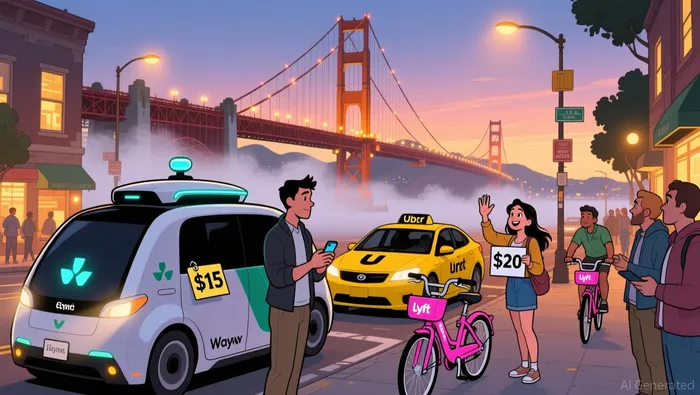
This model contrasts sharply with Waymo's capital-intensive approach. Waymo's robotaxis, while technologically advanced, carry a base cost of $110,000 per unit (including AV equipment), with annual amortization of $22,000 and additional maintenance expenses. In contrast, Uber's gig economy structure shifts vehicle ownership and maintenance costs to drivers, enabling lower per-ride pricing. Data from San Francisco shows Waymo's average ride cost at $20.43, compared to Uber's $15.58 and Lyft's $14.44. Uber's ability to maintain cost efficiency while scaling AV deployments-such as its 5,000-vehicle partnership with NVIDIA-underscores its competitive edge.
Overblown Competition Fears: Rivals Struggle with Costs and Regulation
While investors often assume Waymo and Tesla will outpace Uber, both face significant headwinds. Waymo, despite operating 2,500 robotaxis across five U.S. cities, reported a $1.43 billion loss in Q3 2025, attributed to high development costs and regulatory compliance. Its reliance on pre-mapped infrastructure and cloud connectivity also exposes it to operational risks, as seen during a December 2025 San Francisco blackout that forced service suspensions. Meanwhile, Tesla's robotaxi service, though hyped, remains in beta testing with human safety monitors and has yet to secure California permits for driverless operations.
 Tesla's cost advantage-projected to come from its Cybercab's lower unit price-remains speculative. As of late 2025, Tesla's Austin-based robotaxi fleet numbered just 30 units, dwarfed by Waymo's 200 in the same city. Moreover, public skepticism about Tesla's safety record-exemplified by incidents like its failure to stop for a school bus- highlights the risks of its camera-based AI approach. For Uber, these challenges mean competitors are unlikely to displace it anytime soon, particularly as its partnerships with Baidu, WeRide, and Pony.ai expand robotaxi access in Asia and the Middle East.
Regulatory Hurdles: Uber's Flexibility vs. Rivals' Rigidity
Regulatory complexity further tilts the playing field in Uber's favor. Waymo's recent struggles in Santa Monica-where local authorities demanded noise reductions from its vehicle alarms- illustrate the difficulty of scaling AV operations in diverse markets. Tesla, meanwhile, faces an uphill battle to meet California's stringent safety standards for driverless services. Uber's hybrid model, which integrates AVs into its existing ride-sharing platform, sidesteps many of these issues. By leveraging partners like Avride for Dallas-based robotaxi deployments, Uber avoids the need for extensive regulatory approvals while maintaining operational flexibility.
A Discounted Entry Point in a High-Growth Sector
Uber's stock, currently trading at a discount to its 2024 net income of $9.86 billion and free cash flow of $6.89 billion, offers an attractive entry point for investors. The company's strategic AV partnerships, combined with its ability to scale without shouldering high fixed costs, position it to capture a significant share of the robotaxi market. With the global AV industry projected to grow at a 34.84% CAGR through 2035, Uber's ecosystem-driven approach appears poised to outperform rivals mired in cost overruns and regulatory delays.
Conclusion
The robotaxi revolution is not a binary contest between Uber and its AV rivals. Instead, Uber's partnership-first strategy, cost efficiencies, and regulatory agility create a moat that overcomes the overblown fears of competition. As Waymo and Tesla grapple with operational and financial hurdles, Uber's stock offers a compelling opportunity for investors seeking exposure to the future of mobility.





Comentarios
Aún no hay comentarios