
Uber's Index Inclusion and Its Impact on Market Positioning
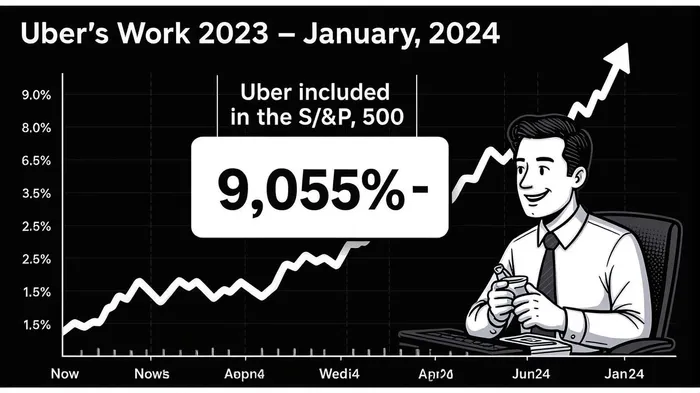
Uber Technologies’ inclusion in the S&P 500 in December 2023 marked a pivotal moment in its evolution from a high-growth disruptor to a mainstream market staple. This strategic reallocation by index providers not only signaled institutional validation of Uber’s financial resilience but also catalyzed a liquidity-driven surge in its valuation. By examining the mechanics of index inclusion and its aftermath, investors can better assess how such reallocations reshape a company’s market positioning and long-term trajectory.
Strategic Index Reallocation: A Catalyst for Institutional Adoption
Uber’s addition to the S&P 500, effective December 18, 2023, was a calculated move by S&P Dow Jones Indices to reflect the company’s transition from speculative growth stock to a stable, cash-generative entity. According to a report by Northern TrustNTRS--, Uber’s inclusion boosted the industrials sector’s weight in the index by 0.3%, underscoring its role as a proxy for the evolving transportation and logistics landscape [1]. This reallocation required ETFs and mutual funds tracking the S&P 500 to purchase approximately $12.7 billion in UberUBER-- shares—a liquidity event that immediately elevated its market capitalization to $127 billion [2].
The inclusion also served as a reputational milestone. As stated by Mellon Asset Management, Uber’s first-ever operating profit in Q2 2023 and consistent adjusted EBITDA growth demonstrated its alignment with S&P’s financial viability criteria [2]. This institutional endorsement likely attracted a broader base of passive and active investors, many of whom are constrained to index constituents. The result was a 9.05% stock price rally from December 4 to December 14, 2023, as algorithmic buying by index-tracking funds amplified demand [2].
Market Capitalization Representation and Sector Dynamics
Uber’s 0.3% weighting in the S&P 500 may seem modest, but its symbolic significance is profound. As of its inclusion, Uber was the largest company not in the index, a status that highlighted its unique position at the intersection of technology and traditional industrials [2]. By joining the index, Uber helped diversify the S&P 500’s sector composition, which had previously underrepresented the gig economy and digital infrastructure. This reallocation also indirectly benefited the industrials sector, as Uber’s revenue growth and EBITDA margins outperformed many legacy industrials [1].
However, the benefits of index inclusion are not without caveats. While the initial liquidity boost was substantial, Uber’s stock has since faced headwinds from macroeconomic concerns. For instance, in September 2025, the S&P 500 closed 0.3% lower amid weak jobs data, and Uber’s shares fell over 2% despite exceeding Q1 EBITDA estimates [5]. This volatility underscores that index inclusion does not insulate a stock from broader market forces or earnings expectations.
Recent Index Shifts and Strategic Implications
In September 2025, Uber further solidified its institutional relevance by replacing Charter CommunicationsCHTR-- in the S&P 100, a more concentrated index of large-cap U.S. stocks [3]. This move reflects ongoing efforts by index providers to align with companies that exemplify innovation and scalability. Unlike the S&P 500, the S&P 100 is weighted more heavily toward sectors with durable cash flows, suggesting that Uber’s business model is now viewed as a benchmark for sustainable growth in the digital economy [4].
Yet, the broader market context remains critical. As of September 2025, concerns over a slowing economy have dampened investor sentiment, with the S&P 500’s 0.3% decline illustrating the fragility of risk-on trades [4]. Uber’s ability to maintain its market positioning will depend on its capacity to navigate these macroeconomic pressures while delivering on its Q2 2025 guidance of $45.75 billion to $47.25 billion in gross bookings [5].
Conclusion: Index Inclusion as a Double-Edged Sword
Uber’s inclusion in the S&P 500 and subsequent reallocation into the S&P 100 have undeniably enhanced its market visibility and institutional ownership. These moves have provided a tailwind for liquidity and valuation, but they also come with heightened expectations. As the company transitions from a high-growth story to a mature player, its ability to sustain profitability and adapt to macroeconomic cycles will determine whether its index representation remains a strategic advantage or becomes a liability in a downturn. For investors, the lesson is clear: index inclusion is a powerful tool for market positioning, but it is no substitute for operational and financial discipline.
Source:
[1] S&P 500 Index Rebalance: Uber Addition Boosts Weight of..., https://www.northerntrust.com/united-states/insights-research/2023/point-of-view/sp-500-index-rebalance-uber-add
[2] Uber Joins S&P 500, https://www.mellon.com/insights/insights-articles/where-to-the-sp-500.html
[3] AppLovinAPP--, Robinhood MarketsHOOD-- and Emcor GroupEME-- Set to..., https://www.morningstarMORN--.com/news/pr-newswire/20250905ny67166/applovin-robinhood-markets-and-emcor-group-set-to-join-sp-500-others-to-join-sp-100-sp-midcap-400-and-sp-smallcap-600
[4] AppLovin, Robinhood Markets and EmcorEME-- Group Set to Join..., https://markets.ft.com/data/announce/detail?dockey=600-202509051834PR_NEWS_USPRX____NY67166-1
[5] Uber earnings: Stock drops despite upbeat current quarter, https://finance.yahoo.com/news/uber-earnings-stock-drops-despite-upbeat-current-quarter-guidance-120305559.html







Comentarios
Aún no hay comentarios