
Why Uber Dominates in the Maturing Ride-Hail Market: A Fundamental Edge Over Lyft
The ride-hailing sector has entered a critical phase of consolidation, where profitability and operational efficiency are paramount. As the market matures, investors must prioritize companies with sustainable competitive advantages. UberUBER-- (UBER) and LyftLYFT-- (LYFT) are the two dominant players, but their trajectories diverge sharply. Uber's global scale, superior margins, and strategic investments position it as the clear winner in this evolving landscape. Here's why UBER outperforms LYFT—and why investors should take note.
1. Profitability: Uber's Lead Is Unassailable
Let's start with the numbers. In Q4 2024, Uber reported $12.0 billion in revenue, a 20% year-over-year (YoY) increase, while Lyft generated just $1.6 billion, up 27% YoY. While both companies grew, Uber's scale is incomparable.
Uber's net income was $6.9 billion in Q4 2024, though this included one-time gains like a $6.4 billion tax benefit. Even excluding those items, Uber's core business delivered strong results. In contrast, Lyft's net income was a modest $61.7 million in Q4, with margins still trailing far behind.
2. Margin Trajectories: Uber's Edge in Efficiency
Margins are the true measure of operational excellence. Uber's Adjusted EBITDA margin hit 4.2% of Gross Bookings in Q4 2024, up from 3.4% a year earlier. Its Mobility segment alone posted a 30.3% margin, while Delivery reached 18.7%—both industry-leading figures.
Lyft's margins, however, lag significantly. Its Q4 2024 Adjusted EBITDA margin was just 2.6%, up from 1.5% in 2023. Even at its best, Lyft's margins remain half of Uber's. The gapGAP-- is even starker when considering net income as a percentage of Gross Bookings: Uber's was 1.6%, versus Lyft's 1.4%.
3. Market Dominance: Global Reach vs. Regional Constraints
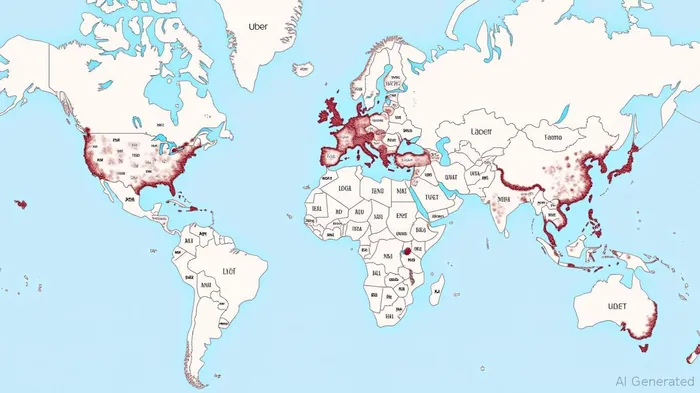
Uber's global footprint is its crown jewel. With operations in nearly 70 countries, it taps into diverse markets, from Asia to Europe. This scale allows Uber to leverage economies of scale and diversify risk. For instance, its Q4 2024 $44.2 billion in Gross Bookings dwarfed Lyft's $4.3 billion—a 10-to-1 advantage.
Lyft, meanwhile, remains U.S.-centric, with 100% of its revenue tied to North America. This limits its ability to weather regional slowdowns or regulatory headwinds. Uber's expansion into autonomous vehicles (e.g., partnerships with NVIDIANVDA-- and Waymo) and delivery services (e.g., Delta's exclusive deals) further cements its leadership in adjacent markets.
4. Unit Economics: Uber's Superior Cash Generation
Cash flow is the lifeblood of any business. Uber's free cash flow hit $1.7 billion in Q4 2024, with $7.0 billion in unrestricted cash—a war chest for innovation. Its trailing twelve-month free cash flow conversion (112% of Adjusted EBITDA) underscores operational discipline.
Lyft's free cash flow, however, is erratic. While its 2024 annual free cash flow turned positive at $766 million, Q4 2024's free cash flow plunged to $10 million—a red flag. Additionally, Lyft's insurance reserves ballooned 38% to $1.7 billion, signaling potential cost pressures.
5. Future Trajectory: Uber's Moats Are Unbreachable
Looking ahead, Uber's strategic moves lock in long-term advantages. Its autonomous vehicle partnerships (e.g., WeRideWRD--, Avride) aim to reduce driver costs by up to 40%, while its Uber One loyalty program (30 million users) boosts retention.
Lyft's $500 million share buyback and improved service metrics are positives, but they're tactical fixes. Without global scale or diversified revenue streams, Lyft remains vulnerable to Uber's dominance.
Investment Thesis: UBER is the Play for This Decade
The ride-hailing sector is no longer about growth—it's about profitability. Uber's superior margins, global scale, and cash flow make it the clear leader. Its stock has outperformed Lyft's over the past three years (UBER: +120%, LYFT: +35%), and the gap will widen as the sector matures.
Buy UBER if:
- You believe in a winner-takes-most market.
- You want exposure to autonomous vehicles and global expansion.
- You prioritize cash flow and margin resilience.
Avoid LYFT because:
- It's overly reliant on the U.S. market.
- Its margins remain structurally weaker.
- Its free cash flow volatility signals operational fragility.
Final Take
The ride-hailing wars are over. Uber has won. Its $1.8 billion net income in Q1 2025 (vs. Lyft's $2.6 million) and $45.75–47.25 billion Q2 2025 Gross Bookings guidance confirm its trajectory. Investors should favor UBER's sustainable advantages over LYFT's regional limitations. In a maturing market, this is the stock to own.







Comentarios
Aún no hay comentarios