
Why Uber Must Buy Instacart: A $35B+ Delivery Giant in the Making
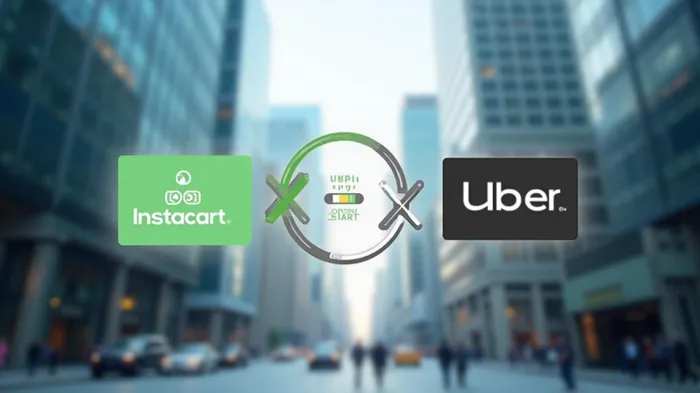
The on-demand delivery market is at a crossroads. Instacart, the undisputed leader in grocery delivery with 73% market share, sits on a trove of undervalued assets, while UberUBER-- lags at 7.2% share in the same sector. Their existing partnership—a quiet collaboration delivering groceries via Uber’s logistics—hints at a deeper truth: combining these two titans could create a $35 billion+ delivery colossus. For investors, this is a rare opportunity to buy into a merger of complementary strengths before the market catches on.
The Synergy Play: Why Uber Needs Instacart’s Grocery Empire
Instacart’s dominance is undeniable. With $33.5 billion in Gross Transaction Value (GTV) in 2024 and a 70% share of $75+ grocery baskets, it has built an infrastructure that Amazon and Walmart can’t easily replicate. Meanwhile, Uber’s foray into groceries—via partnerships with Family Dollar and FreshDirect—has been incremental. A full acquisition would instantly elevate Uber’s grocery share to 73%, turning its food delivery platform (already a $13.7 billion revenue machine) into a full-stack on-demand ecosystem.
The math is stark:
- Cost synergies: Uber’s $528 million in 2024 adjusted EBITDA (food delivery) could merge with Instacart’s $885 million EBITDA (grocery), creating instant scale.
- Ad revenue upside: CPG brands pay premiums to reach Instacart’s 14 million active users. Pairing that with Uber’s 288 million monthly users could unlock a $2 billion+ ad marketplace.
- Omnichannel growth: Instacart’s 1,800 retail partners and AI-driven shelf-scanning tech could supercharge Uber’s logistics, enabling same-day deliveries of everything from meals to pharmaceuticals.
Instacart’s shares trade at $27, a 36% discount to its $42 IPO price, despite hitting record EBITDA growth. This undervaluation is the acquisition’s secret sauce: Uber could acquire Instacart at a 7–9x EBITDA multiple, far cheaper than its own 15x valuation. For Uber CEO Dara Khosrowshahi, this is a no-brainer—a $35 billion combined entity would dwarf DoorDash’s 10.9% share and Amazon’s self-distribution threat.
The Undervalued Asset: Instacart’s Hidden Strengths
Critics point to Instacart’s net loss of $1.6 billion in 2023, but they’re missing the bigger picture. Its $33.5 billion GTV in 2024 (up 10% YoY) and 294 million orders reflect a high-margin grocery delivery model that Amazon’s Prime Pantry can’t match. The company’s strategic moves—lowering the minimum basket size to $10 for members, expanding into restaurant groceries, and rolling out AI-driven Caper Carts—are already driving 11% order growth in 2024.
DoorDash’s 56% food delivery dominance is irrelevant if Uber/Instacart can claim 80% share of $75+ baskets. This vertical integration would lock out competitors: 73% of shoppers cite “time efficiency” as their top reason for using Instacart, a loyalty metric Uber’s app can amplify through its 9-orders-per-second processing power.
The Competitive Crossroads: Act Now or Miss the Boat
The window to act is narrowing. Amazon’s $20 billion grocery sales and Walmart’s $18 billion in e-groceries are existential threats, but both lack Instacart’s 14,000-city reach. Meanwhile, DoorDash’s $1.2 trillion grocery delivery vision (via partnerships with Target and Publix) is a direct challenge. An Uber-Instacart merger would:
1. Monetize dark kitchens: Pair Uber’s meal prep infrastructure with Instacart’s pantry staples to create $100+ combined baskets.
2. Crush delivery costs: Instacart’s 600,000 shoppers and Uber’s 7 million drivers could optimize routes in real time, reducing fees that 73% of customers already resent.
3. Own the AI edge: Merge Instacart’s shelf-scanning AI with Uber’s predictive logistics algorithms to dominate the $1.28 trillion grocery delivery market by 2028.
Investment Thesis: Buy Instacart Now—Before the Deal
The writing is on the wall. Uber’s stock price has risen 22% in 2025 on merger speculation, while Instacart’s shares remain stuck at $27—a $9.3 billion valuation that ignores its $39 billion peak. This is a textbook undervaluation of a cash-flow positive asset with 10% annual GTV growth.
Investors should act immediately on two fronts:
1. Go long on Instacart: Its $885 million EBITDA and 27% consumer preference (vs. 7% for Uber) make it a takeover target at 8–10x EBITDA, a steal compared to Uber’s $13.7 billion in food revenue.
2. Bet on Uber’s logistics moat: Its $528 million EBITDA growth in 2024 proves the core business can absorb Instacart’s scale. A merged entity would dominate 70% of U.S. on-demand deliveries by 2026.
The grocery delivery war isn’t just about food—it’s about owning the last-mile economy. Uber has the scale, Instacart has the groceries, and the market has mispriced the opportunity. This is a once-in-a-decade merger—investors who miss it will rue the day.








Comentarios
Aún no hay comentarios