
The Uber-Baidu Autonomous Taxi Alliance: A Game-Changer for Global AV Adoption?
The partnership between UberUBER-- and BaiduBIDU-- to deploy autonomous vehicles (AVs) globally—starting with Dubai in 2025—is a landmark deal that could redefine the autonomous mobility sector. By combining Uber's platform scale with Baidu's cutting-edge autonomous driving technology, the alliance represents a strategic synergy aimed at accelerating adoption in underserved markets. For investors, this collaboration raises critical questions: How does it position Uber and Baidu in the race to commercialize AVs? What does it mean for their valuations? And can this model replicate in Asia and the Middle East?
The Strategic Synergy: Platform Meets Technology
Uber's strength lies in its global ridesharing network, which processes over 2.3 billion rides annually across 85 countries. Baidu, meanwhile, has accumulated 150 million kilometers of autonomous driving data and completed 10 million rides in China via its ApolloAPO-- Go service. The partnership merges these assets: Baidu's sixth-generation RT6 robotaxis—designed specifically for ride-hailing—will leverage Uber's infrastructure to scale beyond China.
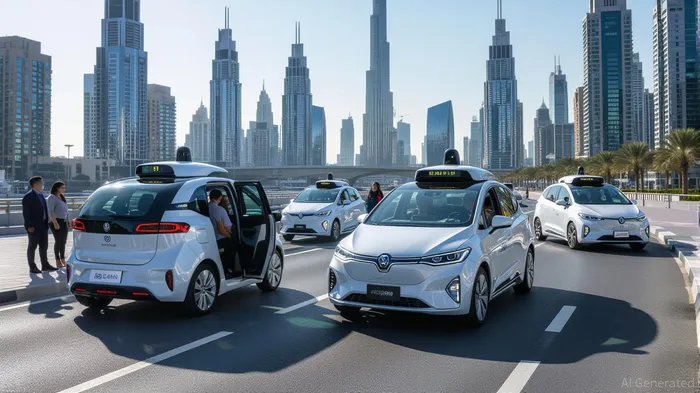
The first trials in Dubai (starting late 2025) are a masterstroke. Dubai's Roads and Transport Authority (RTA) aims for 25% of journeys to be autonomous by 2030, a goal that requires both technology and infrastructure. By deploying Baidu's vehicles on Uber's platform, the alliance addresses two key barriers to adoption: consumer access (via Uber's app) and operational efficiency (through shared data and route optimization).
Market Expansion: Asia and the Middle East as Growth Hubs
The partnership's focus on markets outside the U.S. and mainland China is strategic. In Asia, Uber dominates regions like India and Southeast Asia, where dense urban populations and high ride demand create ideal conditions for AVs. Meanwhile, the Middle East's tech-forward cities—like Dubai, Riyadh, and Abu Dhabi—are aggressively investing in smart transportation.
Note: A visual comparing Uber (UBER) and Baidu (BIDU) stock performance over 18 months would highlight investor sentiment shifts tied to AV partnerships.
Baidu's international expansion via this deal marks its largest move beyond China to date. For Uber, the alliance strengthens its position against rivals like LyftLYFT-- and GrabGRAB--, which are also partnering with autonomous tech firms (e.g., Lyft's tie-up with Motional). But Uber's scale and Baidu's technical maturity give them a leg up.
Competitive Landscape: Outpacing the Pack?
While competitors like PonyPONY--.ai and Momenta are also testing AVs, few have Uber's global distribution network or Baidu's proven ride volume. Baidu's 10 million autonomous rides in China provide a critical edge in data-driven refinement, which is essential for reliability. Meanwhile, Uber's partnerships with Momenta and WeRideWRD-- in Asia complement this deal, creating a multi-pronged approach to regional dominance.
Lyft's progress, by contrast, has been slower. Its Motional partnership is still in pilot phases, and it lacks the global footprint of Uber. In the Middle East, local players like Careem (acquired by Uber) and Talabat are less equipped to handle AV integration at scale.
The ROI Case: Valuation Implications and Risks
For Uber, autonomous taxis could boost ride margins by reducing driver costs—a key metric for profitability. Baidu, meanwhile, gains a revenue stream outside its core search and cloud businesses, potentially justifying its $40 billion valuation.
A graph comparing Baidu's existing 10 million rides in China with Dubai's 2026 targets (e.g., 1 million rides annually) would underscore scalability.
However, risks remain. Technical hurdles—like navigating Dubai's extreme heat or Asia's chaotic traffic—are unresolved. Regulatory delays could push commercial launches beyond 2026. And investor skepticism about AV timelines (remember Tesla's Autopilot setbacks?) might weigh on stock prices.
Final Analysis: A High-Reward, High-Risk Bet
The Uber-Baidu deal is a strategic masterclass in leveraging complementary strengths. By targeting markets where Uber has scale and Baidu has tech, they avoid U.S. AV redoubts dominated by Waymo and Cruise. If successful in Dubai, this model could replicate in Jakarta, Bangkok, or Mumbai—cities where autonomous taxis could revolutionize first/last-mile transit.
For investors, the partnership signals that AVs are moving from pilots to commercial reality, with Asia/Middle East as the proving ground. Baidu's stock could benefit from a narrative shift from "Chinese Google" to "global AV pioneer," while Uber's valuation may finally stabilize if autonomous services boost margins.
Investment advice: For long-term investors willing to tolerate execution risks, this is a compelling story. Baidu's underappreciated AV assets and Uber's platform leverage make both stocks worth considering for portfolios focused on mobility tech. But keep a close eye on trial results in Dubai—success there could validate this partnership as a template for global AV dominance.
This analysis underscores that autonomous mobility is no longer a distant dream but an achievable near-term reality—if the tech works.





Comentarios
Aún no hay comentarios