
The UAE's Strategic Entry into Bitcoin Mining and Its Implications for Sovereign Crypto Reserves
The United Arab Emirates (UAE) has emerged as a global leader in BitcoinBTC-- mining and institutional crypto adoption, leveraging renewable energy, regulatory clarity, and strategic investments to position itself as a blueprint for sovereign crypto reserves. By 2025, the UAE had accumulated $700 million in Bitcoin through direct mining operations, utilizing advanced ASIC hardware and renewable energy sources such as solar and nuclear power to reduce costs and emissions. This infrastructure, combined with a favorable regulatory environment and institutional-grade investment frameworks, has enabled the UAE to attract over $25 billion in cumulative investments in virtual-asset-related projects by year-end.
Renewable Energy and Cost-Efficient Mining Infrastructure
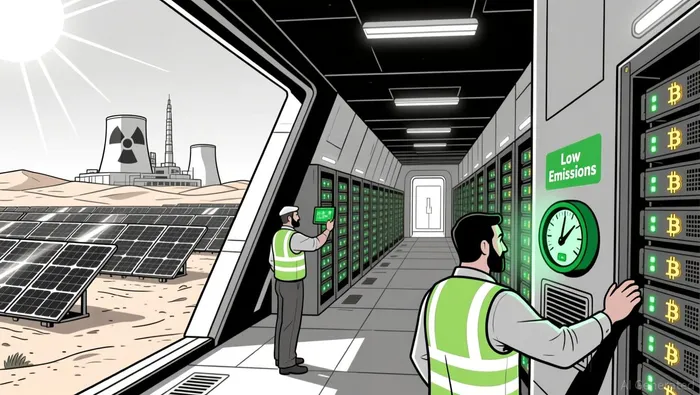
The UAE's competitive advantage in Bitcoin mining stems from its access to low-cost, sustainable energy. The country's Energy Strategy 2050 prioritizes renewable energy, with solar power accounting for a significant share of mining operations. Additionally, some firms have integrated nuclear energy into their mining infrastructure, further enhancing efficiency and environmental credentials. Abu Dhabi, in particular, has become a global hub for industrial-scale mining, combining these energy solutions with government-backed initiatives to reduce operational costs. For instance, NIP Group and Phoenix Group, key players in the UAE's mining sector, emphasize sustainability and scalability, aligning with the nation's broader climate goals.
However, the UAE has also introduced stringent regulations to balance industrial growth with environmental stewardship. A notable example is the ban on cryptocurrency mining on agricultural land, effective September 30, 2025, enforced with heavy penalties for non-compliance. This policy underscores the UAE's commitment to preserving land resources while expanding its digital-asset footprint.
Regulatory Clarity and Institutional Adoption
The UAE's regulatory framework has been instrumental in attracting institutional investors. The Dubai Virtual Asset Regulatory Authority (VARA) and Abu Dhabi Global Market (ADGM) provide clear guidelines for virtual-asset service providers, offering 100% foreign ownership in free zones and streamlined licensing processes. These measures have resulted in the approval of over 70 licensed VASPs by 2025.
Institutional adoption has been further accelerated by the UAE's tax-neutral environment. The absence of personal income or capital gains tax makes it an attractive jurisdiction for digital-asset investment. This, coupled with the Abu Dhabi Investment Council's (ADIC) tripling of Bitcoin ETF investments in Q3 2025, highlights the growing confidence in Bitcoin as a strategic reserve asset. The UAE's alignment with global trends, such as the U.S. Strategic Bitcoin Reserve established in March 2025, also signals a shift in how governments and institutions view Bitcoin's role in diversifying sovereign wealth.
Sovereign Crypto Reserves and Global Standards
The UAE's approach to sovereign crypto reserves is underpinned by its proactive engagement with international standards. By joining the OECD's crypto-asset reporting framework in September 2025, the UAE demonstrated its commitment to transparency and compliance, despite the administrative burdens associated with such frameworks. This move enhances its credibility as a regional leader in cryptoassets and positions it to influence global norms in digital finance.
Moreover, the UAE's exploration of real-world asset tokenization-spanning aviation, real estate, and sovereign bonds-has attracted institutional participation by demonstrating the utility of blockchain technology beyond speculative trading. These initiatives reinforce the UAE's vision of integrating digital assets into its broader economic strategy, creating a self-reinforcing cycle of innovation and investment.
Implications for a Blueprint Model
The UAE's model offers a replicable framework for institutional Bitcoin adoption. Its success hinges on three pillars:
1. Energy Efficiency: Leveraging renewable energy to reduce mining costs and environmental impact.
2. Regulatory Innovation: Establishing clear, business-friendly rules to attract global capital.
3. Institutional Confidence: Aligning with international standards and tax advantages to incentivize large-scale investments.
For other nations, the UAE's experience highlights the importance of harmonizing industrial growth with sustainability goals while providing regulatory certainty. As Bitcoin continues to gain traction as a strategic reserve asset, the UAE's integrated approach-combining mining, regulation, and institutional adoption-sets a precedent for sovereign crypto strategies in the 2020s and beyond.






Comentarios
Aún no hay comentarios