
Tyson Foods: A Tactical Bounce in a Stagnant Structural Landscape
The investment puzzle for Tyson FoodsTSN-- is one of stark contrast. On one side, there is a recent, sharp bounce. On the other, a persistent, grinding lag. This is the setup for a tactical trade, not a fundamental re-rating.
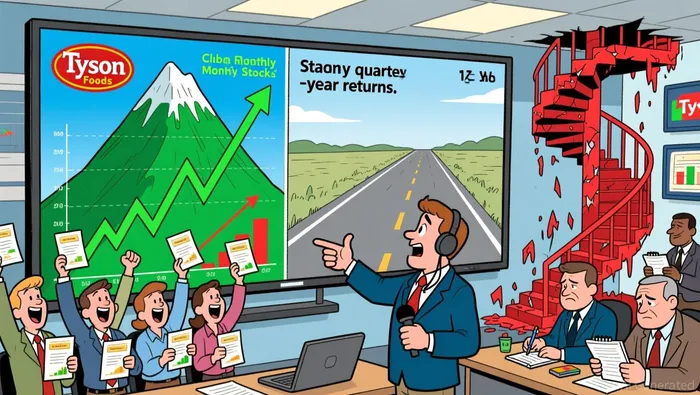
The numbers tell the story. Over the past 12 months, the stock has delivered a return of +7%, a clear underperformance against the S&P 500's +19% growth. More recently, the stock has shown life, with a 10.2% monthly share price return that has only nudged the 1-year total return to a modest 4.4%. This creates the immediate tension: a strong single-month move against a flat year-to-date trajectory.
Zoom out further, and the structural picture becomes clear. The company's trailing 12-month revenue of $54.44 billion is essentially flat compared to three years ago. This isn't a story of scaling or market capture; it's one of holding ground in a competitive, low-margin business. The recent price surge, therefore, looks like a tactical bounce-a reaction to improving quarterly earnings trends and steadier demand across its protein lines-rather than a fundamental re-rating of the entire business.
The core question for investors is sustainability. With the stock still lagging its intrinsic value estimates and trading at a rich multiple, the market appears to be treating these operational improvements as early-stage momentum. The recent outperformance has done little to change the long-term narrative of flat revenue and weak structural profitability. For now, the bounce is real, but it exists against a stagnant structural landscape.
Decoding the Earnings Inflection: Quality of Growth and Profitability
The recent price bounce must be judged against the quality of the underlying earnings trend. The data reveals a story of top-line stagnation and severe profitability pressure, making the sustainability of any improvement highly questionable.
On the surface, the second-quarter revenue decline was minimal, with sales falling by just 0.02% year-over-year. This was indeed better than the industry's -0.88% drop, suggesting TysonTSN-- held its ground in a weak market. Yet, the broader context is one of flat growth. The company's trailing 12-month revenue growth is 1.39%, a figure that masks a sequential decline of -4.03% from the prior quarter. This pattern points to a business struggling to generate volume momentum, not one scaling or gaining share.
The real story, however, is in the bottom line. Here, the pressure has been extreme. The company's income from continuing operations plunged 90.54% year-over-year in the second quarter. This collapse was far worse than the industry's -30.68% drop, indicating Tyson is facing unique or amplified headwinds. The severity of this decline-over 90%-suggests the company is not just facing sector-wide challenges but is also grappling with significant internal cost pressures or margin erosion that are not being offset by volume.
This sets up a stark near-term challenge. Analysts project the company's earnings per share will fall 14.91% year-over-year to $0.97 when it reports in February. This forecast for another quarterly decline underscores the difficulty of translating any top-line stabilization into improved profitability. The market's recent optimism may be betting on a turnaround in this earnings trajectory, but the evidence from the last quarter shows how fragile that path could be.
The bottom line is that the recent stock bounce appears disconnected from the core financial reality. While the company managed a slight revenue hold, it did so at the cost of catastrophic profitability. The upcoming earnings report will be a critical test: can Tyson demonstrate that the worst of the margin pressure is over, or will the projected EPS decline confirm that the structural profitability issues remain unresolved? For now, the quality of the growth story is poor.
Valuation and the Path to Re-rating: Catalysts and Risks
The valuation picture for Tyson Foods is a study in contradictions. On one hand, there is a modest discount to certain fair value estimates. On the other, the stock trades at a rich multiple that prices in perfection. This tension defines the investment case.
The numbers show a gap. A narrative fair value of $62.67 implies a 6.7% undervaluation from the recent close. This upside case is built on expectations for margin improvement, rising earnings, and a conservative future P/E. Yet, this optimistic view sits atop a backdrop of a low-quality business. The company's trailing 12-month revenue of $54.44 billion is essentially flat, and its gross margin has averaged just 7.2% over the last two years. In other words, the market is being asked to look past a fundamentally stagnant, low-margin operation to see a 7% upside. That is a high hurdle.
The primary catalyst for any re-rating is the upcoming February 2026 earnings report. This will be the first major test since the recent tactical bounce. Analysts project a 14.91% year-over-year decline in EPS to $0.97 for the next quarter. The market's patience is thin. The report must deliver clear signs of margin stabilization and demand recovery to shift the narrative from "early-stage momentum" to a sustainable inflection. Any further deterioration in profitability would likely confirm the bearish view of a business with a fixed cost base that cannot adjust to choppy demand.
The key risk is that the market's patience for operational improvements is limited. With the stock already trading at a rich 43.6x P/E-well above both its own historical fair ratio and the broader food industry-the margin for error is minimal. Without a demonstrable path to top-line growth, the stock may remain range-bound despite tactical outperformance. The recent 10% monthly gain has done little to change the long-term trajectory of flat revenue and weak structural profitability. For now, the valuation offers a speculative edge, but it is an edge that depends entirely on the company delivering a turnaround that the evidence from the last quarter suggests is far from guaranteed.





Comentarios
Aún no hay comentarios