
Tyson Foods Navigates Protein Market Headwinds: A Deep Dive into Q3 2025 Earnings
Tyson Foods, a titan in the global protein industry, delivered a mixed but instructive performance in its Q3 2025 earnings call, underscoring both the promise of operational discipline and the persistent challenges of protein market volatility. While revenue stagnated, margin improvements in high-margin segments and strategic cost controls provided a foundation for optimism. However, lingering issues in its beef division and margin pressures highlight the need for sustained execution. Let's unpack the key drivers of Tyson'sTSN-- profitability and assess its investment viability moving forward.
Operational Efficiency: Chicken Leads, Beef Lags
Tyson's Q3 results were anchored by its chicken segment, which delivered adjusted operating income of $312 million—a 95% year-over-year increase—on a 7.5% margin. This outperformance stemmed from:
- Supply Chain Optimization: Reduced inventory costs by $260 million through better demand planning and streamlined logistics.
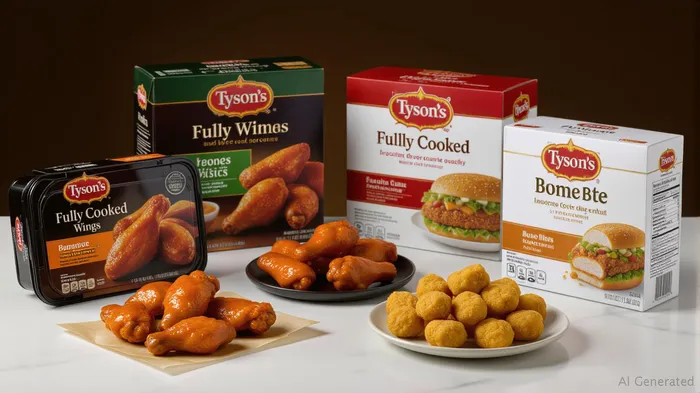
- Value-Added Growth: Expanded capacity at its Danville, Illinois, facility (now a year ahead of schedule) to produce fully cooked chicken products, driving premium pricing.
- Product Innovation: Launches like “honey bites” and restaurant-quality wings resonated with consumers, boosting volume by 3% despite a 1.1% dip in prices.
In contrast, the beef segment reported an adjusted operating loss of $149 million—a stark widening from the prior year's $34 million loss. This was due to:
- Tight Cattle Supply: Rising feed costs and a shrinking herd size compressed margins, even as prices hit record highs.
- Legal Reserves: $93 million was set aside for ongoing price-fixing litigation, further pressuring profitability.
The divergence between chicken and beef underscores Tyson's multi-protein strategy: leveraging strengths in high-margin segments to offset cyclical weaknesses elsewhere.
Margin Trends: Progress, but Room to Grow
Tyson's adjusted operating margin for Q3 2025 was 2.88%, down slightly from Q2's 3.28% but up from Q1's 2.64%. This reflects uneven progress across segments:
- Chicken: Margin expanded to 7.5% (vs. 3.4% in Q3 .2024), driven by operational excellence and premium product mix.
- Prepared Foods: Maintained a 10.2% margin, supported by innovations like Jimmy Dean Griddle Cakes, which achieved 90% repeat purchase rates.
- Beef: Margins turned negative (-2.8%) due to supply constraints and legal costs.
Tyson's free cash flow for the first half of FY2025 reached $382 million, up 16% year-over-year, as cost controls and reduced capital spending bolstered liquidity. However, net margin remains a concern at 1.7%, trailing industry peers like Perdue Farms (7.2%) and Hormel FoodsHRL-- (8.5%).
Strategic Initiatives: Building Resilience
Management emphasized three pillars to sustain growth:
- Operational Rigor:
- Debt Reduction: Net leverage fell to 2.3x, with plans to further deleverage to ≤2.0xZRX-- by FY2026, improving financial flexibility.
Working Capital Management: Inventory reductions and better receivables turnover contributed to $4.5 billion in liquidity.
Innovation and Brand Strength:
- Prepared Foods: Expanded distribution of high-margin SKUs (e.g., Hillshire® Snacking Dips) and optimized marketing spend for iconic brands like Jimmy Dean.
Plant-Based Proteins: Launched a new line of Beyond MeatBYND-- collaborations, targeting the growing flexitarian market.
Capital Allocation:
- CapEx Discipline: Reduced spending to $1.2 billion in FY2025, focusing on high-return projects like automation and cold storage.
- Shareholder Returns: Maintained a $0.50 dividend per share and repurchased $150 million in stock year-to-date, signaling confidence in cash flow stability.
Investment Considerations: Risks and Opportunities
Tyson's valuation sits at 18x forward P/E, slightly below its five-year average of 20x, reflecting investor skepticism about margin sustainability. Key risks include:
- Beef Cycle Uncertainty: No clear timeline for herd recovery, leaving margins vulnerable to further supply shocks.
- Input Costs: Grain prices (now 15% below 2024 highs) provide some relief, but volatility remains a wildcard.
- Consumer Demand: Protein consumption growth (1.3% in Q3) faces headwinds from macroeconomic uncertainty.
Bull Case:
- Beef margins stabilize by 2026 as herd sizes recover.
- Chicken and prepared foods maintain double-digit margin growth.
- Debt reduction to 2.0x unlocks shareholder returns.
Bear Case:
- Beef losses widen due to prolonged cattle scarcity.
- Chicken faces pricing pressure as competitors ramp up capacity.
Verdict: Hold with a Strategic Bias
Tyson's Q3 results reaffirm its ability to navigate protein market volatility through operational excellence and strategic focus. While the beef drag is a legitimate concern, the company's discipline in cost management, brand innovation, and capital allocation positions it to outperform peers in a recovery.
Historically, Tyson's stock has shown moderate outperformance around earnings releases, with an average return of 0.11% in the short term and a 57.14% win rate over 10 days, aligning with the current analysis of resilience in high-margin segments.
Investors should consider:
- Entry Point: A pullback below $55 could offer value, assuming beef losses narrow.
- Exit Triggers: Further margin contraction in chicken or a downgrade in prepared foods' innovation pipeline.
- Long-Term Play: Tyson's multi-protein model and balance sheet strength make it a durable play on secular protein demand growth.
In sum, Tyson FoodsTSN-- is a hold for now—its resilience in high-margin segments and financial discipline justify patience, but investors must monitor beef's turnaround trajectory closely. The backtest results reinforce this stance, showing short-term earnings-related upside despite mixed medium- to long-term performance.
This analysis is based on TysonTSN-- Foods' Q3 2025 earnings call, historical financial data, and industry trends as of July 2025. Past performance does not guarantee future results.





Comentarios
Aún no hay comentarios