
TWT's New Tokenomics Model: Reshaping DeFi Incentives and User Behavior
A New Era for TWT: From Governance to Engagement
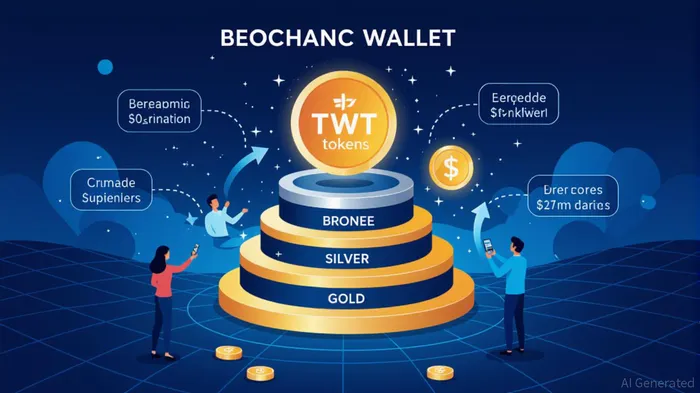
Trust Wallet's reimagining of TWTTWT-- centers on its Trust Premium loyalty program, which transforms the token into a catalyst for user engagement. By introducing a tiered system-Bronze, Silver, and Gold-users earn Trust XPs through activities like swapping, staking, and asset holding. Holding or locking TWT accelerates tier progression, unlocking benefits such as gasGAS-- fee discounts, exclusive airdrops, and early access to features, as reported in CoinEdition's coverage. This shift from governance to utility aligns with broader industry trends, where tokens are increasingly tied to real-world usage rather than speculative voting rights, as noted in Bitget's analysis.
The program's design creates a flywheel effect: the more users engage with Trust Wallet, the more TWT they accumulate or lock, which in turn enhances their rewards. This self-reinforcing cycle not only incentivizes sustained participation but also reduces sell pressure on TWT, as users prioritize long-term value over short-term liquidity, as reported in CoinMarketCap's latest update.
DeFi Incentives: Gamification Meets Utility
TWT's new tokenomics introduces gamified incentives that mirror traditional loyalty programs but with blockchain-native mechanics. For instance, FlexGas-a feature launched in August 2025-allows users to pay transaction fees with TWT, USDT, or USDCUSDC--, expanding the token's utility beyond governance, as reported in CoinMarketCap's latest update. This innovation addresses a critical pain point in DeFi: the friction of using native tokens for gas fees. By enabling TWT to serve as a fee currency on networks like EthereumETH-- and BNBBNB-- Chain, Trust Wallet is embedding the token into everyday user workflows, potentially boosting its demand and scarcity, as reported in CoinMarketCap's latest update.
Moreover, partnerships like the one with OndoONDO-- Finance to tokenize real-world assets (RWAs) further diversify TWT's utility. By integrating TWT into a broader financial ecosystem, Trust Wallet is positioning the token as a bridge between DeFi and traditional finance, a move that could attract institutional and retail investors alike, as reported in CoinMarketCap's latest update.
User Behavior and Adoption: Metrics That Matter
While specific on-chain metrics for TWT post-Trust Premium remain sparse, the program's structure inherently drives measurable behavioral shifts. Users are now incentivized to lock TWT for extended periods, which could stabilize the token's supply and reduce volatility. Additionally, the tiered rewards system encourages frequent, low-cost interactions with the Trust Wallet platform, fostering a habit of continuous engagement, as reported in CoinEdition's coverage.
Expert analysis suggests that Trust Premium's success hinges on its ability to convert passive users into active participants. By tying rewards to on-chain activity, Trust Wallet is creating a feedback loop where user behavior directly impacts token value. This model contrasts with high-yield staking approaches like ZKSync's 10% annual cap, which prioritize short-term returns over ecosystem growth, as noted in Bitget's analysis.
Challenges and Risks
No tokenomics model is without its hurdles. TWT faces headwinds from Binance's recent reduction of its collateral ratio from 60% to 45%, which could dampen leveraged trading volume and institutional demand, as reported in CoinMarketCap's latest update. Additionally, while Trust Premium emphasizes long-term utility, it lacks direct staking APY adjustments, meaning users seeking high yields may look elsewhere. Technical indicators for TWT also show mixed signals, introducing short-term bearish pressures, as reported in CoinMarketCap's latest update.
However, these challenges are not insurmountable. Trust Wallet's focus on real-world utility-through FlexGas, RWAs, and tiered rewards-positions TWT as a stability-oriented token in a market often dominated by speculative frenzies.
Conclusion: A Blueprint for Sustainable Growth
TWT's new tokenomics model exemplifies the future of DeFi: a balance between user-centric incentives and sustainable value creation. By aligning token utility with platform growth, Trust Wallet is fostering a community-driven ecosystem where engagement directly translates to rewards. While challenges persist, the strategic pivot toward gamified, utility-driven incentives offers a compelling blueprint for other blockchain projects. For investors, TWT's evolution underscores the importance of tokens that prioritize long-term adoption over short-term hype-a principle that could redefine the DeFi landscape in 2025 and beyond.






Comentarios
Aún no hay comentarios