
Twilio's Profitability Breakthrough: Can Margin Expansion Outpace Revenue Slowdown?
Strategic Cost Optimization: A Foundation for Profitability
Twilio's cost-optimization initiatives have been pivotal. General and administrative (G&A) expenses fell to $70.9 million, or 5.5% of revenue, from 6.6% in the prior year, while research and development (R&D) spending dropped to 13.4% of revenue from 15.4% (per the Zacks report). These reductions, coupled with a 28.6% year-over-year increase in non-GAAP operating income (noted in the Zacks report), highlight a shift from growth-at-all-costs to operational efficiency. Such measures are critical in an industry where competitors like Pegasystems Inc (PEGA) report cloud margins nearing 80% in Pegasystems' Q3 highlights, underscoring the pressure to scale efficiently.
Strategic Repositioning: Beyond Cost Cutting
Twilio's CEO, Khozema Shipchandler, has spearheaded a broader repositioning. The company has consolidated underperforming units, such as the Segment data platform, while doubling down on AI-driven customer engagement tools in a TS2 analysis. This pivot is paying off: AI voice customers grew by 60% year-over-year (reported in the TS2 analysis), reflecting a shift toward higher-margin offerings. Additionally, Twilio's focus on pricing optimization and product mix has stabilized gross margins, despite a 280-basis-point decline in Q3 2025 due to carrier fees in the earnings call transcript.
Industry Benchmarks: A Mixed Picture
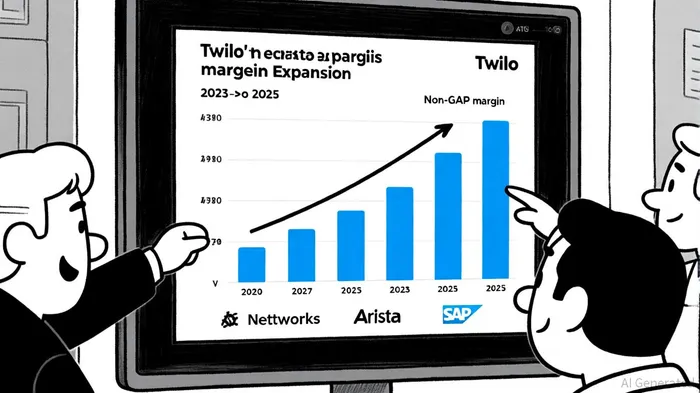
The cloud communications sector is witnessing divergent margin trends. While Arista Networks (ANET) projects a 48% operating margin for 2025 (see the ANET analysis referenced above), and SAP's cloud business achieved a 28.3% non-IFRS margin in Q3 2025 (as noted in the SAP piece above), Twilio's 18% margin lags. However, Twilio's margin expansion-190 basis points year-over-year-is robust compared to the sector's average. For context, SAP's margin improved by 1.8 percentage points YoY (per the SAP Q3 coverage), and Amazon's AWS grew revenue by 20.2% YoY, though its margins remain undisclosed. Twilio's progress suggests it is catching up, but sustainability will depend on its ability to replicate the success of companies like Pegasystems, which leveraged cloud scalability to achieve near-80% margins (see Pegasystems' Q3 highlights above).
Can Margin Expansion Outpace Revenue Slowdown?
Twilio's recent guidance-raising full-year 2025 non-GAAP operating income to $900–$910 million from $850–$875 million (noted in the earnings call transcript above)-indicates confidence in its model. Yet, the company faces headwinds. Bandwidth, another cloud communications player, reported a -1% operating margin in Q3 2025 in a Yahoo Finance deep dive, illustrating the sector's challenges. Twilio's reliance on AI-driven product mix and pricing discipline will be key. If it can replicate the success of SAP's Cloud ERP suite-where higher-margin offerings drove 31% growth (as covered in the SAP piece above)-Twilio may yet outperform. However, risks persist, including carrier fee volatility and competitive pricing pressures (discussed in the earnings call transcript).
Conclusion
Twilio's profitability breakthrough is a testament to its strategic pivot from growth to efficiency. While its margin expansion of 190 basis points is impressive, the company must continue innovating in AI and optimizing pricing to close the gap with industry leaders. For investors, the critical question is whether Twilio can maintain this momentum as revenue growth stabilizes-a challenge that will define its long-term success in a fiercely competitive sector.







Comentarios
Aún no hay comentarios