
Tvardi Therapeutics' Revert Trial: A Pivotal Moment for IPF Innovation and Market Potential
The recent Phase 2 Revert trial of Tvardi Therapeutics' TTI-101 in idiopathic pulmonary fibrosis (IPF) has sparked critical discussions about the future of antifibrotic therapies and the company's strategic positioning in a rapidly evolving market. While the trial did not meet its primary endpoints, the broader implications for IPF treatment paradigms and Tvardi's long-term value proposition warrant a nuanced analysis.
Trial Design and Outcomes: A Mixed Bag of Signals
The Revert trial was designed as a randomized, double-blind, placebo-controlled study evaluating TTI-101, a STAT3 inhibitor, in 88 patients with IPF. Participants were stratified into three groups: TTI-101 400mg/day, TTI-101 800mg/day, and placebo, with 58% of patients also receiving nintedanib (OFEV®), according to Tvardi's press release. The primary endpoints focused on safety, pharmacokinetics, and exploratory lung function metrics, particularly changes in Forced Vital Capacity (FVC).
Preliminary data revealed no statistically significant differences in FVC improvements between treatment and placebo groups, with the placebo cohort showing an unexpectedly lower decline in FVC compared to historical controls, according to Tvardi's enrollment announcement. Discontinuation rates were alarmingly high in the TTI-101 arms (56.7% for 400mg and 62.1% for 800mg) versus 10.3% in the placebo group, driven largely by gastrointestinal adverse events, especially in patients on concomitant nintedanib, according to a FinancialContent article. These findings underscore the challenges of balancing efficacy and tolerability in IPF therapies.
Market Context and Competitive Positioning
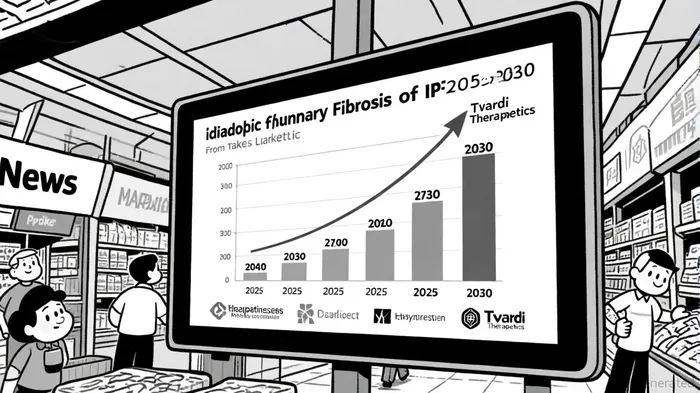
The IPF market, valued at $4.39 billion in 2025 and projected to grow at a compound annual rate of 6.84% through 2030, according to Mordor Intelligence, is driven by aging populations and advancements in antifibrotic therapies. Pirfenidone and nintedanib currently dominate the market, but their limitations-such as side effects and inability to reverse fibrosis-create a significant unmet need. Tvardi's focus on STAT3 inhibition represents a novel mechanism targeting the root drivers of fibrosis, differentiating it from competitors like Boehringer Ingelheim and Bristol-Myers Squibb, which are advancing PDE4B and LPA1 modulators, according to Straits Research.
Despite the Revert trial's shortcomings, Tvardi's pipeline remains a key differentiator. The company is advancing TTI-109, a next-generation STAT3 inhibitor, into clinical trials and plans to report data from a Phase 2 hepatocellular carcinoma trial in early 2026, as detailed in the press release. This dual-track strategy-leveraging TTI-101's lessons while pivoting to TTI-109-positions Tvardi to address IPF's complexities with a more refined therapeutic approach.
Investor Sentiment and Financial Resilience
The market's reaction to the Revert trial was swift and severe, with Tvardi's stock plummeting 30% following the announcement, per Investing.com. Analysts have since tempered their expectations, with some maintaining a "Strong Buy" rating based on the company's long-term pipeline and financial runway. As of June 2025, Tvardi reported $41.0 million in cash, sufficient to fund operations through Q4 2026, according to the company's Q2 2025 results. This financial cushion, combined with its focus on regenerative medicine and STAT3 inhibition, provides a buffer against short-term setbacks.
However, investor confidence hinges on Tvardi's ability to address the Revert trial's limitations. For instance, the high discontinuation rates in the TTI-101 arms highlight the need for improved drug formulations or combination strategies to mitigate gastrointestinal toxicity. Tvardi's upcoming trials in hepatocellular carcinoma and its healthy volunteer study for TTI-109 will be critical in demonstrating the platform's versatility and safety profile, as noted in the company's press update.
Redefining IPF Treatment: Opportunities and Risks
The Revert trial's mixed results underscore the inherent risks of targeting fibrotic pathways but also highlight the potential for breakthroughs. If TTI-109 or future iterations of TTI-101 can overcome tolerability issues and demonstrate meaningful FVC improvements, Tvardi could redefine IPF treatment by offering a therapy that not only slows disease progression but also reverses fibrosis-a paradigm shift in a market dominated by maintenance therapies.
Moreover, the IPF market's growth trajectory, fueled by advancements in diagnostics and regenerative medicine, offers Tvardi a window to capture market share. While competitors like FibroGen and United Therapeutics are also exploring cell-based therapies, Tvardi's STAT3-focused approach aligns with the industry's shift toward mechanistic precision, according to Grand View Research.
Conclusion: A Calculated Bet on Innovation
Tvardi Therapeutics' Revert trial may not have delivered the immediate success its investors hoped for, but it has laid the groundwork for a more refined approach to IPF treatment. The company's commitment to STAT3 inhibition, coupled with its financial resilience and strategic pipeline diversification, positions it as a long-term contender in a market ripe for disruption. While the path ahead is fraught with challenges, the potential to unlock significant value-both in terms of patient outcomes and market capitalization-remains compelling for investors willing to bet on innovation.





Comentarios
Aún no hay comentarios