
Turtle Beach's Strategic Positioning in the Resurgent Gaming Hardware Market: A Cyclical Rebound Analysis
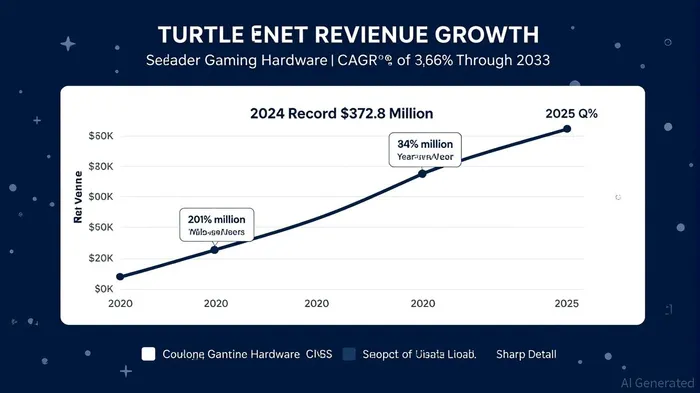
The global gaming hardware market is undergoing a transformative recovery post-pandemic, driven by technological leaps in 4K resolution, ray tracing, and virtual reality (VR) integration. According to a report by BusinessResearchInsights, the market is projected to grow at a compound annual growth rate (CAGR) of 3.6%, expanding from USD 0.14 billion in 2024 to USD 0.2 billion by 2033[1]. Amid this backdrop, Turtle Beach CorporationTBCH-- (TBCH) has positioned itself as a compelling case study in strategic reinvention, leveraging acquisitions, product diversification, and operational efficiency to capitalize on the sector's resurgence.
Strategic Expansion and Product Diversification
Turtle Beach's 2024 acquisition of Performance Designed Products (PDP) for $118 million marked a pivotal shift in its business model. By integrating PDP's high-quality controllers and accessories, the company diversified its revenue streams beyond its core gaming headset business[2]. This move not only expanded Turtle Beach's product portfolio but also unlocked $13 million in annual cost synergies, contributing to a 47% year-over-year revenue surge in Q4 2024, with net income jumping to $20.1 million[5]. The acquisition also enabled Turtle BeachTBCH-- to tap into the $3.0 billion controllers market and the $3.9 billion PC peripherals segment[4], aligning with broader industry trends toward cross-platform gaming and immersive experiences.
The company's product innovation has further solidified its market position. New offerings such as the Airlite Fit for Nintendo Switch 2 and the Victrix Pro BFG Reloaded Modular Controller reflect a focus on niche markets and premium features[4]. These launches mirror the industry's shift toward 4K gaming and haptic feedback systems, as highlighted in a 2025 analysis by TechRadar[3].
Financial Resilience and Operational Efficiency
Turtle Beach's financial performance underscores its ability to navigate cyclical volatility. In 2024, the company reported record net revenue of $372.8 million, a 44% increase from 2023, alongside a 156% rise in adjusted EBITDA to $35.7 million[5]. For 2025, despite a Q2 revenue dip to $56.8 million (compared to $76.5 million in Q2 2024), gross margins expanded to 32%, and the company reaffirmed its full-year guidance of $340–360 million in revenue and $47–53 million in adjusted EBITDA[4]. These figures contrast with its 2020 performance, when the pandemic-driven surge in gaming accessory demand propelled revenue to $360.1 million—a 53% increase from 2019[2].
The company's capital structure has also improved markedly. Debt refinancing in 2025 reduced its cost of capital by 450 basis points, while a $30 million share repurchase program signaled management's confidence in undervaluation[4]. These steps echo historical strategies, such as the 2019 acquisition of ROCCAT, which expanded Turtle Beach's PC accessories footprint and delivered $30 million in 2020 revenues[2].
Cyclical Rebound Potential and Market Challenges
While Turtle Beach's strategic moves align with the gaming hardware market's growth trajectory, challenges persist. The company's Q2 2025 results revealed a 28% decline in January gaming accessory sales year-over-year, attributed to international tariffs and supply chain bottlenecks[5]. Additionally, its market share in the Technology sector remains modest—0.04% as of Q2 2025—compared to industry giants like AppleAAPL-- and HP[4]. However, the global gaming accessories market is projected to grow at a 9.3% CAGR through 2032, reaching $15.7 billion[3], offering ample room for Turtle Beach to scale.
Historically, Turtle Beach has demonstrated resilience during market downturns. For instance, its stock surged 128% in 2020 amid pandemic-driven demand, despite sharp declines in 2014–2015[6]. This pattern suggests a cyclical business model that could benefit from the current recovery, particularly as VR adoption and cloud gaming reduce latency barriers[3].
Conclusion: A Calculated Bet on Gaming's Future
Turtle Beach's strategic acquisitions, product diversification, and financial discipline position it to capitalize on the gaming hardware market's long-term growth. While near-term headwinds like supply chain disruptions and competitive pressures exist, the company's historical ability to adapt—exemplified by its ROCCAT and PDP integrations—bolsters its cyclical rebound potential. With a 10%+ CAGR revenue target and gross margins in the mid-to-high 30s[5], Turtle Beach appears well-positioned to outperform as the sector matures. Investors, however, should monitor its Q2 2025 guidance and the broader market's response to emerging technologies like AI-driven NPCs and Wi-Fi 7 connectivity[3].





Comentarios
Aún no hay comentarios