
How to Turn Home Depot's Negative Outlook into a Profit Opportunity
The U.S. housing market's stagnation has cast a shadow over Home DepotHD-- (HD), with high mortgage rates and tepid demand weighing on near-term performance. Yet, beneath the surface, this retail giant remains a fortress of financial resilience, offering a compelling risk-reward proposition for contrarian investors. Here's why now could be the perfect time to buy—and how to position for a housing rebound.
The Cyclical Slowdown: A Buying Opportunity in Disguise
Home Depot's recent struggles are no secret. Elevated mortgage rates (currently ~6.8%) have crimped demand for large-scale home projects, while housing starts remain near decade lows. The company's Q1 2025 results reflected this reality, with net profit dipping 32% year-over-year to $3.43 billion. Yet, these headwinds are cyclical, not structural.
Why this is temporary:
- Housing Market Bottoming: Management estimates turnover has hit a floor at 3% of units, but stagnant rates and rising inventories could soon spark price corrections, making homes more affordable.
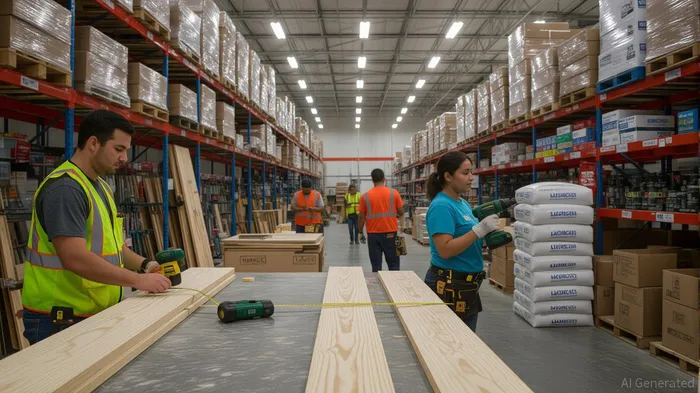
- Pro Business Dominance: While residential construction lags, professional contractors—accounting for ~50% of Home Depot's revenue—remain active. The $5.5B acquisition of GMSGMS-- Distribution (finalized Q2 2025) bolsters this segment, giving HD unmatched logistics and inventory for roofing, landscaping, and other trades.
Dividend Resilience: A Steady Income Stream in a Volatile Market
Home Depot's dividend history is legendary. For 11 consecutive years, the company has raised its payout, with a current yield of 1.7%—modest but reliable. This stability is critical in today's environment:
- Fortress Balance Sheet:
- Debt-to-Equity Ratio: 0.25, far below peers like Lowe's (0.67).
Free Cash Flow: Steadily over $10B annually, even during downturns.
Dividend Safety:
The payout ratio (dividends/earnings) is ~30%, leaving ample room to grow even if earnings dip further.
Compare this to rivals like WalmartWMT--, which recently announced price hikes due to tariff pressures. Home Depot's domestic supply chain (50% of products sourced locally) insulates it from similar shocks, ensuring dividend sustainability.
Valuation: A Rare Bargain in a High-Growth Economy
At 19x forward earnings (vs. a five-year average of 22x), Home Depot's valuation is deeply discounted. This creates an asymmetric bet:
- Upside Catalysts:
- A housing recovery (even a modest 1% rise in starts could boost sales).
Share repurchases: $10B allocated this year to buy back shares at depressed prices.
Downside Protection:
The dividend provides a 1.7% yield, cushioning against further stock declines.
Historically, HD's stock bounces when mortgage rates retreat—a scenario increasingly likely if the Fed pauses rate hikes later this year.
The Contrarian Play: Buy Dips, Wait for the Turn
The key to success here is patience. Here's how to execute:
Average Into Positions:
Use dips below $300 (a key support level) to build a position. Avoid chasing rallies above $380 resistance until momentum confirms a trend reversal.Focus on the Pro Segment:
The GMS acquisition is a game-changer. Track its integration success—strong Pro sales growth could be an early signal of recovery.Hedge with the Dividend:
Reinvest dividends to compound gains while waiting for the housing market to rebound.
Conclusion: A Rare "Buy" in a Slowing Market
Home Depot's current struggles are a gift for long-term investors. Its dividend stability, fortress balance sheet, and strategic moves (like GMS) position it to thrive when housing demand rebounds. At today's prices, the risk-reward is skewed heavily toward reward: a potential 50% upside over two years if rates ease and starts stabilize.
Action Items:
- Buy Now: For income and capital appreciation.
- Hold Through the Cycle: Treat this as a core holding, not a trade.
As the saying goes: "Buy when others are fearful." Home Depot's current undervaluation and dividend strength make it a prime candidate for just that.
Investment Thesis Summary:
- Upside: $460 (if housing recovers and P/E expands to historical norms).
- Downside: $250 (a worst-case scenario of prolonged stagnation).
- Risk-Adjusted Return: A 20% yield over 18 months via dividends + price appreciation.
The time to act is now—before the recovery begins.





Comentarios
Aún no hay comentarios