
Turkmenistan's Strategic Shift in Crypto Regulation and Its Investment Implications
In a rare and calculated move, Turkmenistan has embarked on a transformative journey to integrate cryptocurrency into its state-controlled economic framework. Effective January 1, 2026, the Central Asian nation-long known for its isolation and gas-dependent economy-legalized cryptocurrency mining and exchanges under the Law on Virtual Assets, signed by President Serdar Berdimuhamedov on November 28, 2025. This regulatory overhaul, while maintaining strict state oversight, signals a strategic pivot toward leveraging digital assets to diversify its economy and attract foreign investment. For investors, the shift raises critical questions about the interplay between Turkmenistan's energy resources, geopolitical positioning, and the potential of a tightly regulated crypto market.
A State-Driven Crypto Framework: Balancing Control and Innovation
Turkmenistan's new legal framework classifies cryptocurrencies as "digital property" but explicitly excludes them from legal tender status. The Central Bank of Turkmenistan now oversees a licensing system for mining operations and exchanges, ensuring that all activities align with anti-money laundering (AML) protocols and state-defined technical standards. While this approach mirrors global regulatory trends, it diverges sharply in its emphasis on surveillance and control. For instance, the government has established a state commission to monitor digital asset activities, prioritizing data security and compliance over privacy.
This model reflects Turkmenistan's broader economic strategy: modernization without relinquishing political authority. By legalizing crypto, the country aims to attract foreign expertise and capital while maintaining a monopoly over critical infrastructure, including internet access and energy distribution. According to a report by Al Jazeera, the reforms are part of a broader agenda to introduce electronic visas and streamline bureaucratic processes, signaling a cautious openness to external engagement.
Energy Abundance and the Geopolitical Calculus
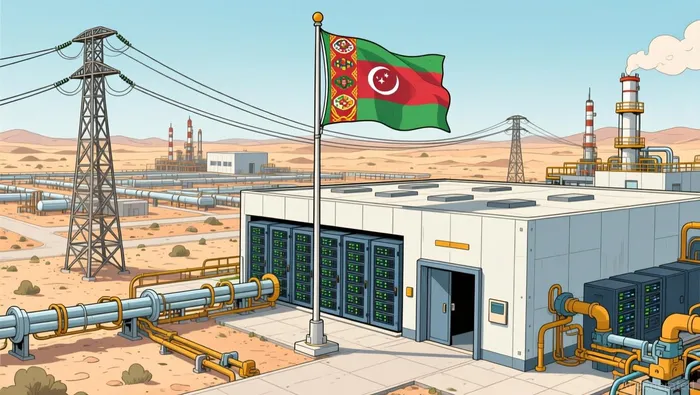 Turkmenistan's decision to pivot toward crypto is inextricably linked to its energy surplus. The country possesses the world's fourth-largest natural gas reserves, yet it has historically struggled to monetize its excess capacity due to limited export infrastructure and geopolitical constraints. Cryptocurrency mining, which requires vast amounts of electricity, offers a novel solution. By channeling surplus energy into mining operations, Turkmenistan can reduce waste and generate revenue without relying on volatile gas prices.
This energy-driven strategy also aligns with regional dynamics. As Central Asian neighbors like Kazakhstan and Uzbekistan explore crypto-friendly policies, Turkmenistan's state-controlled approach positions it as a key player in Eurasia's emerging digital economy. However, the country's reliance on Russia for energy transit and its historical aversion to foreign ownership of critical assets complicate its geopolitical calculus. The government's insistence on maintaining control over blockchain networks-allowing only permissioned systems-suggests a desire to avoid the decentralization risks associated with open markets.
Investment Implications: Opportunities and Constraints
For investors, Turkmenistan's crypto market presents a paradox: a high-growth potential market constrained by stringent regulations. The country's access to cheap, abundant energy could make it a competitive hub for mining, particularly as global energy costs rise. However, the requirement for all operators to obtain licenses from the Central Bank and adhere to strict KYC/AML rules may deter private-sector participation.
Foreign investors must also navigate Turkmenistan's tightly controlled internet and limited access to international financial systems. While the government has introduced electronic visas to attract technical expertise, the absence of legal tender status for crypto limits its immediate economic impact. As noted by Yahoo Finance, the law prohibits financial institutions from engaging in crypto services, further narrowing the scope for innovation.
That said, the regulatory framework's alignment with global trends-such as the classification of "backed" and "unbacked" tokens-suggests Turkmenistan is not entirely disconnected from international markets. For state-aligned investors or those willing to navigate bureaucratic hurdles, the country's strategic location and energy resources could offer long-term value.
Conclusion: A Calculated Gamble in a Controlled Environment
Turkmenistan's foray into crypto regulation is a calculated gamble, blending energy-driven pragmatism with geopolitical caution. While the state-controlled model limits immediate scalability, it creates a unique opportunity for investors who can align with the government's priorities. The success of this strategy will depend on Turkmenistan's ability to balance innovation with control-a challenge that mirrors the broader tensions between economic modernization and political sovereignty in the region.
For now, the market remains a high-risk, high-reward proposition. Investors must weigh the allure of Turkmenistan's energy-driven crypto ecosystem against the realities of a tightly regulated, state-centric environment.







Comentarios
Aún no hay comentarios