
Turkish Airlines' Passenger Growth and Load Factor Momentum as a Strategic Indicator for Airline Recovery
In the post-pandemic aviation landscape, few airlines have demonstrated the resilience and strategic foresight of Turkish Airlines. As global carriers grapple with fluctuating demand and operational headwinds, Turkish Airlines has emerged as a case study in recovery, leveraging its Istanbul hub to dominate regional markets while signaling long-term profitability through robust passenger growth and load factor performance.
Passenger Growth: A Barometer of Operational Resilience
According to Aviation Business ME, Turkish Airlines carried 83.4 million passengers in 2023, a 16.1% increase from 2022, with domestic traffic surging 19.1% to 30.4 million and international traffic rising 14.4% to 53 million (Turkish Airlines registers 83.4 million passengers in 2023). This momentum continued into 2024, with total passengers reaching 85.2 million-a 2.1% year-on-year increase-and 12.8% growth in August 2025 alone, as noted by AviaExchange (Turkish Airlines: Slight growth in 2024 and ambitious targets for ...). By January 2025, the airline had already transported 6.77 million passengers, an 8.2% rise compared to the prior year, per Aviation Outlook (Turkish Airlines - Strategic Analysis and Outlook (2025)). These figures underscore a consistent ability to capitalize on both domestic and international demand, even as global carriers face capacity constraints.
Load Factor Momentum: Efficiency as a Competitive Edge
Turkish Airlines' load factor-a critical metric for airline profitability-has also shown remarkable strength. In 2023, the airline's load factor improved to 82.6%, with domestic routes achieving 84.3% and international routes 82.4%, as Aviation Business ME reported. By July 2025, the load factor had climbed to 85.4%, a trend noted by Aviation Outlook and reflecting operational efficiency and pricing discipline. For the first five months of 2025, the overall occupancy rate stood at 81.2%, with domestic flights hitting 86%, Turkiye Today reported (Turkish Airlines carries 34M passengers in first 5 ...). Such performance is particularly notable given the challenges faced by peers, including fuel volatility and labor costs.
Financial Health and Strategic Diversification
Financially, Turkish Airlines has transformed its balance sheet. Revenue in 2024 reached $22.7 billion, with a 4% increase in passenger revenue and a 35% surge in cargo operations, which now contribute $3.5 billion annually and position Turkish Cargo as the world's third-largest air freight carrier, according to Aviation Outlook. Debt reduction from $14 billion in 2020 to $5.7 billion by 2025, coupled with a Fitch credit rating upgrade in February 2025, further solidifies its financial credibility, as Aviation Outlook also notes.
Strategically, the airline has diversified its offerings. The launch of AJet, its low-cost subsidiary in 2025, enables the group to compete in price-sensitive markets while the mainline carrier focuses on premium traffic. Meanwhile, fleet expansion-from 492 aircraft in 2024 to a planned 530 in 2025-supports its ambition to reach 170 million annual passengers by 2033, as reported by AviaExchange.
Regional Dominance and Long-Term Outlook
Turkish Airlines' Istanbul hub, connecting 352 destinations across 131 countries, remains a linchpin of its strategy. The airline's Available Seat Kilometers (ASK) grew 8.2% in January 2025, reflecting capacity expansion aligned with demand, Aviation Outlook observed. New routes to Minneapolis, Seville, and Africa, alongside its 7.8% compound annual growth rate target through 2033, position it to outpace the global aviation industry's average of 4.8%, per Aviation Outlook.
Conclusion: A Model for Post-Pandemic Recovery
Turkish Airlines' trajectory exemplifies how strategic infrastructure, operational efficiency, and financial discipline can drive long-term profitability. Its passenger growth and load factor momentum are not mere short-term gains but indicators of a well-calibrated recovery plan. For investors, the airline's ability to balance expansion with debt reduction, while diversifying into cargo and low-cost operations, offers a compelling case for sustained regional dominance and global relevance.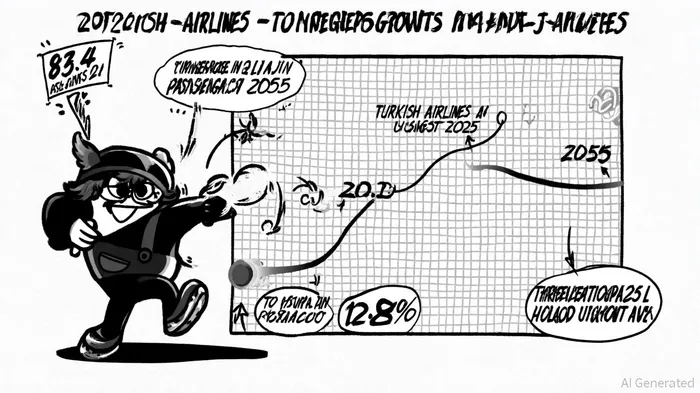







Comentarios
Aún no hay comentarios