
Turkey's Strategic Debt Restructuring: Assessing the Impact of Its 10-Year Dollar Bond Switch on Sovereign Credit and Investor Returns
In the volatile landscape of emerging market debt, Turkey’s 2025 sovereign bond strategy has emerged as a case study in balancing innovation, credit risk, and investor appetite. The country’s recent foray into blockchain-based bond issuance, coupled with a surge in dollar-denominated debt sales, underscores a strategic pivot toward modernizing its capital markets while navigating macroeconomic headwinds. However, the interplay between political instability, inflationary pressures, and divergent credit ratings raises critical questions about the sustainability of this approach for both sovereign credit and investor returns.
Digital Innovation and Sovereign Liability Management
Turkey’s June 2025 issuance of a $100 million digital bond by Türkiye İş Bankası marked a watershed moment in emerging market finance. Utilizing blockchain technology via Euroclear’s D-FMI platform, the bond was priced and settled on the same day, demonstrating the efficiency of distributed ledger technology (DLT) in reducing transaction times and enhancing transparency [4]. This innovation not only positions Turkey as a pioneer in digital finance but also signals a broader effort to attract institutional investors seeking technologically advanced markets. The proceeds, earmarked for post-earthquake recovery, further align with ESG (Environmental, Social, Governance) investment trends, potentially broadening the investor base.
However, the digital bond’s success must be contextualized within Turkey’s broader debt management strategy. The country’s Wealth Fund has simultaneously pursued traditional avenues, including a $1 billion bond sale in March 2025 that attracted $10 billion in orders despite a 51.00% yield spike triggered by political turmoil [1]. This duality—leveraging cutting-edge technology while maintaining conventional issuance—reflects a calculated effort to diversify funding sources and mitigate risks associated with overreliance on any single market segment.
Credit Rating Divergence: A Double-Edged Sword
The credit rating landscape for Turkey remains fragmented. S&P Global Ratings upgraded the country’s long-term sovereign rating to 'BB-' in November 2024, citing reserve accumulation and economic rebalancing [1]. This upgrade, while positive, is tempered by Scope Ratings’ persistent 'B-' rating with a Negative Outlook, which highlights vulnerabilities in policy normalization and balance-of-payments stability [2]. Such divergence creates ambiguity for investors, who must weigh the credibility of these assessments against real-time macroeconomic indicators.
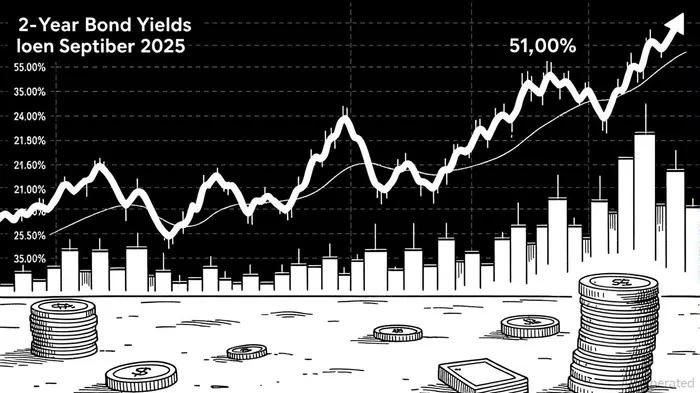
The March 2025 political shock—when Istanbul Mayor Ekrem İmamoğlu’s detention drove the 2-year bond yield to 51.00%—exemplifies the fragility of Turkey’s credit profile. While the Wealth Fund’s subsequent bond sale at 7.75% for 10-year debt demonstrated investor resilience, the real yield (adjusted for inflation) remained near 1.0%, eroding the perceived value of returns [4]. This dynamic underscores a critical risk-reward trade-off: high nominal yields may attract capital, but inflation and political uncertainty significantly dilute their utility.
Market Reactions and the September 2025 Issuance
Turkey’s September 2025 bond plans, including a $500 million dollar-denominated issuance by the Wealth Fund, are being closely watched as a litmus test for investor confidence. The fund’s prior sukuk issuance, trading at 105 cents on the dollar as of late August, suggests a degree of market acceptance for its debt [3]. However, the planned issuance coincides with a broader surge in emerging market debt, with year-to-date issuance nearing $511 billion—the largest since 2021 [3]. This competition for investor attention could pressure Turkey to offer higher yields, further straining its fiscal sustainability.
The Turkish Treasury’s parallel mandate for a 10-year dollar bond, though details remain undisclosed, signals a coordinated effort to stabilize the sovereign’s debt profile. Yet, the success of these initiatives hinges on the government’s ability to address structural challenges, including inflation (which remains stubbornly high) and external vulnerabilities. As noted by Scope Ratings, the risk of financial crises looms large, particularly if policy normalization falters [2].
Risk-Reward Dynamics for Investors
For investors, Turkey’s 2025 bond market presents a paradox. On one hand, the country’s aggressive use of digital finance and strong demand for its debt (e.g., the March 2025 $10 billion order book) suggest a compelling risk-on narrative. On the other, the real returns on these investments are minimal, and political volatility remains a wildcard. The Wealth Fund’s sukuk issuance and murabaha financing further complicate the picture, as Islamic-compliant instruments may appeal to niche markets but lack the liquidity of conventional bonds [3].
A would provide clarity on how market conditions have evolved. Such data could reveal whether investor appetite has stabilized or if yields must rise further to compensate for heightened risks.
Conclusion
Turkey’s strategic debt restructuring in 2025 reflects a blend of innovation and pragmatism. The digital bond issuance and robust demand for dollar debt highlight the country’s potential to attract capital, even amid political and economic turbulence. However, the divergent credit ratings and inflation-adjusted returns underscore the fragility of this strategy. For sovereign credit, the key challenge lies in maintaining policy credibility and fiscal discipline. For investors, the lesson is clear: while high yields may be tempting, the true reward depends on navigating a landscape where technological progress and political instability coexist.
Source:
[1] Turkiye Upgraded To 'BB-' On Reserve Accumulation, [https://www.spglobal.com/ratings/en/regulatory/article/-/view/type/HTML/id/3278665]
[2] Scope affirms Türkiye's long-term foreign-currency ratings at B, [https://scoperatings.com/ratings-and-research/rating/EN/176107]
[3] Turkey's Wealth Fund Plans to Sell Dollar Bond In September, [https://www.bloomberg.com/news/articles/2025-08-26/turkey-s-wealth-fund-plans-to-sell-dollar-bond-in-september]
[4] Tracker of New FinTech Applications in Bond Markets » ICMA, [https://www.icmagroup.org/fintech-and-digitalisation/fintech-resources/tracker-of-new-fintech-applications-in-bond-markets/]







Comentarios
Aún no hay comentarios