
Turkey's Inflation Slowdown and Implications for Central Bank Policy in December
The evolving inflationary landscape in Turkey has become a focal point for global investors, particularly as the Central Bank of the Republic of Turkey (CBRT) navigates a delicate balance between stabilizing price pressures and managing economic growth. With annual inflation reported at 32.87% in October 2025 and projected to ease to 32.5% by year-end, the CBRT faces mounting pressure to recalibrate its monetary policy. This analysis examines the CBRT's potential rate-cut trajectory in December and its broader implications for emerging market (EM) investor sentiment, capital flows, and risk appetite.
A Cautious Disinflation Path
Turkey's inflation trajectory has shown signs of moderation, albeit at a slower pace than anticipated. According to a report by ING Think, the CBRT revised its 2025 inflation forecast to a range of 31-33% (midpoint 32%), reflecting a more cautious stance amid persistent price pressures in food and services sectors. While the annual inflation rate has declined from its peak, the CBRT's interim target of 24% for 2025 remains out of reach. This gap underscores the central bank's dilemma: aggressive rate cuts could reignite inflationary expectations, while overly tight policy risks stifling economic recovery.
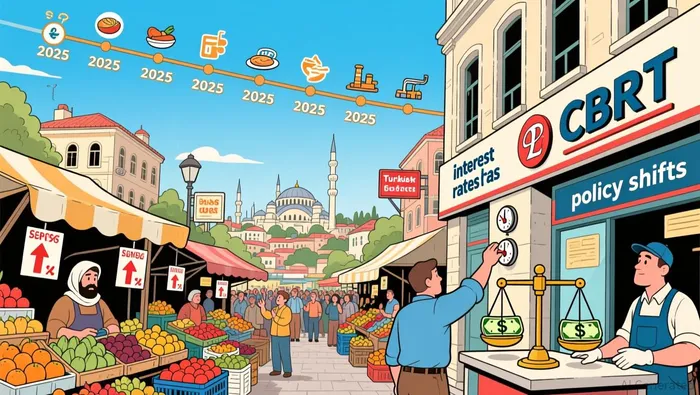 The CBRT's October 2025 decision to reduce the policy rate by 100 basis points to 39.5% signaled a shift toward gradual easing, with Governor Fatih Karahan emphasizing that future adjustments will hinge on inflation data and global uncertainties. A further 100-basis-point cut in December is widely anticipated, bringing the policy rate to 38.5% by year-end. However, this easing is tempered by the CBRT's acknowledgment of structural challenges, including demographic risks and mixed GDP growth signals.
Investor Sentiment and Capital Flows
The CBRT's rate-cut trajectory has had a discernible impact on investor sentiment. In the recent quarter, supportive inflation signals-such as a 1.19% monthly rise in the Istanbul Chamber of Commerce (ITO) inflation index-have bolstered risk appetite in Turkish markets. The BIST 100 index surged 2% in November 2025, while the Turkish lira strengthened modestly against the U.S. dollar according to State Department reports. These developments reflect improved confidence in the CBRT's ability to manage inflation without triggering a liquidity crisis.
However, the broader EM context complicates this optimism. While Turkey's monetary easing has attracted carry-trade flows, concerns about inflation persistence and political volatility linger. As noted by S&P Global, Turkish banks are poised to benefit from wider margins if the easing continues, but external risks-such as global risk appetite shifts-remain a wildcard. For EM investors, Turkey's policy trajectory serves as a barometer of central bank credibility in managing inflationary shocks, with implications for capital flows across the region.
December Policy Outlook and Strategic Implications
The CBRT's December 2025 meeting will be pivotal in shaping investor perceptions. A 100-basis-point rate cut, as widely expected, would align with the central bank's stated focus on gradual disinflation. Yet, Governor Karahan's recent remarks-highlighting potential tightening if inflation deviates from targets-underscore the CBRT's commitment to a data-dependent approach. This duality creates a nuanced environment for investors: while rate cuts may support asset valuations, any deviation from disinflation trends could trigger capital outflows.
For EM investors, Turkey's experience offers a cautionary tale about the interplay between monetary policy and market confidence. The CBRT's ability to balance inflation control with growth support will influence not only Turkey's economic trajectory but also the risk-return profiles of other EM assets. As global investors monitor Turkey's December policy decision, they must weigh the short-term benefits of rate cuts against the long-term risks of inflationary reacceleration.
Conclusion
Turkey's inflation slowdown and the CBRT's December rate-cut trajectory highlight the complexities of managing economic stability in a high-inflation environment. While the central bank's cautious approach has bolstered investor sentiment in the short term, the path to its 2025 inflation target remains fraught with challenges. For emerging market investors, the key takeaway is the importance of vigilance: Turkey's policy decisions will continue to shape capital flows and risk appetite, serving as both an opportunity and a test of resilience in a volatile global landscape.







Comentarios
Aún no hay comentarios