
Turkey's Inflation Easing: A Strategic Window for Investors as the CBRT Pivots to Easing
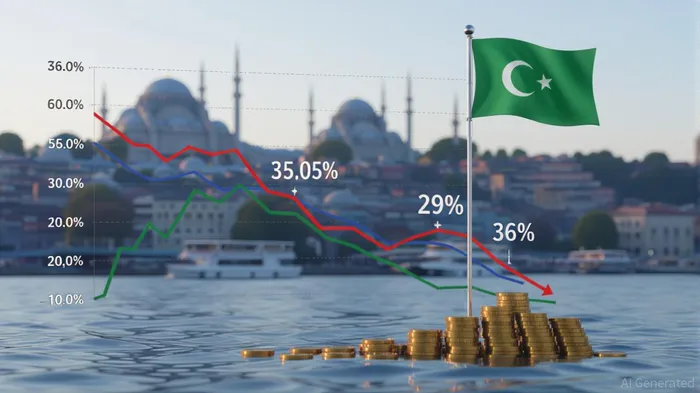
The Turkish economy is at a pivotal inflection point. After years of battling double-digit inflation and currency volatility, the Central Bank of the Republic of Turkey (CBRT) has finally pivoted. A 300 basis point rate cut in July 2025—its first easing since April—marks the start of a broader normalization cycle. With inflation now at 35.05% and Morgan StanleyMS-- projecting a drop to 29% by year-end, investors have a rare opportunity to position for lira stabilization, equity rebounds, and a structural shift in monetary policy. This is not a speculative bet—it's a calculated move grounded in macroeconomic fundamentals and institutional forecasts.
The CBRT's Easing Cycle: A Calculated Bet on Stability
The CBRT's July 2025 rate cut was no accident. It was a calculated response to a disinflationary trend that has persisted for months. While Turkey's inflation rate remains elevated, the trajectory is unmistakable: core inflation has cooled from 38% to 35.64%, and sectors like services and non-food goods are showing signs of moderation. Morgan Stanley's projections—three more 250 basis point cuts by year-end—suggest the central bank is preparing for a controlled easing.
The CBRT's policy statement in August 2025 reinforced this narrative. It emphasized maintaining a “tight monetary policy until price stability is achieved,” but also hinted at flexibility. Analysts at Garanti BBVA and Morgan Stanley have revised their forecasts to reflect a 36% terminal rate for 2025, with the latter predicting a 300 basis point cut in September followed by incremental easing in October and December. This is not a panicked dash to lower rates—it's a measured, data-driven approach to normalize policy while anchoring inflation expectations.
A Favorable External Environment: Lira Stabilization and Equity Rebounds
The external environment is aligning with the CBRT's pivot. Turkey's large domestic market, strategic location between Europe and Asia, and a young, tech-savvy population create a fertile ground for growth. While the Turkish lira (TRY) has depreciated 20.46% against the dollar over the past year, the recent easing cycle has already sparked a modest rebound. Morgan Stanley's models suggest the lira could stabilize at 39.47 per dollar by the end of Q3 2025—a 5% improvement from current levels.
Equities are also primed for a rebound. The BIST 100, Turkey's benchmark index, has fluctuated within a 9,000–11,000 range since January 2025 but shows signs of consolidation. With real interest rates still positive (46% policy rate vs. 35% inflation), Turkish lira-denominated assets offer attractive yields. Morgan Stanley's 12.28% CAGR projection for the stock market through 2026 underscores the long-term potential, particularly in sectors like construction (post-earthquake recovery), renewable energy, and banking.
Investment Opportunities: Positioning for the Easing Cycle
For investors, this is a rare window to act. Here's how to position your portfolio:
- Turkish Equities as a Core Position
- Focus on cyclical sectors like banking and construction. Banks like Yapi ve Kredi Bankasi and VakifBank are trading at discounts after the March 2025 selloff but offer value if long-term bond yields drop from 34% to 30%.
Renewable energy plays (e.g., Enel Green Power Turkey) benefit from the government's 56% green energy capacity target and the CBRT's push for inflation-linked growth.
Lira Stabilization Bets
- Consider short-term lira exposure via inverse currency ETFs or lira-denominated bonds with hedging. A 39.47 USD/TRY level by Q3 2025 would mark a 10% recovery from the March 2025 low of 41.58.
Use gold and energy commodities as hedges against residual volatility.
Bonds with a Twist
- Turkish international bonds, while still trading at 85 cents on the dollar, could rebound if the CBRT's easing continues. Look for short-term instruments with high yield and manageable duration.
The Risks: Political Uncertainty and Structural Challenges
No investment in Turkey is without risk. Political tensions—exemplified by the arrest of Istanbul Mayor Ekrem Imamoglu and subsequent protests—remain a wildcard. The CBRT's ability to maintain credibility is critical. If inflation overshoots expectations or political instability escalates, the lira could retest 41.58 levels.
However, the CBRT's recent actions signal a commitment to price stability. Morgan Stanley's revised inflation forecast (30% vs. 29%) accounts for transitory shocks like regulated electricity and gas price hikes, which are unlikely to derail the disinflationary trend.
Conclusion: A Calculated Entry for Patient Investors
Turkey's rate-cutting cycle is not a silver bullet, but it is a signal. The CBRT's pivot, combined with falling inflation and a stabilizing lira, creates a rare opportunity to enter Turkish assets at a discount. For investors with a 12–18-month horizon, this is a moment to act—before the market fully prices in the CBRT's easing and the BIST 100 breaks out of its consolidation range.
The key is balance: take measured positions in equities, hedge currency exposure, and monitor political developments closely. As the old saying goes, “The best time to plant a tree was 20 years ago. The second-best time is now.” For Turkey, now is the time.





Comentarios
Aún no hay comentarios