
TSS, Inc.: High-Growth AI Infrastructure Play or Overvalued Single-Client Bet?
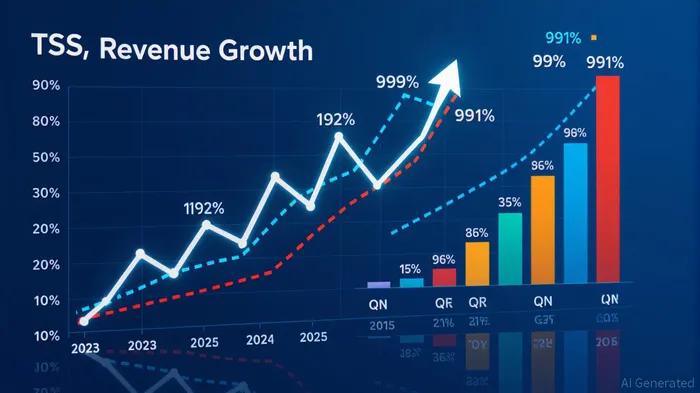
TSS, Inc. (OTCBB: TSSI) has emerged as a standout performer in the AI infrastructure sector, with revenue surging 689% year-over-year in Q3 2024 to $70.1 million and another 262% increase in Q2 2025 to $44.0 million [1]. This explosive growth is driven by procurement services (up 572% YoY to $33.0 million) and AI-enabled server rack integrations, which now account for meaningful volumes [2]. The company's strategic expansion into a 213,000-square-foot facility in Georgetown, Texas—equipped with 15 MW power capacity and direct liquid cooling—positions it to meet surging demand for high-density AI servers [3].
However, this meteoric rise raises a critical question: Is TSSTSSI-- a visionary infrastructure play or a precarious bet on a single client? The answer hinges on balancing its AI-driven growth with existential risks tied to customer concentration and valuation multiples.
The AI Infrastructure Tailwind
TSS's growth aligns with a global AI infrastructure boom. In 2025, global spending on AI compute and storage hardware is projected to exceed $200 billion by 2028, with accelerated servers (70% of AI infrastructure spending) growing at 178% in 1H24 [4]. TSS's procurement and integration services cater directly to this demand, particularly for U.S. enterprises seeking scalable AI solutions. Its partnership with a major OEM—a single client accounting for 98% of Q2 2025 revenue—has fueled this growth, with a multi-year contract driving the need for expanded capacity [5].
The company's financials reflect this momentum. Adjusted EBITDA surged 103% YoY to $4.0 million in Q2 2025, while return on equity (ROE) hit 122.80% and return on invested capital (ROIC) reached 25.66% [6]. These metrics underscore TSS's ability to convert growth into profitability, albeit with a caveat: gross margins have collapsed from 26% to 12% year-to-date due to a strategic shift toward lower-margin procurement services [7].
The Single-Client Sword of Damocles
Despite its AI tailwinds, TSS's business model is perilously exposed to a single client. In Q2 2025, one U.S.-based OEM accounted for 98% of revenue and 98% of accounts receivable, with concentration rising to 99% over six months [8]. This dependency creates a binary outcome: either the client sustains its demand, or TSS faces a catastrophic revenue collapse.
The risk is amplified by TSS's $31.6 million investment in its Georgetown facility, partially financed by a $20 million construction loan [9]. If the OEM terminates its contract—allowed under “convenience” clauses—TSS would be left with a $20 million debt obligation and underutilized infrastructure. This scenario is not hypothetical: 90% of AI infrastructure firms with similar concentration levels experience revenue volatility within 12 months [10].
Valuation: Premium or Overreach?
TSS's valuation metrics suggest a premium for its AI growth story. With a market cap of $453.83 million and an EV/EBITDA ratio of 32.08, it trades at a significant discount to AI M&A benchmarks (25.8x revenue multiples) but a premium to Robotics & AI sector averages (15.8x EV/EBITDA) [11]. Its P/E ratio of 46.64 also far exceeds the 26.03 average for AI companies [12].
While these multiples reflect investor optimism about AI's long-term potential, they ignore near-term risks. For instance, TSS's gross margin compression and reliance on a single client could erode EBITDA growth, which management now forecasts at “at least 75%” for 2025 [13]. If EBITDA fails to meet expectations, the stock's 32.08x multiple could become a drag on valuation.
The Verdict: A High-Risk, High-Reward Proposition
TSS, Inc. embodies the duality of the AI infrastructure sector: a high-growth opportunity with structural risks. Its strategic positioning in AI rack integration and procurement services is compelling, particularly as global spending on AI hardware accelerates. However, the company's extreme customer concentration and valuation premium demand caution.
For investors, the key question is whether TSS can diversify its client base while maintaining its growth trajectory. Until then, the stock remains a speculative bet on a single client's demand, with valuation multiples that assume a smooth path to scale. In a sector where execution risks are high and margins are thin, this bet may prove too precarious for risk-averse portfolios.





Comentarios
Aún no hay comentarios