
TSMC: The Unbeatable Long-Term Play in the AI Infrastructure Revolution
The AI infrastructure sector is undergoing a seismic shift, driven by exponential demand for high-performance computing (HPC) and the proliferation of generative AI. While investors often fixate on chip designers like NVIDIANVDA-- and AMDAMD--, a deeper analysis reveals that TSMCTSM-- (Taiwan Semiconductor Manufacturing) is the superior long-term investment. As the world's leading foundry, TSMC sits at the apex of the AI supply chain, leveraging its technological dominance and financial strength to capture outsized gains from the AI infrastructure market by 2030.
TSMC's Foundry Dominance: A Structural Advantage
according to market analysis. , including the vast majority of AI accelerators for hyperscalers like Amazon and Alphabet, as well as GPUs from NVIDIA and AMD according to market data. This position is reinforced by TSMC's leadership in cutting-edge manufacturing processes, such as its 3nm and 2nm nodes, which are critical for next-generation AI chips.
Advanced packaging technologies like (chip-on-wafer-on-substrate) further cement TSMC's edge. By 2026, CoWoS production capacity is expected to double, enabling the company to meet surging demand for heterogeneous chip designs in AI workloads. This innovation is particularly vital for AI training, where TSMC's packaging solutions allow for the integration of multiple dies and chips into a single, high-bandwidth module-a capability that directly supports NVIDIA's H100 and B100 GPUs, as well as custom accelerators for cloud providers. 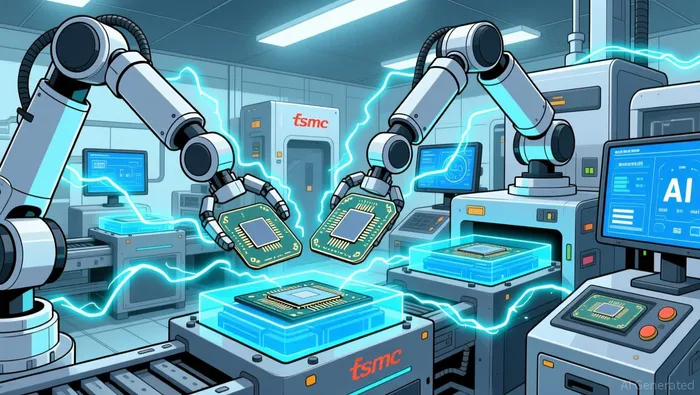
Financially, TSMC is a fortress. , . , according to financial reports, reflecting its growing alignment with AI infrastructure trends. , according to industry outlooks.
The Limits of AI Chip Designers: Ecosystem Lock-In and Marginal Gains
While NVIDIA, AMD, and Intel dominate headlines, their business models face inherent constraints. , driven by its ecosystem and GPUs like the H100 and B100. However, this dominance is increasingly challenged by cost-sensitive clients seeking alternatives. AMD's MI350 GPUs, , and Intel's Gaudi accelerators are gaining traction in markets where price-to-performance ratios matter according to market analysis.
Yet, even NVIDIA's success is inextricably tied to TSMC. The company's Blackwell and Rubin GPUs, , are manufactured exclusively by TSMC according to financial reports. This dependency underscores a critical truth: chip designers rely on TSMC's manufacturing prowess to bring their innovations to market. For investors, this means that while NVIDIA's revenue growth is impressive , its margins and scalability are ultimately constrained by TSMC's capacity and pricing power.
AMD and Intel, meanwhile, face an uphill battle. , , according to market research. Their competitive offerings-such as AMD's MI300X and Intel's Gaudi chips-lack the ecosystem integration and performance benchmarks to displace NVIDIA in training workloads according to industry analysis. For long-term investors, this suggests that incremental gains by AI chip designers are unlikely to rival TSMC's compounding advantages.
Why TSMC Outshines the Competition
TSMC's superiority stems from three pillars: technological leadership, financial resilience, and strategic positioning. Unlike chip designers, which must compete on product innovation and pricing, TSMC operates as an indispensable enabler. Its clients-ranging from NVIDIA to Apple-depend on its advanced nodes and packaging solutions to remain competitive. This creates a flywheel effect: as AI demand grows, TSMC's revenue and margins expand, funding further R&D to maintain its lead.
Moreover, TSMC's business model is less exposed to the volatility of end-market demand. While , this growth is contingent on AI adoption cycles. TSMC, by contrast, benefits from a broader base of clients and applications, from AI to mobile and automotive. Its 90% share of the advanced chip-processing market ensures that it captures value across the entire semiconductor value chain.
Conclusion: A Buy-and-Hold Masterpiece
For investors seeking a long-term AI infrastructure play, TSMC is the clear choice. Its dominance in manufacturing, coupled with its financial strength and technological roadmap, positions it to outperform even the most successful AI chip designers. While NVIDIA and AMD may capture headlines, TSMC's role as the "foundry of the future" ensures that it will remain the bedrock of the AI revolution for decades to come.







Comentarios
Aún no hay comentarios