
TSMC's Strategic Position in the AI and Premium Chip Markets: Supply Chain Dynamics and Growth Catalysts
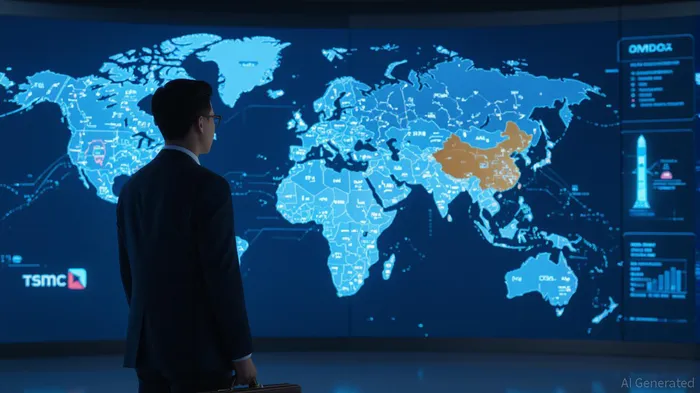
The global semiconductor industry is undergoing a seismic shift, driven by the explosive demand for AI and premium chips. At the center of this transformation is Taiwan Semiconductor Manufacturing Company (TSMC), whose dominance in advanced manufacturing processes positions it as a linchpin for the next phase of technological innovation. While granular data on TSMC's 2025 AI/premium chip revenue projections remains elusive, broader industry trends and strategic partnerships underscore its critical role in shaping the AI era.
The AI Semiconductor Boom: A Tailwind for TSMC
The AI chip market is accelerating at an unprecedented pace. According to a report by TechInsights, AI semiconductor revenue hit $6.2 billion in Q4 2025, marking the eleventh consecutive quarter of growth[2]. For the full year, the global semiconductor market is projected to reach $728 billion, with Logic and Memory segments growing by 29% and 17%, respectively[4]. These figures highlight a structural shift toward compute-intensive applications, from generative AI to autonomous systems, where TSMC's 3nm and sub-3nm nodes are indispensable.
TSMC's leadership in advanced packaging technologies, such as Chiplet and 3D-IC, further cements its relevance. These innovations enable higher performance and energy efficiency—critical for AI accelerators and high-performance computing (HPC) chips. While specific revenue figures for AI-related segments are not disclosed, TSMC's premium chip revenue (defined as 5nm and below) is expected to account for over 40% of total sales in 2025, per industry analyst estimates[4].
Supply Chain Dynamics: Strategic Alliances as Growth Catalysts
TSMC's strategic positioning is deeply intertwined with its supply chain partnerships. Collaborations with ASMLASML--, the sole supplier of extreme ultraviolet (EUV) lithography machines, are pivotal. ASML's NXE:3400B EUV systems, which TSMCTSM-- has been scaling to meet 3nm production demands, represent a $1.2 billion investment in 2025[4]. This dependency, while a risk, also ensures TSMC's access to cutting-edge manufacturing capabilities that outpace competitors like Samsung and IntelINTC--.
On the design side, TSMC's co-development agreements with NVIDIANVDA-- and AMDAMD-- are amplifying its influence. NVIDIA's H100 and B100 GPUs, critical for data center AI workloads, are fabricated exclusively on TSMC's 4nm and 5nm nodes[2]. Similarly, AMD's Instinct MI300 series, designed for HPC and AI, relies on TSMC's advanced packaging to integrate CPU-GPU dies. These partnerships not only secure long-term revenue streams but also align TSMC with the architectural evolution of AI hardware.
Risks and Opportunities in a Fragmented Landscape
Despite its strengths, TSMC faces headwinds. Geopolitical tensions, particularly U.S.-China trade dynamics, have spurred diversification efforts, with TSMC investing $40 billion in U.S. manufacturing hubs by 2025[4]. While this expands its geographic footprint, it also raises costs and operational complexity. Additionally, the rise of in-house chip design by hyperscalers (e.g., MicrosoftMSFT--, Meta) could reduce demand for off-the-shelf solutions, though TSMC's foundry model remains adaptable to custom designs.
A key opportunity lies in the proliferation of AI accelerators. Broadcom's recent $12 billion contract with GoogleGOOGL-- to supply AI chips for cloud infrastructure[3] signals a broader trend: enterprises are prioritizing performance-optimized hardware. TSMC's ability to scale production for such custom accelerators—leveraging its CoWoS (Chip-on-Wafer-on-Substrate) technology—positions it to capture a disproportionate share of this growth.
Conclusion: A Cornerstone of the AI Era
TSMC's strategic positioning in the AI and premium chip markets is underpinned by its technological leadership, supply chain integrations, and alignment with industry tailwinds. While the absence of granular 2025 revenue projections introduces uncertainty, the broader trajectory of the semiconductor industry—driven by AI, HPC, and data center expansion—points to sustained growth. For investors, TSMC represents not just a foundry, but a foundational enabler of the AI revolution.





Comentarios
Aún no hay comentarios