
TSMC's Strategic Expansion into Advanced Node Production in Japan: A Convergence of Geopolitical Resilience and AI-Driven Demand
In a pivotal move reshaping the global semiconductor landscape, TSMCTSM-- has intensified its strategic investments in Japan, aligning with the country's ambitious plans to reclaim its position as a leader in advanced chip manufacturing. This expansion is driven by two interlinked forces: the urgent need for geopolitical resilience in semiconductor supply chains and the explosive demand for AI-driven technologies. With Japan allocating ¥10 trillion in subsidies for semiconductor and AI development by 2030, TSMC's collaboration with Japanese partners like SonySONY--, ToyotaTM--, and the Ministry of Economy, Trade, and Industry (METI) underscores a calculated effort to secure both technological and strategic advantages.
Geopolitical Resilience: Diversifying Supply Chains Amid Global Tensions
The geopolitical landscape has fundamentally altered the semiconductor industry, with nations prioritizing technological sovereignty over cost efficiency. Japan's partnership with TSMC is a direct response to this shift. As a country historically reliant on Taiwanese and South Korean suppliers, Japan seeks to reduce vulnerabilities in its supply chain, particularly as U.S. and European policies incentivize localized production. METI's three-step plan, which includes advancing toward 2 nm technology, positions Japan as a critical node in this new ecosystem.
TSMC's collaboration with Sony and Toyota to establish a fabrication plant in Kumamoto exemplifies this strategy. By leveraging Japan's strengths in semiconductor materials and packaging technologies, the partnership aims to create a self-sufficient production base for advanced nodes according to industry analysis.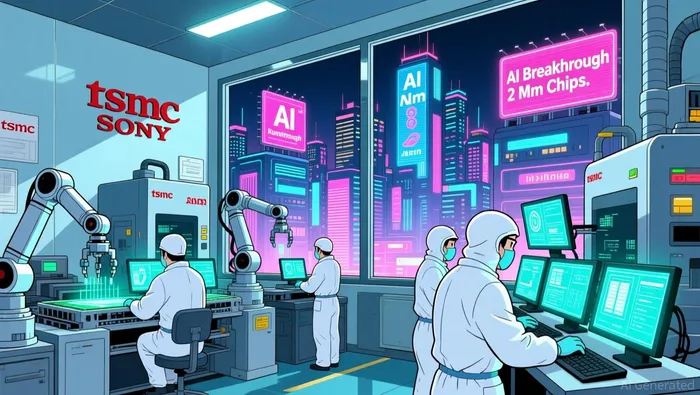 This move not only diversifies TSMC's global footprint but also aligns with Japan's broader goal of achieving 15 trillion yen in domestic semiconductor sales by 2030 as reported by industry sources.
AI-Driven Demand: The 2 nm Race and Market Projections
The surge in AI applications-from generative AI to autonomous systems-has created an insatiable demand for advanced semiconductors. TSMC's 2 nm process, critical for next-generation AI chips, is at the heart of this demand. According to a report by SemiWiki, TSMC is expanding its 2 nm production capacity from seven to ten fabrication plants, with a $28 billion investment in Tainan's Southern Science Park expected to add three new fabs by 2026. These facilities could produce over 100,000 wafers monthly, catering to tech giants like NVIDIA and Google, which are racing to develop faster AI accelerators as reported by market analysts.
Japan's own 2 nm ambitions, led by government-backed startup Rapidus, further highlight the region's strategic importance. Rapidus, collaborating with IBM, aims to achieve pilot production of 2 nm chips by 2027, with prototype wafers expected by July 2025 as stated in industry reports. This effort is bolstered by ¥1.7 trillion in government funding, reflecting Japan's determination to leapfrog traditional FinFET processes and adopt gate-all-around (GAA) architecture according to technology analysts.
Market projections underscore the urgency of these investments. Japan's semiconductor market is forecasted to grow from $56.83 billion in 2025 to $70.47 billion by 2030, driven by AI, 5G/6G infrastructure, and electric vehicles according to market research. Meanwhile, TSMC's AI-related revenues are projected to double in 2025, reflecting its dominant 90%+ market share in 3 nm and 2 nm foundry segments as reported by industry analysts.
Strategic Implications: A Win-Win for TSMC and Japan
TSMC's expansion into Japan is not merely a commercial endeavor but a strategic alignment with global trends. For TSMC, Japan offers access to cutting-edge materials, a skilled workforce, and a government committed to subsidizing advanced manufacturing. For Japan, TSMC's expertise in 2 nm/3 nm nodes accelerates its transition from a materials-centric industry to a full-fledged chip production powerhouse.
This synergy is further reinforced by Japan's $135 billion AI infrastructure investment, which includes seismic-resistant data centers and high-performance GPU deployments as reported by industry sources. By 2030, Japan aims to dominate global markets for photoresists (92%) and manufacturing automation equipment (64%), leveraging its existing strengths to capture value in the AI supply chain according to market analysis.
Conclusion: A Blueprint for Future-Proofing the Semiconductor Industry
TSMC's strategic expansion into Japan represents a masterclass in navigating geopolitical and technological crosscurrents. By anchoring its advanced node production in a country with both the financial muscle and geopolitical foresight to support it, TSMC is not only securing its own future but also enabling Japan's resurgence as a semiconductor leader. As AI demand continues to outpace supply, this partnership offers a blueprint for how global supply chains can evolve to meet the challenges of the 21st century.







Comentarios
Aún no hay comentarios