
TSMC's Q3 Revenue Outperformance: A Strategic Inflection Point for Chipmakers?
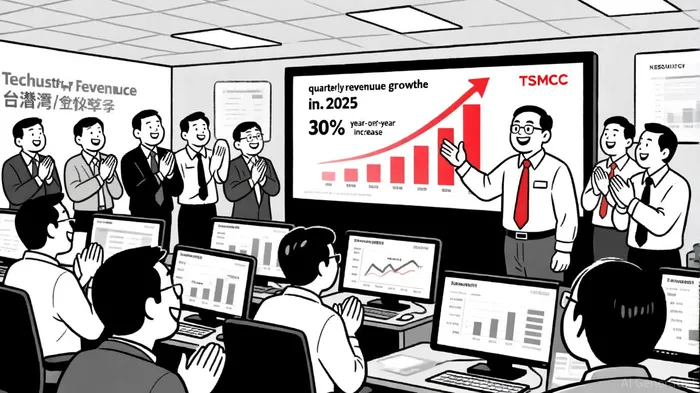
In Q3 2025, TSMCTSM-- reported revenue of NT$323.17 billion ($10.1 billion), marking a 25.8% year-over-year increase and a 22.5% sequential jump, according to an aiplainandsimple article. This outperformance, driven by surging demand for AI and high-performance computing (HPC) chips, has sparked debates about whether the foundry's success signals a strategic inflection point for the semiconductor industry. As global economic headwinds persist, TSMC's ability to navigate geopolitical risks, technological shifts, and supply chain constraints offers critical insights into the sector's resilience and future trajectory.
Operational Resilience: AI and Advanced Packaging as Growth Engines
TSMC's Q3 results underscore its dominance in the AI-driven semiconductor landscape. The company's 3nm and 5nm chips now account for 60% of its revenue, per the 2025 semiconductor outlook, with AI-related applications fueling demand from hyperscalers, NVIDIA, and AMD. Its CoWoS packaging technology, which enables high-bandwidth memory integration for AI accelerators, is expanding to 660,000 wafers in 2025-double 2024 levels, the aiplainandsimple article noted. This technological edge, coupled with internal AI-driven optimizations in chip design and manufacturing, has improved energy efficiency and production yields, according to a Competitive Dynamics analysis.
TSMC's roadmap further solidifies its leadership: trial production of 2nm chips began in 2024, with mass production slated for late 2025, the aiplainandsimple article reported. Analysts project that 2nm and advanced packaging will account for 40% of the company's revenue by 2026, per the Q3 2025 earnings breakdown, positioning it to capitalize on AI's insatiable demand for compute power.
Sector Positioning: A Race for 2nm and Packaging Supremacy
TSMC's outperformance has intensified competition in the semiconductor sector. Samsung, its closest rival, is advancing its Gate-All-Around (GAA) 2nm technology after initial yield challenges with its 3nm node, the Panabee report noted. Meanwhile, Intel aims to disrupt the market with a 1.8nm process by 2026, the aiplainandsimple article observed. However, TSMC's early lead in 2nm and CoWoS, combined with its 55%+ market share in advanced-node manufacturing, reinforces its role as the de facto enabler of AI innovation, according to TSMC's global expansion analysis.
The industry's focus on advanced packaging is equally pivotal. TSMC's CoWoS, Samsung's I-Cube S, and SK Hynix's Hybrid Bonding technologies are redefining performance benchmarks for AI chips, the aiplainandsimple article noted. These innovations address Moore's Law limitations by enabling 3D stacking and heterogeneous integration, reducing latency and power consumption. As AI workloads grow, leadership in packaging could determine market dominance in the next decade, the aiplainandsimple piece argued.
Navigating a Slowing Global Economy
Despite macroeconomic uncertainties, the semiconductor industry is projected to grow to $697 billion in 2025, driven by AI and HPC demand, according to Deloitte. TSMC's global expansion strategy-$100 billion invested in U.S., Japanese, and European fabs-mitigates geopolitical risks while aligning with U.S. CHIPS Act incentives, the Competitive Dynamics analysis observed. However, these moves come with challenges: higher costs, talent shortages, and operational complexities in replicating Taiwan's efficiency, the same Competitive Dynamics analysis warned.
TSMC's diversification extends to its client base. While Apple, NVIDIA, and AMD remain key, the company is also securing contracts with AI startups and automotive firms to reduce dependency on a few clients, the Competitive Dynamics analysis noted. This strategy, paired with AI-driven supply chain optimizations, enhances resilience against demand fluctuations in consumer electronics or automotive sectors, the Panabee report added.
Risks and Mitigation: A Fragile Equilibrium
TSMC's expansion into politically sensitive regions like Arizona and Dresden exposes it to geopolitical tensions and regulatory scrutiny, as highlighted in the Competitive Dynamics analysis. Delays in U.S. projects, such as Arizona's mass production pushed to H1 2025, have underscored the logistical hurdles of globalizing its operations, the TSMC's global expansion analysis reported. Additionally, the industry faces a talent gap, with over one million skilled workers needed by 2030, the same global expansion piece estimated. TSMC's investments in R&D and partnerships with academic institutions aim to address this, but scaling talent remains a long-term challenge, the markets analysis concluded.
Strategic Inflection Point? A Balanced Outlook
TSMC's Q3 outperformance reflects its unparalleled ability to align with AI's trajectory, but whether this marks a sector-wide inflection point depends on broader dynamics. Competitors like Samsung and Intel are closing the gap, while geopolitical fragmentation could fragment supply chains, the Competitive Dynamics analysis cautioned. For investors, TSMC's operational resilience-rooted in technological leadership, strategic diversification, and AI-driven efficiency-positions it as a bellwether for the industry. However, risks such as talent shortages, geopolitical volatility, and capital intensity in advanced nodes necessitate cautious optimism.
Historical context from recent earnings events adds nuance to this outlook. Since 2022, TSMC's stock has underperformed its benchmark by ~2.2 percentage points on average in the 30 days following earnings beats, with a statistically significant negative abnormal return emerging from day 5 onward, according to a TSMC earnings backtest. The win rate for these events never exceeded 49%, suggesting limited upside capture and reinforcing a "sell-the-news" pattern. These findings imply that while TSMC's operational strength is evident, investors should supplement earnings-beat signals with additional filters-such as margin guidance or macroeconomic context-to avoid overreliance on short-term catalysts.
As the semiconductor sector navigates a dual narrative of AI-driven growth and macroeconomic headwinds, TSMC's ability to sustain its innovation edge while mitigating global risks will determine its-and the industry's-long-term success.





Comentarios
Aún no hay comentarios