
TSMC's Pivotal Role in the AI Supercycle and Its Implications for Long-Term Growth
The semiconductor industry is undergoing a seismic shift, driven by the exponential demand for artificial intelligence (AI) compute power. At the heart of this transformation is TSMCTSM--, the world's leading foundry, whose 2nm process technology has positioned it as a linchpin in the AI-driven semiconductor boom. With mass production of its 2nm node now underway and key clients like AppleAAPL--, NVIDIANVDA--, and AMDAMD-- already adopting the technology, TSMC is not only capitalizing on the AI supercycle but also redefining the benchmarks for performance and efficiency in advanced chip manufacturing.
2nm Technology: A Game-Changer for AI and High-Performance Computing
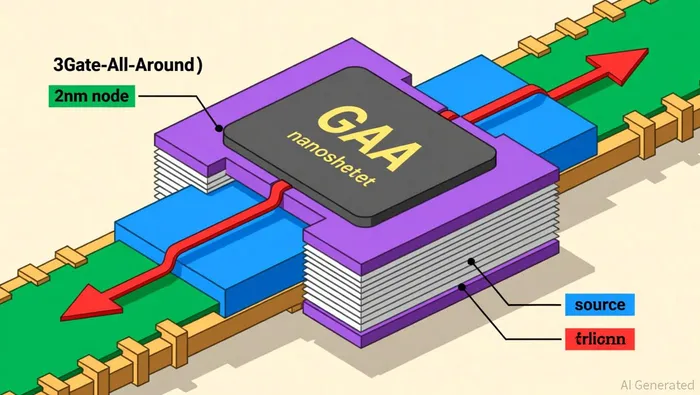
TSMC's 2nm (N2) process, which leverages Gate-All-Around (GAA) nanosheet transistors, marks a critical leap forward in semiconductor innovation. According to a Bloomberg report, the N2 node offers a 10% to 15% speed increase at the same power level or a 25% to 30% power reduction at the same speed compared to the 3nm node. This advancement is particularly vital for AI applications, where energy efficiency and computational density are paramount.
The technology is already in production at TSMC's Fab 20 in Hsinchu and Fab 22 in Kaohsiung, with Apple securing over 50% of the initial 2nm capacity for its A20 and M6 chips. NVIDIA and AMD are also leveraging the 2nm node for high-end AI and compute products, such as the Rubin GPU and Zen 6 CPUs. These partnerships underscore TSMC's ability to meet the surging demand for advanced chips, with its 2nm process serving as a cornerstone for next-generation AI infrastructure.
Strategic Client Relationships and Market Leadership
TSMC's dominance in the semiconductor foundry market is further reinforced by its relationships with industry titans. Apple's exclusive access to a majority of the 2nm production capacity highlights the foundry's critical role in powering the tech giant's ecosystem. Meanwhile, NVIDIA's Rubin GPU, built on the 2nm node, is expected to redefine AI workloads, enabling faster training cycles and more complex models.
This client-centric approach is not just about securing contracts-it's about shaping the future of computing. As stated by a TSMC executive in a recent report, the company's 2nm technology is "a strategic enabler for the AI supercycle, addressing the industry's need for both performance and power efficiency." With AI-driven demand projected to grow at a 60% compound annual rate from 2024 to 2029, TSMC's early mover advantage in GAA technology positions it to capture a disproportionate share of this growth.
Goldman Sachs' 35% Target Increase: A Vote of Confidence
Goldman Sachs' recent 35% increase in its price target for TSMC, lifting it to NT$2,330, reflects the firm's conviction in the company's long-term prospects. The upgrade, announced in late 2025, was driven by TSMC's leadership in the AI semiconductor race and its ability to scale production of cutting-edge nodes like the 2nm. The analyst noted that AI represents a "multi-year growth engine" for TSMC, with improving profit margins and capital expenditures aligned to meet surging demand.
This optimism is already reflected in TSMC's stock performance, which surged 44% in 2025 alone. The valuation has pushed TSMC's market capitalization beyond $1 trillion, a testament to investor confidence in its ability to sustain growth amid a global AI infrastructure boom.
Valuation Metrics: Attractive Entry Points Amid Sector Optimism
Despite its lofty valuation, TSMC's forward P/E ratio of 25.83 as of January 2026 remains slightly below the semiconductor industry average of 28.33. This suggests that the market is pricing in robust earnings growth, which is supported by TSMC's projected 33.73% revenue increase in 2025 and 20%+ EPS growth in 2026 and 2027.
The broader semiconductor sector is also experiencing a renaissance, with global sales expected to reach $975.4 billion in 2026-a 25% year-over-year increase. TSMC's forward-looking metrics, combined with its technological edge and client relationships, make it a compelling investment even in a high-growth sector. As Morgan Stanley highlighted in a recent analysis, TSMC is "well-positioned to outperform peers" due to its "unmatched R&D capabilities and execution in advanced nodes."
Conclusion: A Cornerstone of the AI Era
TSMC's 2nm process, strategic client partnerships, and Goldman Sachs' bullish outlook collectively validate its role as a cornerstone of the AI supercycle. While valuations have risen in tandem with sector-wide optimism, TSMC's forward P/E and projected earnings growth suggest that the company remains attractively priced relative to its long-term potential. For investors seeking exposure to the AI-driven semiconductor boom, TSMC offers a rare combination of technological leadership, market dominance, and scalable growth.
As the demand for AI compute power accelerates, TSMC's ability to innovate and scale will likely cement its position as the industry's most critical enabler. The question is no longer whether TSMC can sustain its growth-but how quickly it can outpace it.







Comentarios
Aún no hay comentarios