
TSMC: The Indispensable Gatekeeper of the AI Supercycle and a Strategic Buy for 2026
In the rapidly evolving landscape of artificial intelligence (AI), Taiwan Semiconductor Manufacturing Company (TSMC) has emerged as the linchpin of the global semiconductor supply chain. As the world hurtles toward an AI-driven future, TSMC's technological leadership, financial resilience, and strategic positioning in advanced packaging and manufacturing make it an indispensable player-and a compelling long-term investment. This analysis examines TSMC's structural dominance, its 2nm node breakthroughs, and the geopolitical and valuation dynamics shaping its trajectory in 2026.
2nm Node Leadership: Powering the Next Wave of AI Innovation
TSMC's 2nm (N2) technology, which entered volume production in Q4 2025 as planned, represents a quantum leap in semiconductor efficiency and performance. Built on first-generation nanosheet transistor architecture, the 2nm node delivers full-node improvements in power consumption and performance, making it ideal for energy-intensive AI workloads and mobile applications according to TSMC's official site. This achievement, confirmed by TSMCTSM-- on its official website as reported, underscores the company's ability to meet surging demand from industry leaders like Apple, NVIDIANVDA--, and AMD according to AnySilicon.
The 2nm node is not just a technical milestone but a strategic one. By 2027, TSMC plans to scale its 2nm capacity to over 100,000 wafers per month across its Hsinchu and Kaohsiung fabrication plants as detailed by AnySilicon. This expansion is critical to sustaining the AI supercycle, as advanced nodes become the bedrock for next-generation AI accelerators and edge computing devices. Furthermore, TSMC's development of the enhanced N2P variant-expected to enter mass production in late 2026-positions the company to maintain its lead in power efficiency and performance according to Taipei Times.
AI Packaging Capacity: The CoWoS Advantage
TSMC's dominance extends beyond traditional chip manufacturing into advanced packaging, where its CoWoS (Chip on Wafer on Substrate) technology is redefining high-performance computing. By the end of 2026, TSMC's CoWoS capacity is projected to reach 127,000 wafers per month-nearly tripling in just 18 months as projected. This exponential growth is directly tied to the insatiable demand for AI chips capable of handling large-scale inference and training tasks.
CoWoS enables the integration of multiple dies into a single package, optimizing data transfer speeds and reducing latency-a critical requirement for AI workloads. As AI models grow in complexity, TSMC's packaging expertise becomes a moat, ensuring that its customers can scale their architectures without compromising performance. This technological edge, combined with TSMC's 2nm node, creates a flywheel effect: advanced packaging amplifies the value of TSMC's leading-edge nodes, while those nodes enable more sophisticated packaging solutions. 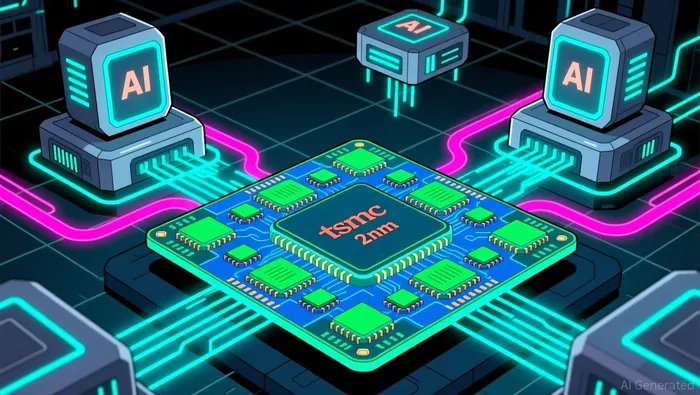
Resilient Financials: A High-Margin Engine
TSMC's financial performance in 2025 further cements its status as a structural winner. The company reported a 32.8% year-over-year increase in cumulative revenue for the first eleven months of 2025 according to PredictStreet, driven by robust demand for its 2nm and CoWoS technologies. Gross margins, a key metric for foundry businesses, are forecasted to remain above 54-55% during the 2nm ramp as projected, with Q4 2025 guidance projecting margins of 59-61% according to PredictStreet. These figures highlight TSMC's ability to maintain pricing power and operational efficiency even as it invests heavily in capacity expansion.
From a valuation perspective, TSMC's premium multiples reflect its market leadership. As of January 2026, the company trades at a P/E ratio of 32.62 and a P/B ratio of 8.67 according to GuruFocus, underscoring investor confidence in its long-term earnings potential. While these multiples may appear elevated, they are justified by TSMC's high operating margins, strong balance sheet, and its role as a critical infrastructure provider in the global semiconductor ecosystem as noted by GuruFocus.
Geopolitical Risks: Navigating a Fractured Landscape
TSMC's strategic importance also exposes it to geopolitical headwinds. U.S.-China trade tensions and export controls have reshaped the semiconductor supply chain, with TSMC at the center of these dynamics. The U.S. government's restrictions on advanced chip exports to China have forced TSMC to suspend sales to Chinese-affiliated entities as reported, while simultaneously investing in U.S. fabrication facilities under the CHIPS and Science Act to reduce reliance on East Asia according to Francesca Tabor.
However, TSMC's geographic diversification and technological moats mitigate these risks. By expanding its U.S. footprint and leveraging its 2nm and CoWoS technologies, TSMC is aligning with U.S. security priorities while maintaining access to global markets. Additionally, its 92% share of advanced chip production as cited ensures that even in a fragmented world, TSMC remains the go-to partner for cutting-edge AI and high-performance computing.
Conclusion: A Strategic Buy for the AI Era
TSMC's structural dominance in the AI-driven semiconductor supply chain is underpinned by its 2nm node leadership, CoWoS packaging innovation, and resilient financials. While geopolitical risks persist, the company's strategic investments in U.S. manufacturing and its technological moats position it to navigate these challenges while compounding value for shareholders. With a valuation that reflects its market leadership and a forward-looking roadmap that includes 1.4nm node trials according to SemiWiki, TSMC is not just a beneficiary of the AI supercycle-it is the indispensable gatekeeper. For investors seeking exposure to the next decade of technological progress, TSMC represents a strategic buy in 2026.





Comentarios
Aún no hay comentarios