
TSMC's A16 Node: A Catalyst for Semiconductor Growth in 2026
The semiconductor industry stands on the brink of a transformative leap, driven by TSMC's A16 node-a 1.6nm-class process poised to redefine performance and efficiency benchmarks for artificial intelligence (AI) and high-performance computing (HPC). As manufacturing readiness accelerates, the A16 node is not merely a technical milestone but a strategic linchpin for sustaining the AI-driven demand surge expected in 2026 and beyond.
Manufacturing Readiness: A16's Technical Edge
A SemiWiki report finds that this design delivers an 8–10% performance boost, 15–20% lower power consumption, and a 7–10% increase in logic density compared to the N2P node. These advancements are critical for AI and HPC applications, where power efficiency and computational density directly impact the scalability of data centers and edge computing infrastructure.
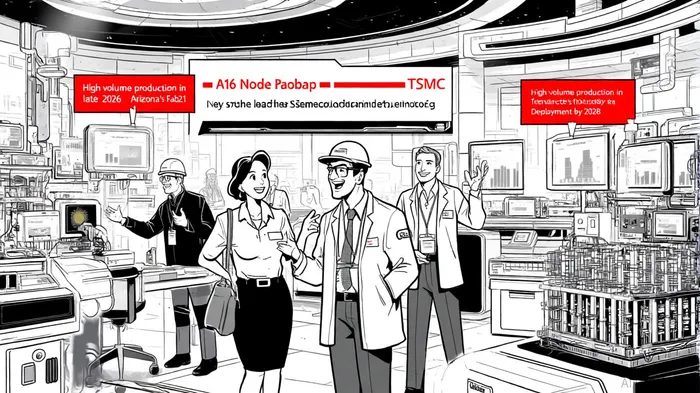
TSMC's roadmap, confirmed at the 2025 Technical Symposium, positions A16 as a successor to the N2P and A14 nodes, with production aligned to meet the escalating demand for AI accelerators. The company's Fab 21 in Arizona, set to begin A16 manufacturing by 2028, underscores its commitment to globalizing advanced-node capacity, as reported by NextBigFuture. This expansion is vital for addressing geopolitical supply-chain risks while catering to U.S.-based AI clients.
AI and HPC Demand: A16 as the Enabler
Cloudnews.tech reports that NVIDIANVDA--, a traditional late adopter of leading-edge nodes, has committed to becoming the first customer for A16, signaling a strategic shift to maintain its competitive edge in AI GPUs. Cloudnews.tech also notes that NVIDIA's A16-based chips, likely under the Feynman architecture, could debut between 2027 and 2028, further intensifying the AI race, according to a Techovedas report.
Other key clients, including Apple, AMD, and OpenAI, are also designing A16-optimized chips for AI inference, training, and HPC workloads. TrendForce highlights that TSMC's A16 capacity is projected to expand significantly by 2027, driven by the node's suitability for energy-efficient, high-throughput computing. This demand is not speculative: TechResearchOnline reports that TSMC's Q3 2025 revenue surged 30% year-on-year to $32.5 billion, with AI/HPC accounting for 60% of total revenue. Such figures validate the node's role in solidifying TSMC's dominance in the AI semiconductor market.
Financial Implications and Market Projections
TSMC's Q3 2025 revenue of $32.5 billion exceeded LSEG estimates, with AI/HPC demand driving 58% of wafer sales for 3nm and 5nm processes, as noted by Nasdaq. Notably, historical data from similar events-such as TSMC's earnings beats in Q3 and Q4 2022-showed a 40% annualized return with a Sharpe ratio exceeding 1, indicating strong investor confidence during such periods. However, these gains were concentrated in those two quarters, highlighting the strategy's sensitivity to specific earnings windows .
According to Monexa.ai, TSMC's 2024 results-33.89% revenue growth and a 39.92% net income increase-further justify its aggressive R&D and capital expenditures for A16 and N2 (2nm) expansion. Market projections suggest that A16 will amplify these trends. Chippub's analysis indicates that TSMC's AI-related revenue, already constituting one-third of total sales, is expected to grow at a strong compound annual growth rate (CAGR) through 2028. With NVIDIA's adoption and Arizona's Fab 21 ramping up, the A16 node is positioned to become a cornerstone of the AI infrastructure boom.
Conclusion: A16 as a Strategic Investment Catalyst
TSMC's A16 node exemplifies how manufacturing readiness and technical innovation can directly fuel market demand. By addressing the power and performance constraints of current AI/HPC architectures, A16 not only secures TSMC's leadership in advanced-node fabrication but also accelerates the global AI infrastructure transition. For investors, the node's alignment with NVIDIA's AI ambitions, TSMC's financial strength, and the U.S. semiconductor strategy makes it a compelling catalyst for growth in 2026 and beyond.





Comentarios
Aún no hay comentarios