
TRX Supply Control and Justin Sun's 64% Dominance: Assessing Market Risks and Tron's Undervalued Decentralized Future
The Centralization Conundrum: Justin Sun's 64% TRXTRX-- Control
According to a report by Cryptorank, Justin Sun reportedly controls 64% of Tron's circulating TRX supply as of September 2025[1]. This level of token concentration has ignited fierce debates about the decentralization of the TronTRX-- network. Critics argue that such control grants Sun disproportionate influence over governance, market dynamics, and development priorities[2]. While Sun has contested these claims in court, a recent ruling denied his attempt to block Bloomberg's disclosure of his holdings[5], signaling a potential shift toward transparency.
Despite the controversy, TRX's price has remained relatively stable, with a muted market reaction to the allegations[1]. This suggests that investors may be prioritizing Tron's utility—such as its role in stablecoin infrastructure—over governance concerns. However, the long-term risks of centralization, including regulatory scrutiny and investor trust erosion, cannot be ignored[3].
On-Chain Metrics: Deflationary Trends and Network Resilience
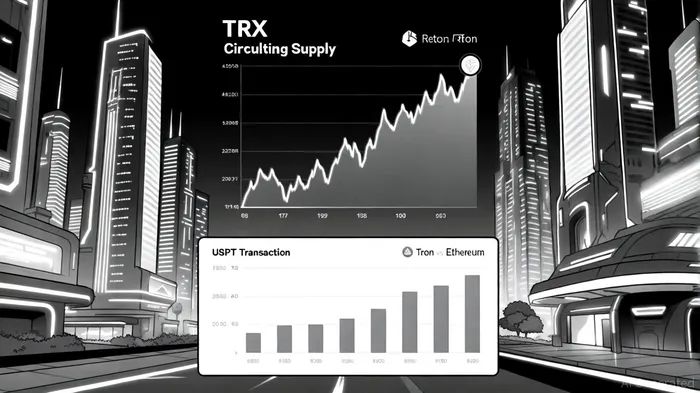
Tron's on-chain data reveals a deflationary narrative. The circulating supply of TRX has declined by -2.59% in Q4 2024 and -1.8% in Q2 2025, driven by token burns from transaction fees outpacing new minting[1]. Staking adoption under the Stake 2.0 mechanism has further reinforced this trend, with 51% of the total supply staked by Q4 2024[4]. This deflationary pressure, combined with Tron's dominance in USDTUSDT-- transactions (99.2% of stablecoin supply in Q2 2025[2]), positions the network as a critical infrastructure layer for global payments.
However, decentralization risks persist. The geographic concentration of Super Representatives (SRs)—with 21% of nodes in the U.S.—and the influence of large TRX holders over SR elections highlight vulnerabilities[1]. While Tron's DPoS model allows for frequent SR rotations (every six hours), the top 27 SRs still wield significant power[4].
Governance and Market Sentiment: A Mixed Bag
Tron's governance structure has evolved to include community-driven initiatives like the TRON DAO framework, enabling autonomous organizations to manage decentralized projects[2]. Yet, the centralization of voting power among large stakeholders remains a concern[4]. The recent 60% fee reduction approved by the governance community[5] underscores Tron's agility in adapting to user needs, but it also raises questions about the influence of insiders like Sun.
Market sentiment is equally divided. TRX's price surged 138% in 2024 and reached $0.2643 in early 2025[2], supported by a 17% quarter-over-quarter rise in market cap to $26.5 billion[4]. However, whale activity has plummeted, with a 121.7% drop in net flows over the past week[4], indicating caution among large investors. Retail traders, on the other hand, remain bullish, with 65% of Binance users taking long positions[4]. This divergence suggests a potential disconnect between short-term volatility and long-term utility.
Undervaluation Thesis: Tron's Decentralized Future
Despite the centralization risks, Tron's fundamentals suggest it is undervalued relative to its peers. The network processes 10 billion transactions in 2025[1], with daily USDT transfers exceeding $24 billion—surpassing Ethereum's $20 billion[5]. This utility, combined with a growing TVL of $6.41 billion in DeFi platforms like JustLend and SunDEX[1], highlights Tron's role as a low-cost, high-throughput blockchain.
Comparisons with EthereumETH-- and BSC further reinforce this case. While Ethereum dominates DeFi TVL (53.3% of the market[5]), Tron's focus on stablecoin settlements and emerging markets provides a complementary niche. BSC's $6.734 billion TVL[3] pales in comparison to Tron's deflationary momentum and institutional adoption (e.g., partnerships with MoonPay and Chainlink[1]).
Strategic Investment Case
For long-term investors, Tron presents a compelling opportunity. The network's deflationary supply dynamics, stablecoin dominance, and governance upgrades position it to capture value in a fragmented crypto ecosystem. While Sun's token control introduces risks, the recent P2P network upgrade and fee cuts[5] demonstrate a commitment to scalability and user adoption.
However, caution is warranted. The legal and regulatory landscape remains uncertain, and further centralization could deter institutional adoption. Investors should monitor the outcome of Sun's legal battles and the evolution of Tron's DAO frameworks.
In conclusion, Tron's decentralized future may be undervalued by current market prices. For those willing to navigate the risks, positioning in Tron-based assets offers exposure to a network that is redefining blockchain utility in the stablecoin era.





Comentarios
Aún no hay comentarios