
Trusted Execution Environments: The New Frontier in Blockchain Security and Scalability
The Transformative Role of TEEs in Blockchain
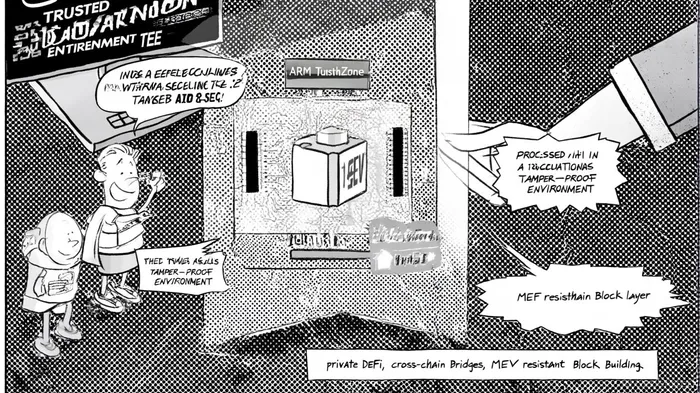
Trusted Execution Environments (TEEs) are reshaping the blockchain landscape, offering a hardware-backed solution to longstanding challenges in privacy, scalability, and security. By creating isolated, tamper-proof execution environments within a processor, TEEs enable sensitive computations to occur without exposing data to the broader system. This innovation is particularly critical in decentralized finance (DeFi), cross-chain interoperability, and secure off-chain processing. According to a report by Cointelegraph, over 50 teams are actively developing TEE-based blockchain projects, signaling a paradigm shift in how trust is established in Web3 ecosystems [1].
Privacy: The First Pillar of TEE Adoption
Privacy-preserving smart contracts have long been a holy grail for blockchain developers. TEEs address this by allowing sensitive data—such as transaction inputs, outputs, and contract logic—to remain encrypted within secure enclaves. Secret Network, for instance, leverages IntelINTC-- SGX to execute private DeFi applications where user balances and transaction details are hidden, yet the integrity of the blockchain layerLAYER-- is preserved [1]. Similarly, Ekiden employs distributed key management within TEEs to protect cryptographic keys, ensuring that even if a single node is compromised, the system remains secure [1].
Beyond DeFi, TEEs are enabling new use cases in data tokenization and enterprise blockchain. TrustChain, a privacy-focused smart contract model, integrates TEEs to safeguard sensitive computations in supply chain and healthcare applications [3]. These advancements underscore TEEs' role in expanding blockchain's utility beyond public finance into sectors requiring strict data confidentiality.
Scalability: Off-Chain Computation Without Compromise
Scalability has been a persistent bottleneck for blockchain adoption. TEEs mitigate this by offloading computationally intensive tasks to secure enclaves, reducing on-chain gas costs and increasing throughput. IExec, a decentralized cloud computing platform, uses TEEs to verify the integrity of off-chain computations before submitting results to the blockchain, ensuring trust without sacrificing performance [1].
In the context of EthereumETH-- layer-2 solutions, Unichain—an optimistic rollup developed by the UniswapUNI-- team—has pioneered TEE-based block-building to resist MEV (Maximal Extractable Value) manipulation. By constructing blocks within protected enclaves, Unichain minimizes the risk of front-running and other MEV-related exploits [1]. TEE-Boost, another innovation, replaces centralized relay services in the MEV-Boost architecture with TEE-based builders, enhancing fairness and privacy in transaction ordering [3].
Security Challenges and Mitigations
Despite their promise, TEEs are not without vulnerabilities. Hardware flaws, such as Intel's Plundervolt attack, highlight the risks of relying on chip manufacturers for security [1]. Additionally, geopolitical pressures could compel manufacturers to introduce backdoors, undermining the trust model.
However, emerging solutions are addressing these concerns. Ekiden's use of short-lived keys and distributed key management reduces the impact of potential breaches [1]. Meanwhile, hybrid architectures combining TEEs with zero-knowledge proofs (ZKPs) are gaining traction, offering multi-layered security without over-reliance on a single technology [3]. These innovations suggest that TEEs are evolving from niche privacy tools into foundational infrastructure components.
The Future: TEEs as a Catalyst for Web3 Growth
Looking ahead, TEEs are poised to drive broader adoption of blockchain in AI, verifiable computation, and cross-chain interoperability. Projects like Phala Network and iExec are already using TEEs to build decentralized cloud computing platforms, enabling secure off-chain processing while maintaining trustless properties [3]. As TEEs integrate with AI-driven analytics, they could also facilitate secure data sharing between enterprises and decentralized networks, unlocking new revenue streams.
For investors, the TEE space presents a compelling opportunity. The market capitalization of TEE-based projects has grown exponentially since 2023, driven by demand for privacy, scalability, and security [3]. However, due diligence is critical: projects must demonstrate robust mitigation strategies for hardware vulnerabilities and avoid over-reliance on single manufacturers.
Conclusion
Trusted Execution Environments are no longer a theoretical concept but a transformative force in blockchain. By addressing privacy, scalability, and security challenges, TEEs are enabling a new generation of decentralized applications that were previously unfeasible. While risks persist, the rapid innovation in hybrid architectures and key management systems suggests that TEEs will remain a cornerstone of Web3 infrastructure. For investors, the key is to identify projects that balance cutting-edge security with practical use cases—those that don't just talk about the future but are actively building it.







Comentarios
Aún no hay comentarios