
The Trust Wallet Breach: A Wake-Up Call for Crypto Custody Security
In December 2025, Trust Wallet-a widely used cryptocurrency wallet-fell victim to a breach that exposed vulnerabilities in crypto infrastructure, resulting in a $7 million loss across multiple cryptocurrencies. The attack exploited compromised software versions, a technical oversight that underscores the fragility of even seemingly robust crypto platforms. This incident, while specific to Trust Wallet, is emblematic of a broader crisis: the systemic risks embedded in crypto custody systems. As the industry grapples with a record $3.4 billion in security breaches in 2025, the Trust Wallet case serves as a stark reminder of the urgent need for multi-layered custody solutions and regulatory clarity.
The 2025 Breach Landscape: A Perfect Storm
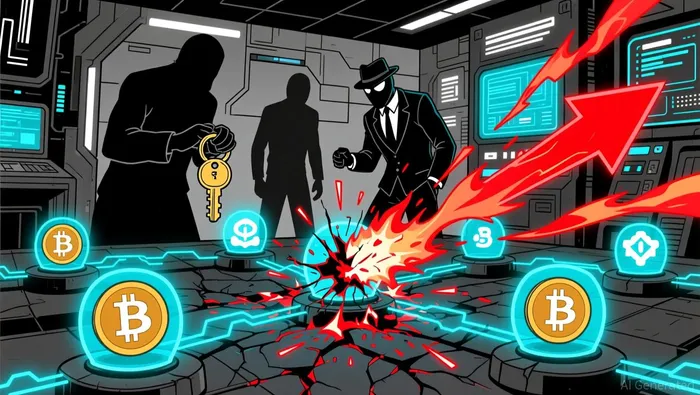 The Trust Wallet breach did not occur in isolation. 2025 saw a surge in attacks targeting both centralized and decentralized infrastructure. Centralized exchanges, in particular, remained prime targets, with 88% of Q1 2025 thefts attributed to private key compromises. The February hack of Bybit, which accounted for $1.5 billion in losses, exemplifies how centralized custodians remain attractive targets for adversaries. Meanwhile, state-sponsored actors, notably from the Democratic People's Republic of Korea (DPRK), stole $2.02 billion alone, leveraging sophisticated laundering tactics such as bridge protocols, mixing services, and structured on-chain transfers.
Even decentralized finance (DeFi) platforms, often touted for their resilience, faced challenges. While hack losses in DeFi declined compared to previous years, this was not due to reduced vulnerability but rather improved detection and mitigation strategies. The September 2025 Venus Protocol incident, for instance, demonstrated how rapid community response could limit damage-a luxury not afforded to centralized custodians.
Systemic Risks: Beyond Technical Flaws
The Trust Wallet breach highlights a deeper issue: the lack of standardized security protocols in crypto custody. According to a report by TokenMetrics, 17% of 2025 incidents involved unencrypted user data breaches, leading to identity theft and cascading financial losses. These breaches are compounded by operational risks, such as delayed patching of vulnerabilities. In Trust Wallet's case, the failure to swiftly address software flaws created an opening for attackers-a problem exacerbated by the absence of multi-signature (multi-sig) requirements in certain wallet configurations.
Regulatory gaps further amplify these risks. Federal banking regulators have warned that crypto-asset safekeeping lacks a clear legal framework for insolvency scenarios, leaving customers with irretrievable losses. Unlike traditional banking, where deposit insurance mitigates custodial risks, crypto users bear the full brunt of breaches-a systemic asymmetry that erodes trust in the ecosystem.
The Path Forward: Multi-Layered Custody and Governance
To mitigate these risks, the industry must adopt a multi-layered approach to custody. First, technical safeguards such as mandatory multi-sig solutions, hardware wallet integration, and real-time anomaly detection must become standard. Trust Wallet's breach could have been contained if multi-sig requirements had been enforced for large transactions-a lesson echoed in post-incident analyses.
Second, regulatory frameworks must evolve to address custody-specific risks. The 2025 guidance from U.S. banking regulators emphasizes the need for robust risk management, including third-party audits and insurance mechanisms as highlighted in official guidance. While some platforms have begun offering insurance-backed custodial services, these remain fragmented and underutilized.
Finally, user education is critical. The 158,000 personal wallet compromises in 2025 reveal a persistent vulnerability: human error. Phishing, social engineering, and weak password practices continue to enable breaches, even as institutional-grade security improves.
Conclusion: A Call for Resilience
The Trust Wallet breach is not an outlier but a symptom of systemic weaknesses in crypto infrastructure. As attacks grow in scale and sophistication, the industry must prioritize resilience over convenience. Multi-layered custody solutions, regulatory clarity, and user empowerment are not just best practices-they are existential imperatives. For investors, the message is clear: security is no longer a peripheral concern but the bedrock of value in the crypto ecosystem.







Comentarios
Aún no hay comentarios