
Trump's World Liberty Financial: A High-Stakes DeFi Play in a Regulated Crypto Era
Donald Trump's World Liberty FinancialWLFI-- (WLF) has emerged as one of the most polarizing yet ambitious projects in the decentralized finance (DeFi) space. Launched in 2024, the platform aims to bridge traditional finance (TradFi) and DeFi by offering lending, borrowing, and crypto trading services, backed by a native governance token ($WLFI) and a U.S. dollar-pegged stablecoin (USD1). For early investors, the project presents a unique blend of political branding, institutional backing, and innovative tokenomics. However, its strategic and financial implications are deeply intertwined with regulatory uncertainties and governance controversies.
Strategic Innovations: Tokenomics and Stablecoin Dynamics
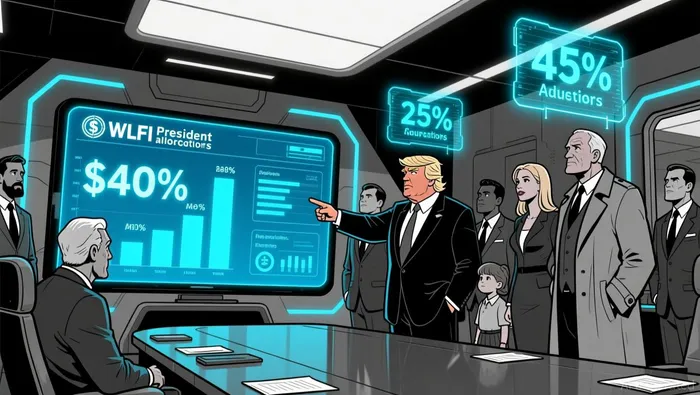
WLF's tokenomics are designed to incentivize participation while centralizing control. The $WLFI token, with a total supply of 100 billion, allocates 33.5% to the founding team and advisors, including 22.5% directly to the Trump family and affiliated entities. This concentration of ownership raises questions about decentralization but aligns with the project's governance model, where $WLFI holders can vote on protocol upgrades and integrations.
The platform's USD1USD1-- stablecoin, fully backed by U.S. Treasuries and cash equivalents, is a cornerstone of its strategy. By pegging USD1 to the dollar and integrating it across multiple blockchains, WLF aims to attract institutional and retail users seeking transparency. Crucially, USD1's reserves generate interest, which is used to buy and burn $WLFI tokens via smart contracts, creating a deflationary mechanism tied to real-world cash flows. This model could drive token value appreciation as USD1 adoption grows, particularly with institutional investors like DWF Labs and ALT5 Sigma holding significant stakes.
Financial Implications: Valuation, Volatility, and Institutional Backing
At launch, $WLFI traded at over $0.30, implying a fully diluted valuation (FDV) exceeding $30 billion. While this valuation appears inflated by traditional metrics, it reflects speculative optimism about WLF's potential to disrupt the banking sector. The platform's application for a U.S. national banking charter-currently under review by the Office of the Comptroller of the Currency (OCC)- could unlock access to critical payment systems like Fedwire and ACH, enabling services such as checking accounts and commercial lending. If approved, this would position WLF as a hybrid DeFi-traditional bank, a first in the crypto industry. Price predictions for $WLFI are bullish, with analysts forecasting a rise to $0.28 in 2025. These projections hinge on USD1's adoption and the success of WLF's deflationary token model. However, the token's low circulating supply (5% at launch) and concentrated ownership could exacerbate price volatility, posing risks for early investors.
Risks and Regulatory Scrutiny: A Double-Edged Sword
Despite its strategic innovations, WLF faces significant regulatory and governance challenges. Critics argue that the platform's ties to the Trump administration create conflicts of interest, particularly as the OCC's approval of its banking charter is subject to presidential oversight. U.S. Senators Elizabeth Warren and Jack Reed have raised concerns about WLF's lack of safeguards against illicit actors, including entities linked to North Korea, Russia, and Tornado CashTORN--. The sale of $WLFI tokens to these groups could grant them undue influence over the platform's governance.
The regulatory landscape itself is evolving. The U.S. enacted the GENIUS Act in 2025 to clarify stablecoin regulations, while the EU's MiCA framework entered implementation. WLF's compliance with these standards is critical, yet its political affiliations may complicate oversight. Additionally, the Trump administration's pro-crypto policies-such as disbanding the National Cryptocurrency Enforcement Team (NCET)-have reduced enforcement actions against crypto firms, potentially lowering the immediate risk of legal penalties. However, this leniency could backfire if regulators later scrutinize WLF's operations more closely.
Conclusion: A High-Risk, High-Reward Proposition
For early investors, WLF represents a speculative bet on the convergence of DeFi and traditional finance. Its innovative tokenomics, institutional backing, and potential banking charter approval could drive substantial returns. However, the project's governance structure, regulatory uncertainties, and political entanglements introduce significant risks. Investors must weigh the allure of a $30 billion valuation against the possibility of regulatory pushback or governance failures.
In a market where DeFi projects increasingly seek legitimacy through traditional financial integration, WLF's success-or failure-could set a precedent for how political influence and regulatory frameworks shape the future of crypto innovation.







Comentarios
Aún no hay comentarios