
Trump's Venezuela Oil Play: Strategic Opportunities Amidst Geopolitical Turmoil
The removal of Nicolás Maduro from power in early 2026 has reignited global interest in Venezuela's oil sector, a resource-rich but politically fractured landscape. For U.S. energy companies, the shift presents a tantalizing opportunity to reclaim assets, revive production, and secure access to the world's largest proven crude oil reserves. However, the path to re-entry is fraught with geopolitical risks, infrastructure decay, and complex ESG (Environmental, Social, and Governance) considerations. This analysis evaluates the viability of U.S. energy investments in post-Maduro Venezuela, balancing strategic potential against the realities of a volatile transition.
Strategic Opportunities: A Gateway to Venezuela's Oil Reserves
Venezuela's oil sector, long crippled by underinvestment and U.S. sanctions, now stands at a crossroads. According to a report by , President Donald Trump has explicitly urged American oil giants like Exxon MobilXOM--, ConocoPhillipsCOP--, and ChevronCVX-- to re-enter the country to recover assets seized during Hugo Chávez's 2007 nationalization of U.S. interests. Chevron, already operating through joint ventures with PDVSA, is uniquely positioned to scale production quickly, leveraging its existing infrastructure and expertise.
The potential rewards are immense. Venezuela holds over 300 billion barrels of proven reserves, with heavy crude oil that aligns with U.S. Gulf Coast refineries optimized for high-sulfur processing. Restoring production to pre-2019 levels-around 1.1 million barrels per day- could generate significant revenue for Venezuela while stabilizing U.S. energy markets. Goldman Sachs estimates that a recovery to 2 million barrels per day by 2030 could introduce downward pressure on global oil prices, though this would require easing sanctions and resolving legal disputes over past expropriations.
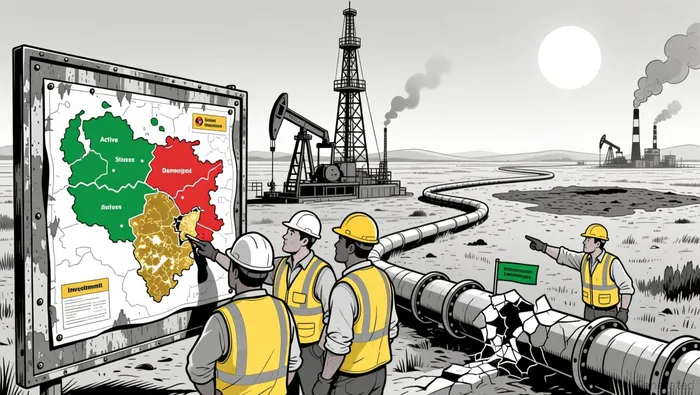
Geopolitical Risks: A Fragile Transition and Global Backlash
The U.S.-led capture of Maduro and the subsequent military intervention have introduced profound geopolitical uncertainties. While the Trump administration frames the operation as a step toward "regime change" and regional dominance, the move has drawn sharp condemnation from Russia, China, and European allies. China, in particular, has a vested interest in Venezuela, having extended $60 billion in loans and secured 80% of the country's oil exports. U.S. control of Venezuela's oil sector risks destabilizing these relationships and escalating tensions with non-Hemispheric powers.
Domestically, Venezuela's political transition remains untested. Vice President Delcy Rodríguez, a key figure in the new leadership, has yet to demonstrate the capacity to implement governance reforms or attract foreign investment. The U.S. military's role in the transition also raises questions about long-term stability, with experts warning that without a "trustworthy government," infrastructure investments may remain at risk.
ESG Challenges: Environmental and Social Stewardship
Environmental and social governance factors loom large over U.S. energy projects in Venezuela. The country's oil infrastructure has deteriorated significantly, with outdated processing upgraders and rampant gas flaring contributing to environmental degradation. For U.S. firms, compliance with global ESG standards-particularly carbon reporting requirements-will be critical to securing financing and public support.
Social responsibility initiatives will also be paramount. Chevron's past investments in Venezuela, including $115 million in health, education, and economic development programs, offer a blueprint for responsible engagement. However, the scale of Venezuela's humanitarian crisis-marked by mass emigration and collapsing public services-demands far greater commitments. Investors will need to balance profit motives with efforts to address labor conditions, community impacts, and human rights concerns according to Chevron.
Legal and Infrastructure Hurdles: A Capital-Intensive Recovery
Restoring Venezuela's oil sector will require tens of billions of dollars in capital. According to , infrastructure rehabilitation alone could cost $100 billion, with production recovery to 3.5 million barrels per day taking seven to ten years. U.S. companies must also navigate legal complexities, including claims for past expropriations and negotiations with PDVSA. While Trump has hinted at subsidizing or reimbursing firms for infrastructure costs, such measures remain untested and politically contentious.
Conclusion: A High-Stakes Gamble
Trump's Venezuela oil play represents a high-stakes gamble for U.S. energy companies. The strategic value of Venezuela's reserves is undeniable, but the path to re-entry is obstructed by geopolitical tensions, infrastructure decay, and ESG challenges. For investments to succeed, the new Venezuelan leadership must prioritize governance reforms, legal clarity, and sustainable development. Until then, the promise of Venezuela's oil remains as elusive as ever.





Comentarios
Aún no hay comentarios