
Trump's Venezuela Oil Gambit: Strategic Opportunities Amid Political and Market Volatility
The U.S. energy sector is at a pivotal crossroads as President Donald Trump's administration embarks on a high-stakes geopolitical and economic strategy to reassert American influence in Venezuela's oil industry. With the removal of Nicolás Maduro in late 2025 and the subsequent U.S.-led military intervention, the stage is set for a dramatic reshaping of global energy dynamics. For U.S. energy firms, this represents both a strategic opportunity and a complex risk landscape, as they navigate the interplay of infrastructure decay, political instability, and the broader implications for global oil markets.
Strategic Opportunities: Rebuilding Venezuela's Oil Infrastructure
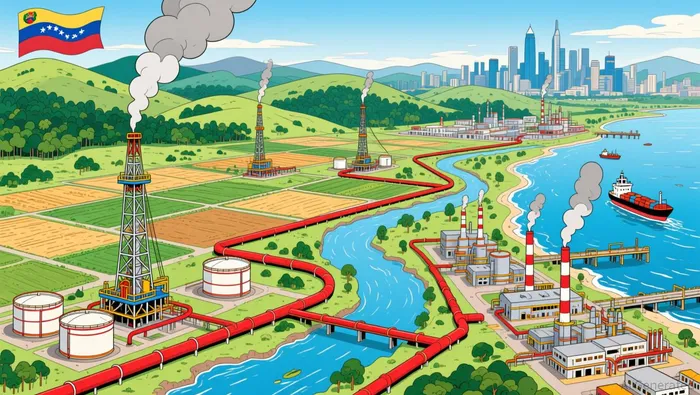
Venezuela's oil sector, once a cornerstone of global energy supply, has languished under years of mismanagement and sanctions. The country holds the world's largest proven oil reserves-303 billion barrels-yet production has plummeted to 800,000 barrels per day, a fraction of its historical output. Trump's pledge to invest billions in revitalizing Venezuela's oil infrastructure has positioned U.S. firms like ChevronCVX--, ExxonMobilXOM--, and ConocoPhillipsCOP-- at the forefront of this effort. Chevron, already operating in Venezuela with a current output of 140,000 barrels per day, is poised to expand its footprint, while Trump has signaled that other majors will follow suit if they commit to infrastructure investment.
The potential rewards are immense. Analysts estimate that with $15–$20 billion in investment, Venezuela's production could rebound to 2 million barrels per day within two years. This would not only restore a critical energy supplier to global markets but also provide U.S. firms with access to heavy crude-a resource vital for U.S. Gulf Coast refineries.
However, the scale of required investment and the state of Venezuela's crumbling infrastructure, including corroded pipelines and undermaintained refineries, present significant hurdles.
Geopolitical Implications: Countering Rival Influence
The U.S. intervention in Venezuela is as much about geopolitical dominance as it is about energy. By asserting control over the country's oil sector, the Trump administration aims to counter Chinese and Russian influence, which had previously secured significant stakes in Venezuela's energy infrastructure. China, for instance, holds $50–60 billion in loans tied to Venezuelan oil projects, a financial exposure that the U.S. now seeks to neutralize. The "Donroe" Doctrine, a modern iteration of the Monroe Doctrine emphasizing U.S. hegemony in the Americas, underpins this strategy.
This shift has broader implications for global energy markets. Venezuela's oil exports, previously directed to China at steep discounts, could now flow to U.S. allies, diversifying supply chains and reducing reliance on OPEC+ dynamics. However, the U.S. blockade of oil tankers and sanctions on Venezuelan exports have already reduced production by 25%, creating a short-term supply gap that could exacerbate diesel price volatility. The long-term success of Trump's gambit will depend on stabilizing Venezuela's political transition and ensuring that infrastructure investments translate into sustainable production.
Market Volatility and U.S. Energy Independence
The U.S. energy landscape has evolved significantly under Trump's "drill, baby, drill" agenda, with domestic production surpassing 13.4 million barrels per day. This energy independence has insulated the U.S. from global shocks, but it has also emboldened the administration to leverage oil as a geopolitical tool. For example, Trump's pressure on OPEC to reduce prices has already prompted the cartel to adjust production policies. Venezuela's potential reintegration into global markets could further disrupt OPEC+ coordination, particularly as the cartel grapples with Venezuela's historically erratic output.
Yet, market volatility remains a wildcard. The U.S. military action in Venezuela has already triggered uncertainty, with crude prices fluctuating amid fears of supply disruptions. While the U.S. Strategic Petroleum Reserve could absorb some of Venezuela's stranded crude, logistical bottlenecks-such as underdeveloped port facilities-threaten to delay production recovery. Additionally, the European Union's climate policies and carbon border adjustments may complicate U.S. LNG exports, adding another layer of complexity to the energy trade dynamic.
Risk Mitigation: Navigating Legal and Political Challenges
For U.S. energy firms, the path to Venezuela is fraught with risks. Chevron, the only major firm still operating in the country, has adopted a cautious approach, emphasizing compliance and employee safety. Meanwhile, ExxonMobil and ConocoPhillips, which were expropriated under Hugo Chávez, face unresolved arbitration awards totaling $10.37 billion. The Trump administration's insistence that these firms "invest to get paid" has created a high-stakes negotiation, with companies weighing the potential returns against the political and legal uncertainties of a post-Maduro Venezuela.
Risk mitigation strategies will likely include leveraging international arbitration rulings, securing government-backed protections, and structuring investments to avoid direct financial exposure to the Venezuelan government. For example, Chevron's current arrangement-handing over oil to sanctioned trading entities-highlights the need for creative financial engineering to comply with U.S. sanctions while maintaining operations.
Conclusion: A High-Stakes Bet on Energy and Empire
Trump's Venezuela oil gambit is a bold reimagining of U.S. energy and geopolitical strategy. For energy firms, the rewards are tantalizing: access to the world's largest oil reserves, a chance to reshape global supply chains, and a strategic counter to rival powers. Yet, the risks-political instability, infrastructure decay, and market volatility-cannot be ignored. As U.S. firms weigh their options, the success of this venture will hinge on the ability to balance short-term geopolitical objectives with long-term economic viability. In a world where energy and empire remain intertwined, Venezuela's oil sector may well become the next battleground for global influence.







Comentarios
Aún no hay comentarios