
Trump's Upcoming Fed Chair Appointment and Its Implications for U.S. Financial Markets
The appointment of a new Federal Reserve Chair under President Donald Trump's administration has ignited intense speculation about the future of U.S. monetary policy and its ripple effects across financial markets. With Kevin Hassett emerging as the leading candidate, the potential shift in central bank leadership raises critical questions for investors: How will equity, bond, and commodity markets respond to a Fed Chair aligned with Trump's economic agenda? To answer this, we must examine the interplay between central bank leadership transitions and market dynamics, drawing on historical precedents and the specific policy priorities of Trump's shortlisted candidates.
Equity Markets: A Dovish Tailwind or a Volatility Risk?
A Fed Chair like Kevin Hassett, who advocates for aggressive interest rate cuts, could catalyze a surge in equity markets-particularly in sectors sensitive to borrowing costs. Lower rates reduce the discount rate for long-duration assets, boosting valuations for growth stocks, real estate, and consumer discretionary sectors according to analysis. For example, a 1–1.5 percentage point reduction in rates over a year could revive housing markets by lowering mortgage rates and stimulate corporate borrowing for expansion.
However, the politicization of monetary policy introduces a wildcard. If the Fed is perceived as a tool for short-term political goals rather than data-driven economic stability, market confidence could erode. This uncertainty might amplify volatility, especially in sectors like banking, where interest rate expectations directly influence lending margins and profitability according to market analysis. Historical data supports this duality: past Fed Chair transitions have coincided with short-term economic slowdowns averaging 0.6 percentage points in the first year, as markets grapple with policy continuity risks.
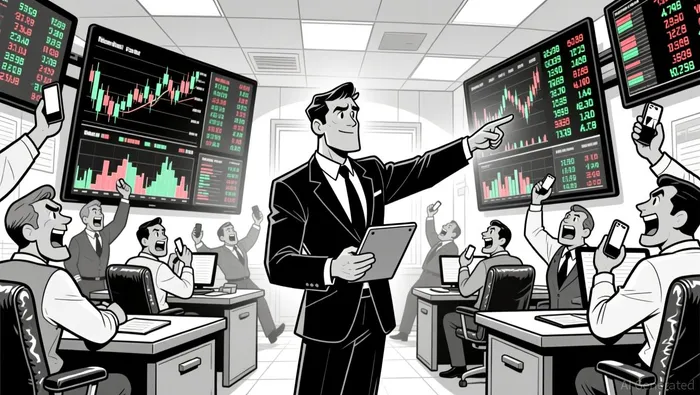
Bond Markets: Rate Cuts vs. Risk Premiums
The bond market's response to a dovish Fed Chair is nuanced. While short-term rates are likely to decline, long-term Treasury yields could rise if investors demand a "political risk premium" for uncertainty around the Fed's independence according to market analysis. This tension mirrors the 2025 gold rally, where gold prices surged amid fears of Fed politicization, reflecting a flight to safe-haven assets.
Christopher Waller, another potential candidate, offers a middle path. His preference for gradual rate cuts and labor market monitoring could mitigate some volatility compared to Hassett's more aggressive stance according to market analysis. Yet, even a cautious pivot would require the Fed to navigate expectations around inflation and economic growth, with Treasury Secretary Scott Bessent emphasizing the need for "forward-looking regulators" to manage this transition.
Commodities: Dollar Weakness and Safe-Haven Demand
Commodities are poised to benefit from a weaker U.S. dollar, a likely outcome of aggressive rate cuts. A depreciating dollar historically boosts non-U.S. assets and commodities priced in USD, such as gold, oil, and copper according to market analysis. For instance, gold prices spiked in 2025 as uncertainty around Fed leadership intensified, illustrating how central bank transitions amplify demand for safe-haven assets.
The debate over the Fed's balance sheet further complicates the outlook. Some candidates, like Rick Rieder, have called for a re-evaluation of the Fed's role in crisis interventions, potentially limiting the scale of future asset purchases. This could reduce the liquidity tailwinds that have historically supported commodities during downturns, introducing a new layer of uncertainty for investors.
The Bigger Picture: Strategic Positioning for Investors
For ETF investors, the key takeaway is the need for strategic positioning. Exposure to duration-sensitive assets (e.g., long-duration bonds or rate-sensitive equities) and global diversification could hedge against a dovish Fed pivot. Conversely, inflation-linked assets or emerging-market equities might thrive in a weaker dollar environment according to market analysis.
Yet, the broader risk lies in the erosion of the Fed's institutional independence. As noted in a report by Politico, Trump's preference for a Fed that prioritizes affordability and economic growth over inflation control could redefine the central bank's mandate-a shift that might destabilize global confidence in U.S. financial markets according to analysis.
Conclusion
The appointment of a new Fed Chair under Trump's administration represents more than a personnel change-it signals a potential realignment of monetary policy priorities. While aggressive rate cuts could provide a near-term boost to equities and commodities, the long-term implications hinge on whether the Fed's independence is preserved. Investors must balance the allure of lower rates with the risks of politicized policy, a delicate dance that will define the next chapter of U.S. financial markets.







Comentarios
Aún no hay comentarios