
Trump's Troop Deployments Spur Legal Battles Over Executive Power
President Trump's Domestic Military Deployments
President Donald Trump continues to expand troop deployments to U.S. cities, escalating a campaign to assert military power at home with little precedent in U.S. history. In the first year of his second term, Trump has deployed National Guard troops and other military personnel to Los Angeles, Washington, DC, Chicago, and Portland, Oregon, with a planned deployment to Memphis also announced.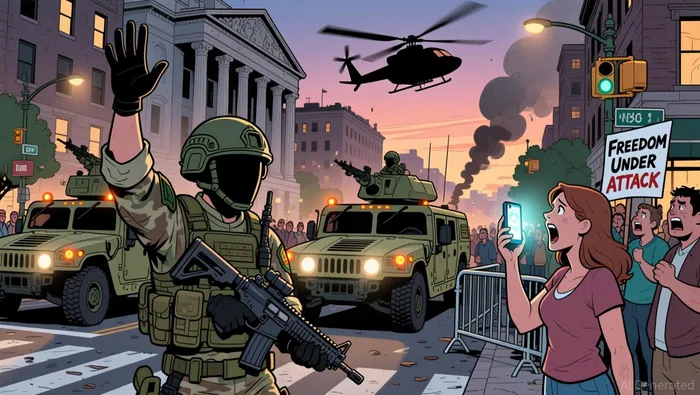 These actions have sparked legal challenges, with courts blocking deployments in Chicago, Portland, and Memphis as of November 19.
Trump's use of the military domestically marks a sharp departure from past administrations, which historically used the armed forces sparingly for such missions. The president has framed the deployments as a means to curb violent crime and support federal immigration enforcement. Critics, however, argue that this represents an authoritarian abuse of power.
Legal challenges are mounting as the deployments continue. Courts have ruled that the president's actions may violate the Posse Comitatus Act, which bars the use of active-duty military for domestic law enforcement. These legal decisions have raised questions about the scope of presidential authority in domestic affairs.
Legal and Constitutional Concerns
The Posse Comitatus Act has been a central point of contention in the lawsuits challenging Trump's troop deployments. This 1878 law prohibits the use of the active-duty U.S. military for domestic law enforcement. The Trump administration has justified the deployments by arguing that local and state officials have failed to maintain order in their jurisdictions. However, judges have questioned whether the conditions cited by Trump meet the narrow requirements for military intervention outlined in the 1807 Insurrection Act.
Federalization of National Guard troops is another legal mechanism used by the Trump administration. This involves shifting control of state National Guard units from governors to the federal government. Once federalized, these troops operate as federal forces under the president's command. This approach has been used in Los Angeles, Portland, and Chicago, where local officials have pushed back against the deployments.
Precedent and Public Reaction
Trump's troop deployments are drawing comparisons to past U.S. presidents, who have rarely used active-duty military domestically without state requests. For example, President Lyndon Johnson deployed the National Guard in the 1960s to manage civil unrest, but always at the request of state governors. In contrast, Trump has federalized National Guard troops without such requests, a move that has not occurred since 1965.
The public reaction to these deployments is mixed. While some support Trump's efforts to address crime and immigration, others view the militarization of cities as a threat to civil liberties. Legal scholars and political analysts are closely watching how the courts will ultimately rule on these cases, as they could set a significant precedent for future presidential actions.
Broader Implications for U.
S. Policy
The debate over Trump's troop deployments extends beyond legal arguments. It touches on broader questions about the balance of power between the federal government and states. Historically, the use of the military for domestic purposes has been seen as an option of last resort, reserved for cases of invasion, rebellion, or when local authorities cannot enforce federal law. Trump's approach challenges this historical norm, raising concerns about the potential for expanded executive power.
The implications of these deployments for U.S. policy could be far-reaching. If courts continue to rule against them, the Trump administration may be forced to reconsider its strategy. Alternatively, if the administration prevails in its legal arguments, it could open the door for future presidents to use the military in similar ways. This would mark a significant shift in how the U.S. government responds to domestic challenges, with potential consequences for civil liberties and state autonomy.







Comentarios
Aún no hay comentarios