
Trump's Tension with ExxonMobil and the Viability of U.S. Energy Investment in Venezuela
The interplay between U.S. energy policy and emerging market oil assets has long been a delicate balancing act, but the current dynamics in Venezuela under President Trump's 2025 framework reveal a particularly fraught landscape. At the heart of this tension lies a stark disconnect between the administration's ambitious geopolitical goals and the cautious, risk-averse stance of major energy firms like ExxonMobilXOM--. This divergence underscores the challenges of aligning political objectives with corporate pragmatism in a volatile environment.
Corporate Hesitations: Legal and Structural Barriers
ExxonMobil's recent engagement with the Trump administration has laid bare the structural hurdles facing U.S. energy companies in Venezuela. According to a report by , ExxonMobil CEO Darren Woods explicitly stated that Venezuela remains "uninvestable" without sweeping reforms to its hydrocarbon laws and legal system. The company's concerns are not unfounded: Venezuela's history of asset seizures, including two expropriations of foreign investments, has eroded trust in the country's commitment to contract enforcement. ConocoPhillipsCOP-- CEO Ryan Lance echoed these sentiments, emphasizing the need for a complete restructuring of Venezuela's state-owned oil company, PDVSA. These corporate reservations highlight a critical mismatch between the administration's diplomatic assurances and the operational realities on the ground.
Geopolitical Risks: A Double-Edged Sword
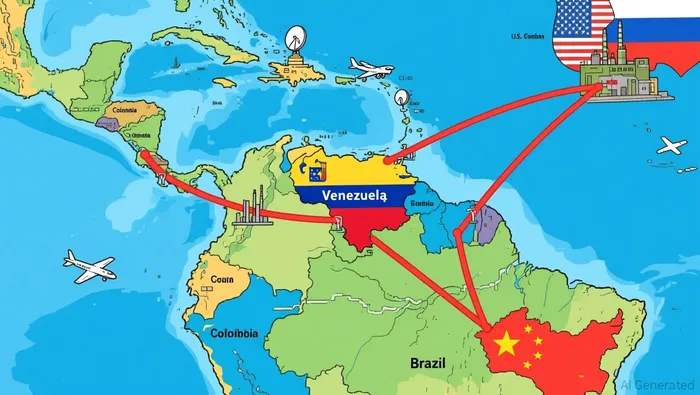
While Trump's pledge of U.S. security guarantees and a $100 billion investment in Venezuela's energy sector signals a strategic push for influence, the geopolitical fallout is far from benign. As noted by , the U.S. military operation and regime change have strained relations with China and Russia, key allies of the former Maduro government. This has not only heightened regional tensions but also disrupted Venezuela's oil exports to China, a market that previously accounted for a significant share of its shipments. The resulting instability raises questions about the long-term viability of U.S. energy projects in a region increasingly polarized by great-power rivalries.
Financial Implications: Opportunities Amid Uncertainty
Despite these risks, the potential rewards for U.S. energy firms remain substantial. Morgan Stanley analysts argue that the U.S. intervention has created an opening for companies to access Venezuela's vast oil reserves, with the possibility of restitution for nationalized assets. Additionally, U.S. refiners could benefit from renewed access to heavy crude, a resource in which Venezuela is abundant. However, these opportunities are tempered by the operational uncertainty introduced by the political upheaval. Treasury Secretary Scott Bessent's suggestion that smaller, independent oil companies might be more willing to invest in Venezuela reflects a recognition that major firms are unlikely to bear the brunt of this high-risk, high-reward proposition.
Strategic Implications for Investors
For investors seeking exposure to emerging market oil assets, the Venezuela scenario underscores the importance of risk diversification and scenario planning. The Trump administration's aggressive posturing, while aimed at securing U.S. energy interests, has introduced a layer of unpredictability that complicates traditional investment models. The lack of tangible guarantees-such as enforceable legal frameworks or stable political conditions- means the risk-return profile for energy firms remains skewed toward caution. Investors must also contend with the broader geopolitical ramifications, including the potential for retaliatory actions from China and Russia, which could further destabilize the region.
Conclusion
The tension between Trump's Venezuela policy and the reluctance of major energy firms like ExxonMobil illustrates a broader challenge in emerging market investments: the difficulty of aligning political ambition with corporate risk tolerance. While the administration's vision of a U.S.-led energy renaissance in Venezuela is compelling, the structural and geopolitical barriers are formidable. For now, the path forward appears to hinge on smaller, more agile firms willing to navigate the uncertainties, with larger players waiting for a more stable and predictable environment. Investors, meanwhile, must remain vigilant, balancing the allure of Venezuela's oil wealth against the realities of a volatile and contested landscape.





Comentarios
Aún no hay comentarios