
Trump Tariffs and the Supreme Court: Legal Risks and Strategic Opportunities for Global Investors
Legal Risks: A Test of Presidential Power
The core legal dispute centers on whether the IEEPA, enacted in 1977, authorizes the president to impose broad, indefinite tariffs on nearly all goods from nearly every country. Lower courts, including the U.S. Court of Appeals for the Federal Circuit, have ruled that Trump's actions exceeded his authority under IEEPA, citing the statute's lack of explicit tariff provisions and procedural safeguards, according to a Reuters report. The Supreme Court's conservative justices, however, face a dilemma: balancing deference to presidential authority in foreign affairs against skepticism toward expansive executive power in economic matters.
According to a Politico analysis, justices like Brett Kavanaugh have emphasized the "major questions doctrine," requiring clear congressional authorization for executive actions with vast economic impact. This tension is further complicated by political implications-striking down Trump's tariffs could provoke backlash, while upholding them may contradict recent rulings, such as the rejection of Biden's student debt relief plan under the same doctrine, the Politico analysis notes.
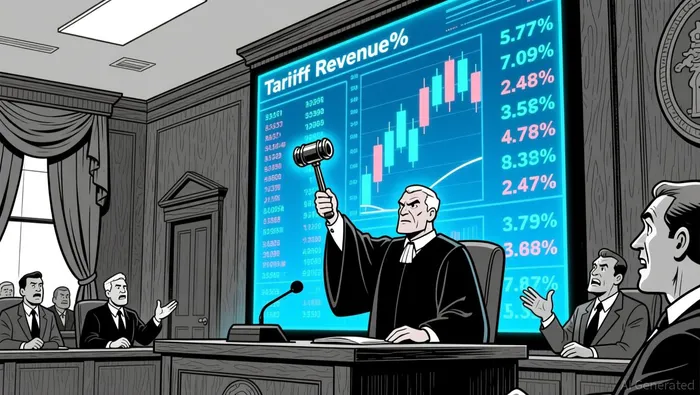
Fiscal and Market Implications: A Pendulum of Uncertainty
If the Court rules against Trump's tariffs, the immediate fiscal impact could be staggering. Analysts estimate that up to $130 billion in tariff revenue collected this year alone may need to be refunded, creating a liquidity shock for the federal budget, according to a Brookings report. UBS warns that such a ruling could strain fiscal policy, prompting the Federal Reserve to consider rate cuts as inflationary pressures ease, a Bitget report notes. Conversely, if the tariffs are upheld, inflation could accelerate, with core PCE inflation rising by 0.3 percentage points and GDP growth dragged down by 0.5%, according to a Russell Investments analysis.
The ruling will also reshape trade policy. If invalidated under IEEPA, the Trump administration is likely to pivot to other statutes, such as Section 232 of the Trade Expansion Act of 1962, which offer clearer authority for tariffs, according to a Reuters report. However, this shift could prolong uncertainty, particularly if refund processes for collected tariffs face legal challenges.
Strategic Opportunities for Global Investors
Amid this uncertainty, investors are recalibrating portfolios to hedge against volatility. Here are key strategies emerging from the analysis:
Overweight Bonds and Defensive Sectors
Global asset managers are increasing allocations to bonds, particularly outside the U.S., due to attractive valuations and the potential for rate cuts, according to a JPMorgan report. Defensive sectors like healthcare and utilities are gaining traction as investors seek resilience amid trade policy shifts.Diversify Away from Mega-Cap Tech
With the top eight mega-cap tech stocks now accounting for nearly 40% of the S&P 500, strategists recommend reducing exposure to mitigate overconcentration risks, according to a CNBC report. Rebalancing toward value stocks and sectors less sensitive to trade tensions, such as consumer staples, is gaining favor.European and Emerging Market Equities
European equities, trading at a 33% valuation gap relative to U.S. markets, offer compelling upside potential, according to an AllianzGI report. In emerging markets, China's technology sector and Brazil's commodity-driven economy are attracting attention, though trade tensions and currency pressures remain risks, a Vaneck report notes.Safe-Haven Assets and Gold
BlackRock highlights the role of gold as a buffer against macroeconomic shocks, particularly in a stagflationary environment, according to a BlackRock analysis. Investors are also exploring opportunities in energy and financials, which could benefit from potential tax cuts and deregulation.
Regional and Sector-Specific Risks
The ruling's impact will vary by region and sector. In Europe, the Stoxx 600 is projected to see 12% earnings growth in 2026 as fiscal stimulus and monetary easing take effect, according to an AllianzGI report. However, export-dependent economies like Germany face short-term challenges if retaliatory tariffs escalate. In emerging markets, China's tech sector could thrive under fiscal stimulus but remains vulnerable to U.S. export controls, the Vaneck report notes. Brazil's strong commodity backdrop offers resilience, but inflation and political risks persist.
Conclusion: Navigating a Fragmented Global Trade Landscape
The Supreme Court's decision will not only determine the fate of Trump's tariffs but also set a precedent for presidential power under emergency statutes. For investors, the key takeaway is adaptability. Diversification, sector rotation, and a focus on defensive assets will be critical in mitigating risks while capitalizing on opportunities in a fragmented global trade environment. As the Court's ruling looms, the markets brace for a verdict that could reshape the rules of international commerce for decades to come.







Comentarios
Aún no hay comentarios