
Trump's Tariff Threats and Geopolitical Leverage: Implications for India's Market and Global Trade Exposure
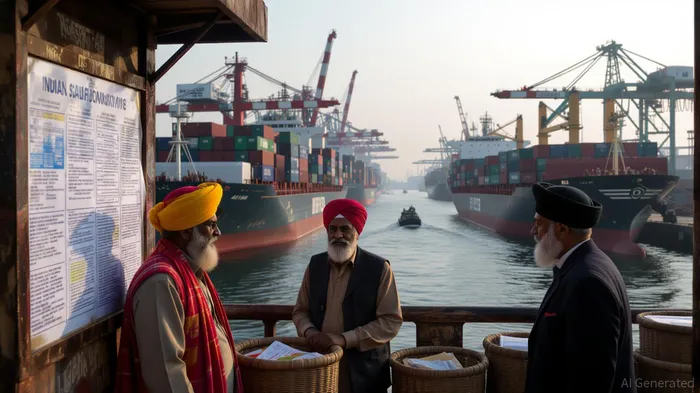
The global economic landscape is shifting under the weight of U.S. President Donald Trump's aggressive trade policies, with India now squarely in the crosshairs. On August 1, 2025, a 25% tariff on Indian exports to the U.S. will take effect, marking a pivotal moment in U.S.-India trade relations. This move, coupled with an unspecified penalty tied to India's procurement of Russian energy and military equipment, has sent ripples through equities and commodities markets, forcing investors to reassess risk exposure in the world's fifth-largest economy.
The Tariff Storm: Sectoral Impacts and Investment Risks
The 25% tariff, announced as part of Trump's “Liberation Day” policy, targets India's labor-intensive exports, including textiles, pharmaceuticals, and electronics. For instance, India's pharmaceutical sector—responsible for 40% of U.S. generic drug supplies—faces a potential double whammy. While currently exempt from the tariff, the sector remains vulnerable to secondary penalties if India's Russia-linked energy imports persist. Similarly, metals like steel and aluminum, which account for 12% of India's total exports to the U.S., could see demand erosion as American buyers pivot to lower-cost alternatives.
The agricultural sector, a longstanding point of contention, is equally at risk. India's 39% average tariff on U.S. agricultural goods has been a red line for Washington, which seeks greater market access for American dairy and corn. A retaliatory response from India—such as imposing tariffs on U.S. machinery or energy exports—could further destabilize trade flows.
Geopolitical Leverage: Russia's Role in India's Energy Strategy
India's procurement of Russian oil and military equipment has become a geopolitical flashpoint. With Russian oil imports surging to $56 billion in Q4 2024 (a tenfold increase from pre-war levels), the U.S. has weaponized trade policy to pressure New Delhi. The “unspecified penalty” on India's exports, while not quantified, signals a shift from traditional tariffs to strategic economic coercion. This could manifest as secondary sanctions on Indian firms facilitating Russian oil trade or a clawback on U.S. investment incentives.
For investors, this creates a dual dilemma: India's energy security strategy—anchored on discounted Russian oil—has insulated it from inflationary shocks, but its reliance on Moscow risks long-term trade repercussions. The Indian rupee's recent four-month low reflects market unease, with analysts estimating a 0.2–0.5% GDP drag if tariffs persist through FY26.
India's Resilience and Strategic Rebalancing
Despite the short-term pain, India's structural reforms offer a buffer. Initiatives like “Make in India,” Production-Linked Incentive (PLI) schemes, and the digital economy's growth have diversified the country's trade profile. For example, India's solar manufacturing sector—exposed to U.S. tariffs—could pivot to Southeast Asian markets, leveraging its cost advantages.
The “Atmanirbhar Bharat” (Self-Reliant India) campaign has also spurred domestic manufacturing in critical sectors like pharmaceuticals and electronics. While U.S. tariffs may disrupt short-term exports, they could accelerate India's shift toward self-sufficiency. Investors should monitor the PLI program's success in sectors like semiconductors and EVs, which could offset trade losses.
Investment Opportunities Amid Uncertainty
Pharmaceuticals (Bulls and Bears):
Indian drugmakers like Cipla and Sun Pharma have maintained U.S. market access for now, but long-term risks loom. Investors should weigh near-term revenue resilience against potential regulatory changes.Metals and Mining (Defensive Plays):
Steel and aluminum producers (e.g., Tata Steel, JSW Steel) face demand headwinds, but India's domestic consumption—driven by infrastructure spending—offers a floor. Look for companies with hedging strategies against currency volatility.Energy Exports (High Volatility):
While India's energy exports to the U.S. are minimal, its energy import strategy is a wildcard. Firms involved in oil refining (e.g., Reliance Industries) could benefit from Russia's discounted crude, but U.S. sanctions risks remain.Equities and Currency (Hedge Strategies):
The rupee's weakness has made Indian equities attractive via dollar-linked ETFs. However, investors should hedge against further depreciation, particularly if U.S. penalties escalate.
The Path Forward: Negotiation or Escalation?
The U.S. and India's sixth trade round in late August 2025 could determine the trajectory. A deal unlocking duty relief on Indian exports in exchange for agricultural concessions would stabilize markets. Conversely, a breakdown could force India to double down on its Russia ties, inviting harsher U.S. measures.
For now, investors should adopt a cautious, diversified approach. Sectors with strong domestic demand (e.g., consumer goods, utilities) and those with exposure to non-U.S. markets (e.g., textiles for Vietnam, electronics for the EU) present relative safety. Meanwhile, geopolitical developments—particularly Trump's stance on Russia—will remain a key driver of volatility.
In the end, India's ability to balance its strategic autonomy with economic pragmatism will define its response to U.S. pressure. For investors, the lesson is clear: in a world of shifting alliances, resilience and adaptability are the ultimate assets.







Comentarios
Aún no hay comentarios