
Trump's Tariff Threat: A March 4 Deadline Looms for Mexico, Canada, and China
Generado por agente de IAWesley Park
jueves, 27 de febrero de 2025, 10:42 am ET3 min de lectura
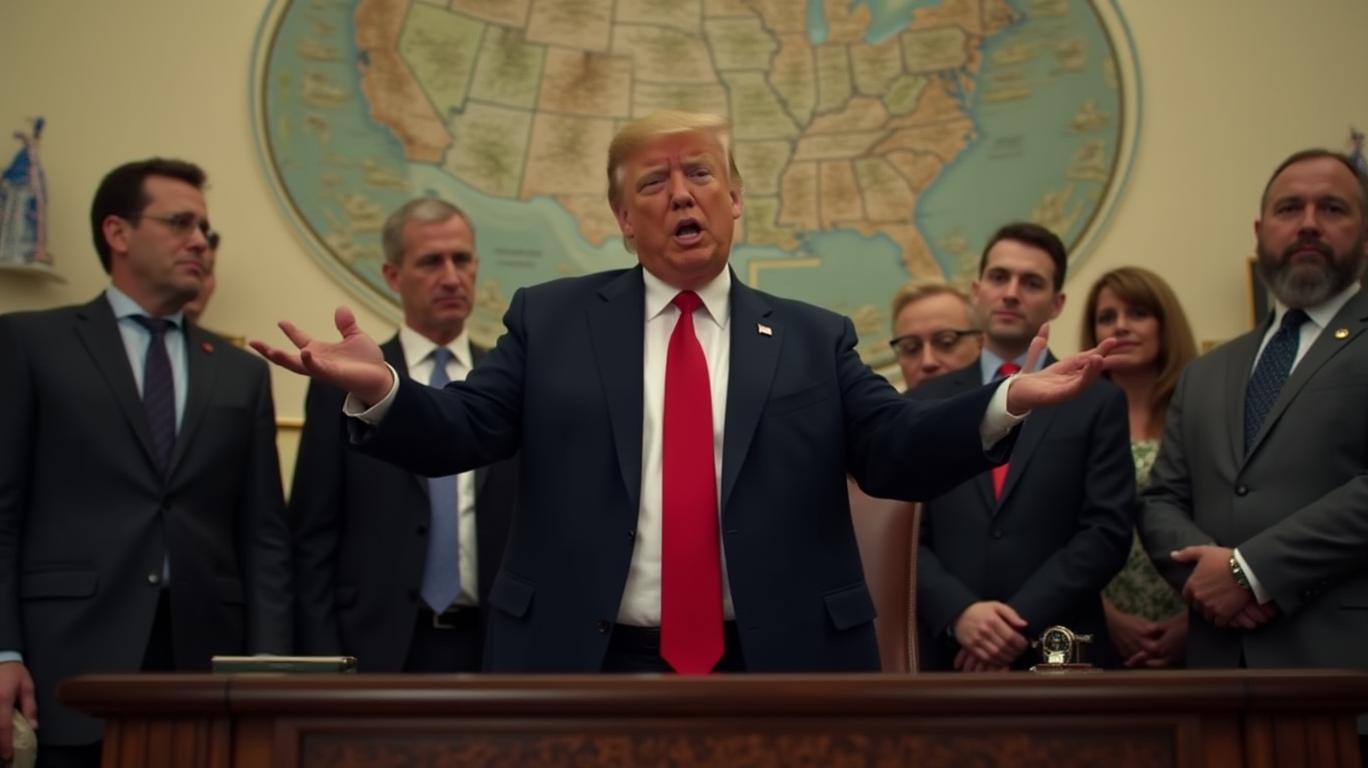
As the clock ticks down to March 4, President Donald Trump's tariff threat looms large over Mexico, Canada, and China. In a recent announcement, Trump stated that tariffs on these countries would commence on that date, with Mexico and Canada facing a 25% tariff on most goods and a 10% tariff on energy products from Canada. Additionally, China would be subject to a 10% additional tariff on all goods. The White House claims that these actions aim to advance U.S. priorities on immigration and drug trafficking, though specific goals for lifting the tariffs remain unspecified.
The potential impact of these tariffs on the U.S. economy and markets is significant. J.P. Morgan strategists anticipate that the tariffs could lower their expectations for U.S. economic growth by 0.5% to 1% and increase their inflation outlook by the same amount. This is a notable change from their initial expectations, as they had previously assumed a substantial tariff hike from 20% to 50% on imports from China, which was incorporated in their inflation outlook.
The strategists' revised expectations suggest that the tariffs on Mexico and Canada could have a more substantial impact on the U.S. economy than initially anticipated. The 25% tariff on most goods imported from Mexico and Canada, along with the 10% tariff on energy products from Canada, could lead to increased costs for U.S. businesses and consumers, potentially slowing down economic growth. Additionally, the tariffs could contribute to higher inflation rates, as the increased costs may be passed on to consumers in the form of higher prices for goods and services.
In comparison, the strategists had previously assumed a significant tariff hike on China, which was expected to have a more modest impact on the U.S. economy. The revised expectations for the tariffs on Mexico and Canada indicate that the strategists now believe these tariffs could have a more substantial impact on the U.S. economy than initially thought.
If the tariffs on Mexico and Canada are imposed for a prolonged period, our strategists expect several potential market reactions:
1. Lowered expectations for U.S. economic growth: The strategists anticipate a reduction in U.S. economic growth expectations by 0.5% to 1% due to the negative impact of tariffs on North American growth.
2. Increased inflation outlook: They also expect an increase in the inflation outlook by the same amount, as tariffs tend to raise prices for consumers and businesses.
3. Elevated stock market volatility: Given that U.S. large-cap equities are trading at premium valuations, the strategists believe there will likely be more elevated stock market volatility as investors grapple with the implications of the tariffs.
4. Continued U.S. dollar strength: The strategists expect the U.S. dollar to remain strong relative to major trading partners.
5. Greater economic impacts on Mexico and Canada: These countries heavily rely on exporting goods to the U.S., so they are most at risk to tariffs. The strategists would expect even greater economic impacts on these countries.
Quoting from the material: "They would likely lower their expectations for U.S. economic growth by 0.5% – 1% and increase their inflation outlook by the same amount... They expect it is likely we will see more elevated stock market volatility as investors grapple with the implications given that U.S. large-cap equities are trading at premium valuations... They believe we will likely see continued U.S. dollar strength relative to major trading partners... They would expect even greater economic impacts on Mexico and Canada, as they heavily rely on exporting goods to the U.S."
These reactions are based on the assumption that the tariffs will be in place for an extended period, which could lead to significant uncertainty in the economic and market outlook.
The U.S. dollar is expected to strengthen relative to major trading partners due to the tariffs imposed by President Trump. This is because the tariffs are likely to increase U.S. inflation and reduce economic growth, which in turn will make the U.S. dollar more attractive to investors seeking higher returns and a safe haven. This is evident in the market reaction to Trump's announcement, where the U.S. dollar index (DXY) rose to 107.31 from 107.87, and USD/JPY almost fully reversed Wednesday's jump higher.
The strengthening U.S. dollar will have several implications for international trade and investment:
1. Increased trade deficit: A stronger U.S. dollar makes U.S. goods more expensive for foreign buyers, which could lead to a decrease in exports and an increase in imports, resulting in a larger U.S. trade deficit.
2. Reduced foreign investment: A stronger U.S. dollar makes it more expensive for foreign investors to buy U.S. assets, which could lead to a decrease in foreign investment in the U.S. This could have negative implications for U.S. economic growth and job creation.
3. Increased borrowing costs: A stronger U.S. dollar makes it more expensive for foreign governments and corporations to borrow in U.S. dollars, which could lead to a decrease in foreign borrowing and investment in the U.S.
4. Impact on emerging markets: A stronger U.S. dollar can lead to capital outflows from emerging markets, as investors seek higher returns in the U.S. This can result in currency depreciation, increased borrowing costs, and economic instability in emerging markets.
In conclusion, the tariffs imposed by President Trump are likely to strengthen the U.S. dollar relative to major trading partners, which could have negative implications for international trade and investment. However, it is important to note that these implications are based on assumptions and projections, and the actual impact of the tariffs on the U.S. dollar and international trade and investment remains to be seen.



Divulgación editorial y transparencia de la IA: Ainvest News utiliza tecnología avanzada de Modelos de Lenguaje Largo (LLM) para sintetizar y analizar datos de mercado en tiempo real. Para garantizar los más altos estándares de integridad, cada artículo se somete a un riguroso proceso de verificación con participación humana.
Mientras la IA asiste en el procesamiento de datos y la redacción inicial, un miembro editorial profesional de Ainvest revisa, verifica y aprueba de forma independiente todo el contenido para garantizar su precisión y cumplimiento con los estándares editoriales de Ainvest Fintech Inc. Esta supervisión humana está diseñada para mitigar las alucinaciones de la IA y garantizar el contexto financiero.
Advertencia sobre inversiones: Este contenido se proporciona únicamente con fines informativos y no constituye asesoramiento profesional de inversión, legal o financiero. Los mercados conllevan riesgos inherentes. Se recomienda a los usuarios que realicen una investigación independiente o consulten a un asesor financiero certificado antes de tomar cualquier decisión. Ainvest Fintech Inc. se exime de toda responsabilidad por las acciones tomadas con base en esta información. ¿Encontró un error? Reportar un problema


SOBRE NOSOTROS
Nuestra historiaAutores de noticiasBase de conocimientosPolítica de privacidadTérmino de usoDescargo de responsabilidad de corretaje de tercerosTérminos de uso de AIMEDivulgaciones de riesgos de AInvest AICarrerasCONTÁCTENOS
Email: support@ainvest.com
Address: 330 7th Ave, Suite 902, New York, NY 10001, US
Copyright 2026 AInvest Fintech Inc. All rights reserved.


Comentarios
Aún no hay comentarios