
The Trump Tariff Shock: Strategic Opportunities Amid Crypto and Equity Volatility
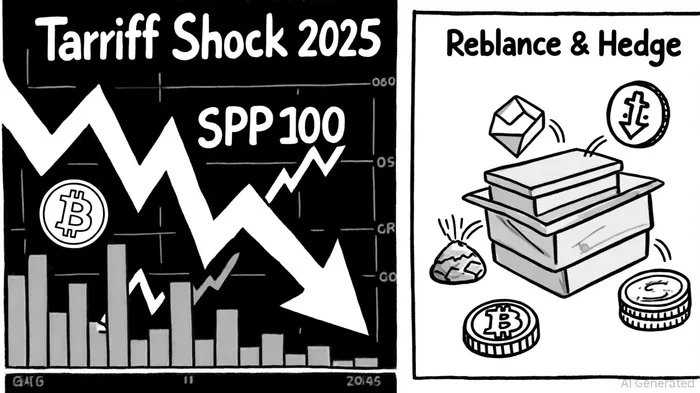
The Trump administration's 2025 tariff policy has ignited a seismic shift in global markets, creating both chaos and opportunity. With a 125% tariff on Chinese imports and 10% levies on trade partners like Canada and Mexico, the U.S. has triggered a "risk-off" environment that sent BitcoinBTC-- plummeting to $74,500 and erased $1.2 trillion in global equity value within weeks, according to an Aurpay analysis. Yet, for investors with a long-term lens, this volatility is not a crisis-it's a catalyst for strategic rebalancing.
The Tariff-Driven Market Reset
The immediate impact of Trump's tariffs has been twofold: short-term panic and structural reshaping. Cryptocurrency markets, already sensitive to macroeconomic shifts, reacted first. Bitcoin's 20% drop in early April 2025 followed by a 6.7% decline in October 2025 underscores the sector's vulnerability to trade policy shocks, according to CCN. Equities fared no better, with the S&P 500 losing 2.7% in a single day after Trump's October 10 announcement of a "massive increase" in Chinese tariffs, as CNBC reported.
However, the structural effects are more profound. For instance, U.S. crypto miners now face a 40% surge in ASIC procurement costs due to tariffs on Chinese imports, forcing a geographic shift in mining operations to Southeast Asia and the Middle East, per a JU blog post. Meanwhile, stablecoins like USDTUSDT-- and USDCUSDC-- are seeing increased cross-border adoption but face regulatory headwinds that threaten liquidity, according to a BeInCrypto guide.
Bitcoin's Resilience in a Fractured World
Despite the turbulence, Bitcoin's historical performance during inflationary periods offers a counter-narrative. CoinRank notes that U.S. Treasury data show Bitcoin has historically gained 4.2% for every 1% rise in U.S. CPI, according to CoinRank's analysis. With the tariffs likely to exacerbate inflation through supply chain disruptions, Bitcoin's role as a hedge against fiat devaluation becomes increasingly compelling.
Michael Saylor's assertion that Bitcoin's decentralized nature insulates it from trade policy shocks is gaining traction, as The CC Press reports. While short-term volatility persists, the long-term trajectory for Bitcoin remains intact-provided investors adopt disciplined rebalancing strategies.
Strategic Rebalancing: A Framework for Uncertainty
The key to navigating this environment lies in portfolio diversification and disciplined rebalancing. Here's how to structure your approach:
- Crypto Allocation: Prioritize Stability
- Allocate 60–70% of crypto holdings to large-cap assets like Bitcoin and EthereumETH--, which are less volatile than mid-cap altcoins.
- Use threshold-based rebalancing (e.g., adjust allocations when assets deviate ±15% from targets) to lock in gains and mitigate downside risk, as suggested by CoinCodex.
Example: If Bitcoin's dominance grows beyond 70%, sell a portion and reinvest in underweighted assets like Ethereum or DeFi tokens.
Equity Exposure: Hedge with Hybrid Strategies
- Reduce exposure to high-beta tech stocks (e.g., Apple, AMD) and increase holdings in defensive equities or ETFs.
Pair crypto with traditional safe-haven assets like gold or U.S. Treasuries to balance risk. For instance, a 50/30/20 split (crypto/stocks/gold) could stabilize returns during trade wars, as BitUnix suggests.
Dollar-Cost Averaging (DCA) in Volatile Markets
Automate purchases of Bitcoin and blue-chip equities to smooth out price swings. DCA mitigates the risk of buying at market peaks, especially in a "risk-off" environment, per Solberg Invest's advice.
Tax-Loss Harvesting
- Offset gains from rising assets (e.g., Bitcoin's eventual rebound) by selling underperforming positions at a loss. This strategy is particularly effective in crypto, where tax rules remain fragmented, as Youccet outlines.
The Long Game: Why This Works
The Trump tariff shock is not an isolated event-it's a harbinger of deeper geopolitical fragmentation. As trade tensions escalate, the U.S. dollar's global dominance may weaken, accelerating demand for Bitcoin as a store of value, according to AIER's analysis. Meanwhile, equity markets will remain volatile, but disciplined rebalancing ensures you're positioned to capitalize on rebounds.
For example, the S&P 500 lost $4.7 trillion in market value between November 2024 and April 2025 but partially recovered after a temporary tariff pause, according to a Gate analysis. By maintaining a balanced portfolio, investors can ride out these cycles without overexposure.
Conclusion: Embrace the Dislocation
The Trump tariff shock has created a "black swan" scenario for markets, but it also offers a rare opportunity to rebalance portfolios at attractive entry points. By prioritizing Bitcoin's inflation-hedging properties, diversifying equities, and automating rebalancing strategies, investors can turn uncertainty into advantage.
As the adage goes: "Volatility is your friend if you're prepared." The question is not whether markets will stabilize-it's whether you'll be ready when they do.






Comentarios
Aún no hay comentarios