
Trump's Tariff Resilience: Strategic Implications for Global Markets
The Legal Uncertainty and Its Market Impact
The International Emergency Economic Powers Act (IEEPA) has been a cornerstone of U.S. trade policy since 2025, enabling the executive branch to impose tariffs on imports from China, Mexico, and other countries under the guise of national security. However, the U.S. Court of International Trade recently invalidated two major IEEPA-based tariff programs, ruling that the executive overstepped its authority by using the statute to address economic concerns rather than direct foreign threats. While a stay by the Federal Circuit Court of Appeals has kept these tariffs in place for now, the legal ambiguity has created a volatile environment for businesses and investors.
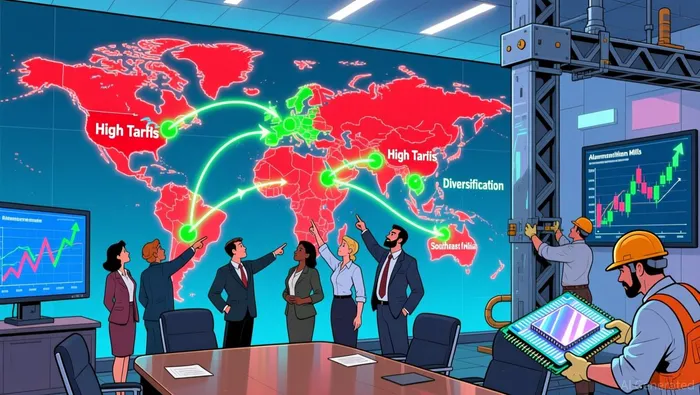
If IEEPA is struck down, the Biden administration has signaled its intent to pivot to alternative statutes, including Sections 232, 301, and 338. These mechanisms, though narrower in scope, could still reshape trade flows and sector dynamics. For instance, Section 232 tariffs on steel and aluminum-already expanded to 50% in 2025-have redirected supply chains to Southeast Asia and Latin America, creating both challenges and opportunities for importers and exporters.
Sector-Specific Vulnerabilities and Opportunities
Metals and Manufacturing: A Double-Edged Sword
The metals sector, particularly steel and aluminum, has been a focal point of U.S. tariff policy. The 2025 expansion of Section 232 tariffs to 50% has boosted domestic producers but imposed significant costs on downstream industries. For example, Construction Partners, Inc. (ROAD) reported a 54% year-over-year revenue increase in fiscal 2025, driven by higher steel prices and strategic acquisitions. However, this growth came at the expense of automotive and construction firms reliant on imported materials, which now face inflationary pressures and supply chain bottlenecks.
Investors in domestic metals producers stand to benefit from sustained high tariffs, but those in steel-dependent sectors must prepare for margin compression. The elimination of tariff exemptions and the closure of exclusion programs under the new rules further complicate risk management.
Technology and Semiconductors: A Battle for Supply Chain Control
The IT and telecom sector has faced rising costs due to tariffs on semiconductors and rare earth magnets, with China dominating over 97% of global solar wafer production. Section 301 tariffs, initially imposed in 2018 and expanded under Biden, have disrupted the U.S. solar supply chain, forcing companies to seek alternative suppliers or invest in domestic production. While this could spur long-term resilience, the short-term financial toll is evident: KGHM Polska Miedz SA, a major copper producer, recently missed earnings forecasts, with its stock price dropping 0.38% amid investor concerns.
Automotive and Transportation: A Tale of Two Regions
The automotive sector has been hit hard by Section 232 tariffs on trucks, parts, and buses, which now apply to imports from outside North America. Domestic and USMCA-compliant manufacturers have gained a competitive edge, but non-compliant importers face steep costs. For example, the U.S. imports 30% of its cars from Mexico alone, and tariffs on non-USMCA parts could further tilt trade flows. Investors should monitor how automakers adapt-through nearshoring, material substitutions, or price hikes-to mitigate these pressures.
Historical Precedents and Investment Lessons
The 2018–2025 Section 232 and 301 tariffs offer critical insights. When Trump imposed 25% steel and 10% aluminum tariffs in 2018, U.S. allies like Canada and the EU retaliated, creating trade friction that persists today. Similarly, Biden's 2022 solar tariffs, while aimed at reducing reliance on Chinese polysilicon, have constrained U.S. renewable energy growth. These precedents suggest that while tariffs can protect domestic industries, they often come with unintended consequences, including higher consumer prices and retaliatory measures.
Financial data underscores this duality. The Yale Budget Lab estimates that U.S. effective tariff rates reached 22.5% in 2025-the highest since 1909-contributing to a 2.3% rise in consumer prices and a $3,800 annual loss in household purchasing power. For investors, this highlights the regressive impact of tariffs and the need to balance short-term gains with long-term economic stability.
Strategic Recommendations for Investors
- Hedge Against Legal Uncertainty: Companies should maintain detailed records of IEEPA-related tariff payments and prepare for potential refund processes if the statute is invalidated. Investors should prioritize firms with agile supply chains and diversified sourcing strategies.
- Target Resilient Sectors: Domestic metals producers and U.S.-based manufacturers with low import dependency are well-positioned to benefit from sustained high tariffs. Conversely, sectors like apparel and textiles-where prices have risen 17% under current tariff scenarios-pose higher risks.
- Monitor Alternative Tariff Mechanisms: If IEEPA is struck down, the administration's reliance on Sections 232, 301, and 338 could create new opportunities. For example, Section 232's focus on national security allows for targeted tariffs on critical materials, which could favor companies in the clean energy transition.
- Leverage Historical Volatility: Past tariff cycles have shown that sectors like construction and metals can outperform in the short term, as seen with Construction Partners' 15% EBITDA margins. However, long-term success requires adapting to shifting trade policies and geopolitical risks.
Conclusion
The potential invalidation of IEEPA and the subsequent reliance on alternative tariff mechanisms will redefine global trade dynamics. While domestic industries in metals, automotive, and technology may see near-term gains, the broader economy faces inflationary pressures and supply chain fragility. Investors must adopt a nuanced approach, balancing sector-specific opportunities with macroeconomic risks. As the Supreme Court's ruling looms, agility and strategic foresight will be paramount in navigating this turbulent landscape.







Comentarios
Aún no hay comentarios