
The Trump Tariff Legal Battle and Its Implications for U.S. Trade Policy and Financial Markets
The U.S. Supreme Court's impending ruling on the legality of President Trump's 2025 global tariffs-imposed under the International Emergency Economic Powers Act (IEEPA)-has become a pivotal event for investors, policymakers, and global trade stakeholders. As the court prepares to deliver its decision by January 14, 2026, the outcome will not only redefine the boundaries of executive power but also reshape the economic landscape for industries deeply entangled in the Trump-era trade war. This analysis examines the investment risks and opportunities across key sectors-manufacturing, agriculture, and technology-under both scenarios: tariff reversal or continued protectionism.
The Legal Crossroads: IEEPA and Executive Overreach
The Trump administration's 2025 tariffs, which raised the average U.S. import tariff rate to 15.8%-the highest since 1943-were justified under IEEPA to address trade deficits and the fentanyl crisis. However, lower courts ruled that this invocation of emergency powers exceeded constitutional authority. The Supreme Court's decision will determine whether these tariffs are invalidated, potentially unlocking $2.2 trillion in federal revenue projections and altering the trajectory of U.S. trade policy. A ruling against the tariffs could spur a shift toward multilateral trade agreements or sector-specific reforms, while a ruling in favor would embolden future administrations to leverage emergency powers for protectionist measures.
Sector-Specific Exposure and Investment Dynamics
1. Manufacturing: Reshoring vs. Cost Pressures
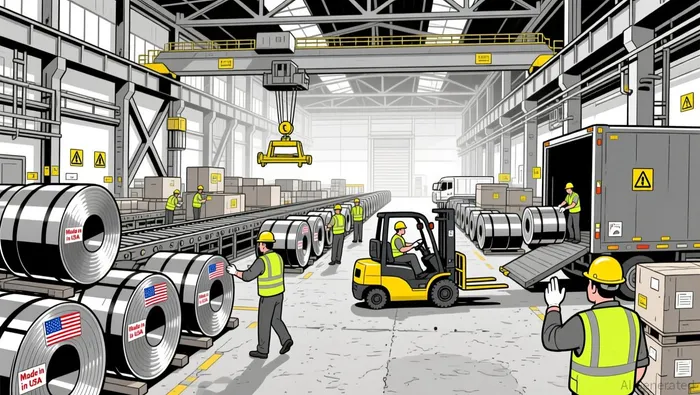
The manufacturing sector, particularly steel, aluminum, and automotive industries, has been a primary beneficiary of Trump's tariffs, which shielded domestic producers from foreign competition. For example, the steel industry's utilization rates remain below pre-pandemic peaks, yet tariffs have curtailed foreign imports, allowing domestic producers to operate without immediate capacity expansion. However, this protectionism comes at a cost: tariffs have inflated raw material prices, squeezing margins for downstream manufacturers. Automotive original equipment manufacturers (OEMs), for instance, face compounded pressures from rising labor, energy, and and material costs, with tariffs exacerbating vehicle price inflation.
If the Supreme Court invalidates the tariffs, manufacturing stocks could face short-term volatility as input costs rise. Conversely, a ruling upholding the tariffs would reinforce reshoring trends, with 43% of supply chain leaders planning to shift production to the U.S. over the next three years. Investors should monitor companies like U.S. Steel and General Motors, whose valuations hinge on the durability of trade barriers.
2. Agriculture: Export Vulnerabilities and Domestic Price Volatility
The agriculture sector has borne the brunt of retaliatory tariffs from China, Mexico, and Canada, which slashed U.S. soybean and corn exports by 30% and 12%, respectively. While Trump's tariffs aimed to bolster domestic competitiveness by shielding farmers from subsidized imports, they inadvertently triggered a 18% surge in U.S. corn prices, disproportionately affecting low-income consumers.
A reversal of the tariffs could alleviate domestic price pressures but expose U.S. farmers to renewed foreign competition. Conversely, continued protectionism might stabilize farm revenues in the short term but deepen reliance on volatile export markets. The sector's valuation metrics, including earnings growth and P/E ratios, remain sensitive to trade policy shifts, with companies like Archer Daniels Midland and Cargill facing asymmetric risks.
3. Technology: Supply Chain Disruptions and AI-Driven Resilience
The technology sector has experienced dual pressures from Trump's tariffs: component price inflation and supply chain fragmentation. Tariffs on Chinese imports have driven up costs for semiconductors, batteries, and other critical inputs, while retaliatory measures have disrupted global logistics. However, the sector has responded with innovation, including increased domestic investment in AI infrastructure and reshoring of manufacturing.
Q4 2025 saw mixed performance: while AI-driven companies like NVIDIA and Western Digital posted extraordinary gains (over 500% in some cases), broader tech indices faced selloffs amid concerns over debt-fueled AI expansion. A Supreme Court ruling against the tariffs could reduce input costs and stabilize margins, but prolonged trade uncertainty may persist. Investors should focus on firms with diversified supply chains and strong R&D pipelines, such as Intel and Tesla.
Market Implications: Volatility and Strategic Reallocation
The Supreme Court's decision will act as a binary catalyst for financial markets. A tariff reversal could trigger a short-term rally in export-dependent sectors like agriculture and technology, while manufacturing stocks may underperform as input costs rise. Conversely, a ruling in favor of the tariffs would likely reinforce protectionist trends, benefiting reshoring-focused manufacturers but exacerbating inflationary pressures.
Valuation metrics across all sectors remain stretched, with the S&P 500's forward P/E ratio at 22.5-well above historical averages. Earnings growth, which decelerated to 7.7% in Q4 2025, will be critical in determining whether markets absorb the ruling's fallout or face a correction.
Conclusion: Navigating Uncertainty in a Post-Tariff World
The Trump tariff legal battle epitomizes the tension between short-term protectionism and long-term economic efficiency. For investors, the key lies in hedging against both outcomes:
- If tariffs are invalidated, prioritize sectors poised for cost relief (agriculture, technology) and avoid overexposure to manufacturing.
- If tariffs are upheld, favor companies with reshoring capabilities and supply chain resilience.
As the Supreme Court's decision looms, the broader lesson is clear: trade policy is no longer a background variable but a central determinant of market dynamics. In this environment, agility-both in portfolio construction and corporate strategy-will define success in 2026 and beyond.







Comentarios
Aún no hay comentarios