
Trump's Tariff House of Cards: Supreme Court to Decide Fate
President Donald Trump's administration is quietly preparing contingency measures should the Supreme Court invalidate its sweeping tariff powers, signaling a strategic pivot to maintain its trade policies amid legal uncertainty. The White House, which has imposed record-high tariffs under the International Emergency Economic Powers Act (IEEPA), is evaluating alternatives such as Sections 301 and 122 of the Trade Act, which allow unilateral duties but come with narrower scope and potential legal risks. These efforts underscore the administration's determination to uphold its protectionist agenda, even as the court's skepticism during recent arguments has raised alarms about potential disruptions to global trade and corporate planning.
The administration's reliance on IEEPA has already drawn judicial pushback. Lower courts have ruled the president's country-based tariffs-justified as responses to "economic emergencies"-unlawful, a stance the Supreme Court has yet to resolve. If the justices strike down the IEEPA-based levies, the administration faces a scramble to reimpose duties using other statutes. While Sections 301 and 122 offer pathways, they require lengthy investigations or are limited to 150-day durations, complicating long-term enforcement. 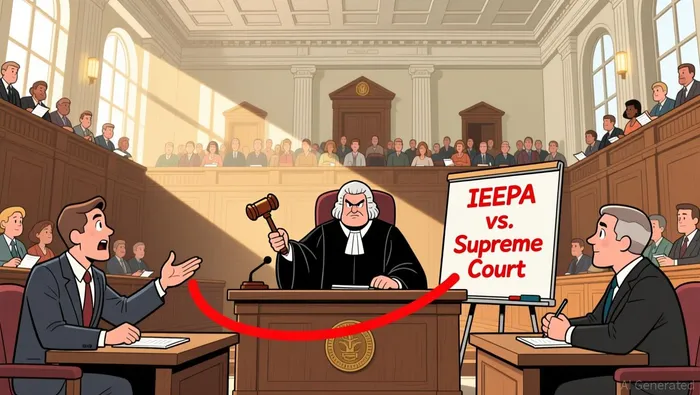 Bloomberg Economics estimates that over half of the current 14.4% average tariff rate on U.S. imports stems from IEEPA duties, which would need rapid replacement to avoid gaps in revenue and policy continuity.
The stakes extend beyond legal technicalities. A ruling against the tariffs could trigger refunds of over $88 billion in collected duties and force renegotiations with trade partners like China and Brazil. Recent tariff relief for Brazil, which reduced the share of its exports subject to 40% extra levies from 36% to 22%, highlights the administration's balancing act between economic diplomacy and domestic political pressures. Meanwhile, crypto markets have priced in a 24% probability of the Supreme Court siding with the administration, reflecting investor anxiety over regulatory instability.
The administration's contingency plans also face internal challenges. Section 232 tariffs on metals and autos, already contentious with European allies, could expand further, risking violations of trade agreements. Former U.S. trade negotiator Wendy Cutler has warned that broadening these sectoral duties might become the de facto Plan B if IEEPA is invalidated. Such measures, however, risk litigation and could exacerbate tensions with trading partners.
Legal scholars and economists caution that the fallback options lack the flexibility of IEEPA. For instance, Section 122 tariffs expire after 150 days, requiring repeated renewals that could invite fresh lawsuits. Peter Navarro, a top trade adviser, has dismissed this as impractical, while National Economic Council Director Kevin Hassett remains optimistic about navigating the constraints.
The Supreme Court's decision, expected by early summer, will test the administration's ability to adapt. Deputy Chief of Staff James Blair estimates a 50-50 chance of victory, with officials ready to "piece it all back together" if the ruling is unfavorable. For now, the White House insists it has "lawful authority" and remains confident in its ultimate legal standing.
As the clock ticks, businesses and foreign governments brace for further uncertainty. The administration's Plan B, while prepared, underscores the fragility of a trade policy built on unprecedented emergency powers.







Comentarios
Aún no hay comentarios